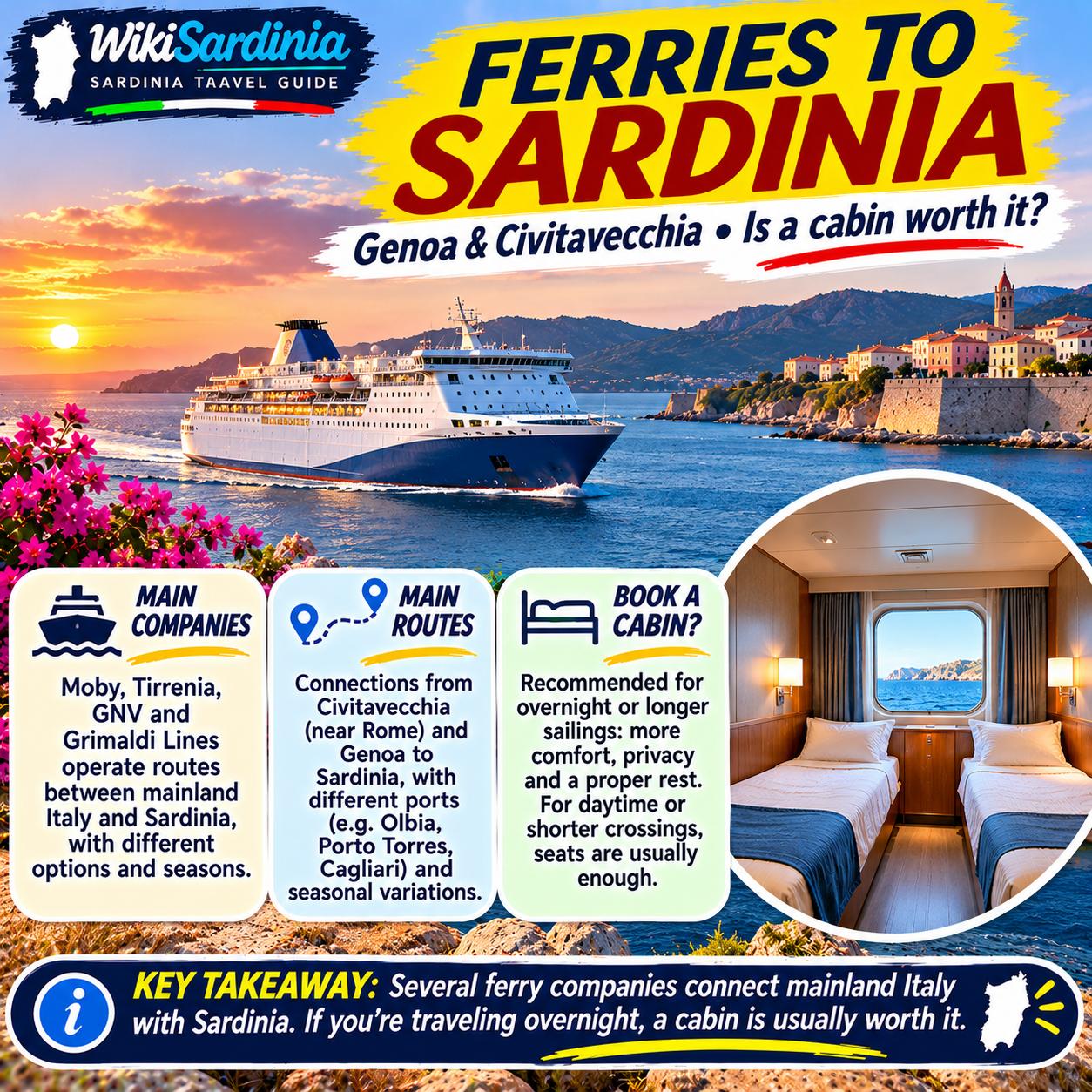
Travelling to Sardinia by ferry is an excellent option if you want to bring a car, motorbike or campervan, or simply enjoy arriving on the island by sea. Two important mainland departure ports are Civitavecchia, near Rome, and Genoa, in northern Italy. But the ferry company, arrival port and whether to book a cabin can make a big difference to your trip.
The main operators to compare are Tirrenia, Moby Lines, Grandi Navi Veloci (GNV) and Grimaldi Lines. Their routes, sailing days and seasonal availability differ. For overnight sailings, a private cabin is often worth the extra cost; for a shorter daytime crossing, a reserved seat or standard passenger ticket may be sufficient.
Which ferry companies connect mainland Italy with Sardinia?
The principal ferry operators include:
- Tirrenia: a longstanding operator on connections involving Genoa and Civitavecchia, including routes to Porto Torres and Olbia.
- Moby Lines: operates several routes to northern Sardinia, including Genoa–Olbia and Civitavecchia–Olbia services, with seasonality depending on the crossing.
- GNV (Grandi Navi Veloci): advertises Genoa–Olbia, Genoa–Porto Torres and Civitavecchia–Olbia among its Sardinia connections.
- Grimaldi Lines: operates routes including Civitavecchia–Olbia, Civitavecchia–Porto Torres, Civitavecchia–Cagliari and Civitavecchia–Arbatax, as well as Livorno–Olbia and Naples–Cagliari.
These are route networks rather than promises that every departure operates every day. Verify the actual sailing for your travel date on the company's booking website. The Port of Civitavecchia authority, GNV's Sardinia routes page, Grimaldi's route directory and Tirrenia's 2026 service charter provide useful operator information.
Ferries from Civitavecchia to Sardinia
Civitavecchia is a practical departure point for visitors travelling from Rome and central Italy. Ferries connect it with several Sardinian ports:
- Olbia: convenient for north-eastern Sardinia, Costa Smeralda and the Gallura area. Tirrenia, Moby, GNV and Grimaldi appear across operator schedules and route listings, but not all sail year-round.
- Porto Torres: a useful arrival for Sassari, Stintino and Alghero; Grimaldi advertises this route.
- Cagliari: best suited to southern Sardinia; Grimaldi advertises this service.
- Arbatax: a gateway to Ogliastra and the east coast; Grimaldi advertises this connection.
According to the Ferryhopper Sardinia route overview, some Civitavecchia–Olbia sailings can take around five and a half to eight hours, depending on vessel and schedule. Other crossings, especially those reaching the south, can be considerably longer. Check the exact itinerary, because some sailings may have intermediate stops.
Ferries from Genoa to Sardinia
Genoa is a major departure port for travellers from northern Italy, Switzerland, Germany and France who want to bring their vehicle to Sardinia. The two key Sardinian arrival ports are Olbia and Porto Torres.
GNV lists both Genoa–Olbia and Genoa–Porto Torres, while Moby and Tirrenia also serve Genoa routes. Crossing times commonly run around 10–14 hours, although the exact duration varies by sailing. Genoa–Porto Torres services may operate through more of the year than some seasonal Genoa–Olbia departures.
Because many Genoa departures are overnight, the accommodation choice on board can matter as much as the ticket price.
Which Sardinian arrival port should you choose?
Olbia is useful for Costa Smeralda, San Teodoro, La Maddalena and north-eastern Sardinia. Porto Torres is generally more convenient for Sassari, Stintino, Castelsardo and much of the north-west, including Alghero. Cagliari is the logical choice for southern Sardinia and its surrounding beaches. Arbatax can be ideal for Ogliastra and the east-central coast.
Do not choose a ferry solely because its headline ticket is cheaper. A lower fare can be offset by several hours of additional driving, fuel and tolls. Compare the complete journey from your starting point to your final accommodation.
Should you book a ferry cabin?
For an overnight crossing, usually yes—if your budget allows. A cabin offers a bed, more privacy and a place to rest away from busy public areas. Depending on the ship and cabin category, it may also provide a private bathroom, shower and other amenities.
On a long Genoa–Sardinia sailing, arriving after a reasonable night's sleep can make the first day of your holiday much more enjoyable, particularly if you must drive after disembarking. Families with young children, older travellers and people who value uninterrupted rest may find a cabin especially worthwhile.
For a shorter daytime crossing from Civitavecchia, a reserved reclining seat or ordinary passenger accommodation may be enough. But travellers who want to sleep, work privately or rest with children may still prefer a cabin.
Cabin vs reclining seat vs deck passage
| Option | Advantages | Trade-offs |
|---|---|---|
| Private cabin | Bed, privacy, often bathroom facilities | Higher cost; availability can be limited |
| Reserved reclining seat | Usually cheaper; designated seat | Less privacy and sleeping comfort |
| Deck or standard passage | Lowest-cost option on some sailings | No guaranteed private sleeping space; rules vary by ship |
Not all ticket types or cabin categories are available on every ferry. Check whether the advertised cabin is private, shared, internal or external, and whether the price covers all passengers in your party.
What is the difference between an inside and outside cabin?
An inside cabin usually has no exterior window and can be a cost-effective way to get a proper bed. An outside cabin has a porthole or window, which some travellers prefer for natural light. Cabin size, beds and bathrooms vary by ship.
Before paying extra for an outside cabin, confirm its exact features on your chosen vessel. A window does not necessarily mean an unobstructed panoramic sea view.
Are cabins worth it when travelling with children?
Often. A private space can help children rest and gives families somewhere to keep essential belongings during a long crossing. If travelling with a baby, ask about cots, accessible lifts and cabin layouts. Availability may be limited and should be requested before departure.
Cabins are also useful for managing an early morning arrival. If you have a long drive ahead, however, remember that even a comfortable cabin cannot guarantee a full night's sleep or eliminate fatigue.
Can you bring a car, motorbike or campervan?
Many mainland–Sardinia ferries carry vehicles. The booking process usually asks for the vehicle type and dimensions. Provide accurate details, especially for campervans, roof boxes, bicycle racks, trailers or unusually tall vehicles.
Vehicle spaces can sell out before passenger places on popular summer sailings. Check the company's rules for loading, arrival at the terminal and any restrictions on equipment or items carried in the vehicle.
Can you return to your car during the crossing?
Usually, vehicle decks are closed to passengers during navigation for safety reasons. Take medication, travel documents, chargers, warm layers, children's supplies and anything needed overnight with you when you leave the car. Follow the crew's instructions; do not assume you can retrieve forgotten belongings once the ferry has sailed.
What about travelling with pets?
Some ferry companies offer pet-friendly cabins, kennels or designated pet areas, but arrangements vary by vessel and ticket type. Pet-friendly cabins can be limited, particularly in summer. Check vaccination and documentation requirements, whether your animal may remain with you, and the company's rules for leads, carriers and access to public areas.
Do not book a standard cabin assuming pets are automatically allowed inside it.
When should you book ferries and cabins?
For July and August, school holidays and popular weekends, booking earlier is sensible—especially when taking a vehicle, travelling with pets or needing a specific cabin category. Prices and availability change with demand, route, departure date and ticket conditions.
There is no single cheapest booking day or universal fare. Compare the total amount for all passengers, vehicles, cabins and optional services. Check whether your fare is refundable or changeable before buying.
Are ferries cheaper than flying?
It depends. A foot passenger might find a flight more convenient or economical, especially for a short stay. A family bringing its own car and luggage may find a ferry competitive once car-rental costs and baggage allowances are considered.
Include fuel and road tolls to the mainland port, parking or transfers, onboard accommodation, food and the drive from your Sardinian arrival port. A low headline ferry fare may not represent the full journey cost.
How early should you arrive at the ferry terminal?
Check the operator's instructions printed on your ticket. Boarding deadlines vary by company, route, departure and whether you have a vehicle. Vehicle passengers generally need additional time for check-in and loading. International or special services may have different requirements.
Allow extra time for traffic near Genoa and Civitavecchia, particularly on peak summer travel days. The check-in deadline is not necessarily the ship's departure time.
What if the ferry is delayed or cancelled?
Bad weather, port operations and other disruptions can affect departures. Monitor official operator messages and provide accurate contact details when booking. For qualifying passenger sea services, European Union Regulation (EU) No 1177/2010 establishes passenger rights relating to information, assistance and certain delays or cancellations, subject to conditions and exceptions.
Keep booking confirmations and receipts and contact the ferry company for instructions. Do not assume compensation applies automatically in every weather-related disruption.
Useful Italian ferry vocabulary
- Traghetto: ferry
- Imbarco: boarding
- Sbarco: disembarkation
- Cabina: cabin
- Cabina interna: inside cabin
- Cabina esterna: outside cabin
- Poltrona: reserved reclining seat
- Passaggio ponte: deck passage
- Auto al seguito: car travelling with passenger
- Animali ammessi: pets allowed
- Orario di partenza: departure time
- Orario di arrivo: arrival time
- Conviene prenotare una cabina? Is it worth booking a cabin?
Frequently asked questions
Which ferry companies sail from Civitavecchia to Sardinia?
Routes are advertised by operators including Tirrenia, Moby, Grimaldi Lines and GNV, depending on the Sardinian port, season and sailing date.
Which ferry companies sail from Genoa to Sardinia?
GNV, Moby and Tirrenia are key names to check for services to Olbia and Porto Torres.
How long is the ferry from Genoa to Sardinia?
Many crossings take roughly 10–14 hours, but duration depends on the port, vessel and schedule.
How long is the ferry from Civitavecchia to Olbia?
Some sailings take around 5.5–8 hours, depending on the service. Always check the scheduled duration for your chosen date.
Do I need a cabin on an overnight ferry?
No, not always. But a cabin is generally more comfortable for sleeping and privacy, especially on longer crossings.
Can I sleep in a reclining seat?
Yes, where that ticket type is offered, though comfort and privacy are different from a cabin.
Can I sleep in my car on the ferry?
Normally no. Vehicle decks are generally inaccessible during the voyage, and passengers must follow onboard safety rules.
Are pet-friendly cabins available?
Some vessels have them. Availability and conditions vary, so reserve the correct category early.
Can I take a campervan to Sardinia?
Many ferries accommodate campervans. Declare accurate dimensions and check vehicle restrictions.
Which port is best for Alghero?
Porto Torres is generally a convenient option for reaching Alghero by road, though your total itinerary may make another arrival port preferable.
Do ferries operate all year?
Some routes operate year-round, while others are seasonal or have reduced winter frequencies. Check the operator's current timetable.
The bottom line
For a ferry trip from mainland Italy to Sardinia, compare the route as carefully as the price. Genoa is useful for travellers coming from northern Europe, while Civitavecchia serves Rome and central Italy. Olbia, Porto Torres, Cagliari and Arbatax lead to different parts of the island. If you are sailing overnight, a cabin is often money well spent; on shorter daytime trips, a seat may be enough. Book the sailing and accommodation that suit your actual journey, and verify the operator's live schedule before committing.
Official sources and further reading
- Port Authority of Civitavecchia — Ferry Operators and Destinations
- GNV — Ferries to Sardinia
- Grimaldi Lines — Sardinia Routes
- Tirrenia — 2026 Service Charter
- Ferryhopper — Sardinia Ferry Routes and Seasonal Information
- Italian Ministry of Infrastructure and Transport — 2026 Maritime Public-Service Route Tender
- EU Regulation 1177/2010 — Passenger Rights by Sea