
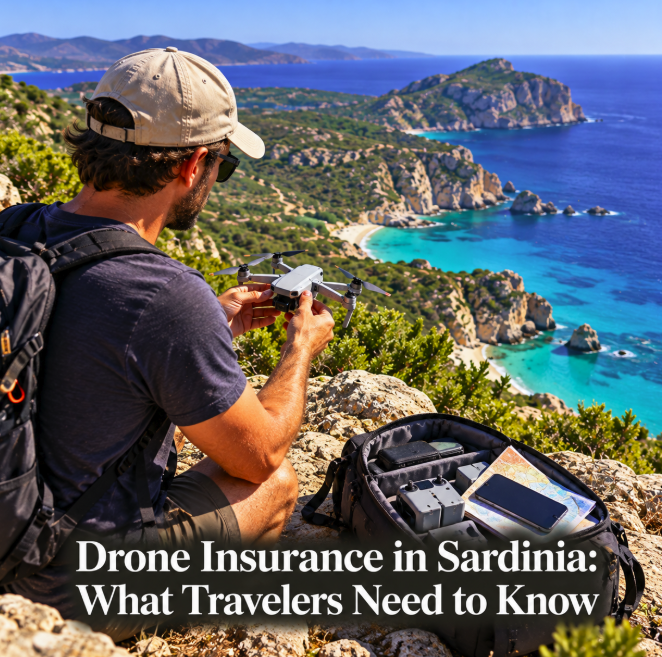
If you bring a drone to Sardinia, liability insurance is not an optional extra to consider after checking the weather. Italy requires drone operators to have appropriate third-party liability insurance before flying, and ENAC explicitly states that this requirement also applies to camera-equipped drones weighing less than 250 grams. That detail is particularly important for travelers carrying popular lightweight drones: being under 250 g can remove some pilot-certificate requirements, but it does not remove the Italian insurance requirement.
Insurance is only one part of the legal checklist. Depending on the drone, you may also need operator registration, an operator identification code displayed on the aircraft, the appropriate remote-pilot competency and a check of the official D-Flight map before every flight. In Sardinia, protected areas, airports and other geographical zones can make the location itself as important as the drone's weight.
Yes, third-party liability insurance is required in Italy
ENAC, Italy's civil aviation authority, lists insurance among the responsibilities of a UAS operator. Its current guidance says the operator must insure drones for third-party civil liability. ENAC's Open Category requirements likewise state that adequate third-party liability coverage is required for the type of operation being conducted.
The underlying Italian UAS regulation is explicit: UAS operations cannot be conducted unless appropriate third-party liability insurance has been taken out and remains valid, with coverage meeting the applicable minimum parameters.
This is a national Italian requirement layered onto the common European drone framework. EASA explains that EU rules always require insurance above 20 kg, while individual EASA member states may require third-party insurance for lighter drones. Italy does exactly that.
What if your drone weighs less than 250 g?
This is where travelers frequently confuse separate rules. ENAC states that a camera-equipped drone under 250 g can be flown in the Open category without a remote-pilot certificate under the relevant conditions, but operator registration on D-Flight and liability insurance are still required.
In other words, a DJI Mini-class or similar lightweight camera drone does not become exempt from Italian insurance simply because its takeoff mass is below 250 g.
There is a narrow distinction for very light drones without a camera, microphone or another device capable of collecting personal data. ENAC says operators of drones below 250 g without those sensors can be exempt from operator registration. Toys meeting the relevant toy-safety definition also have specific exemptions. Most travelers taking a drone to photograph Sardinia, however, are carrying a camera drone and should not assume these exceptions apply.
Will insurance bought in another country work?
Do not assume that a policy purchased at home automatically satisfies Italian requirements. Before traveling, ask the insurer for written confirmation that the policy covers third-party liability arising from recreational or professional drone operations in Italy and that Sardinia is within its geographical coverage.
EASA recommends obtaining an insurance certificate that proves drone coverage. Read exclusions carefully: a generic travel-insurance policy, homeowners policy or personal liability policy may exclude aircraft or drone activity even if it otherwise provides broad liability protection.
Keep the insurance certificate available digitally while flying and consider carrying an offline copy. If the policy wording is unclear about Italy or UAS operations, obtain clarification from the insurer before departure rather than trying to interpret it on a Sardinian beach.
Registration is a separate requirement
Insurance does not replace operator registration. ENAC requires UAS operators who fall within the registration rules to register through D-Flight and obtain a European operator identification code, provided as a QR code in the Italian system, to be placed on each drone they operate.
For a camera-equipped drone under 250 g, ENAC specifically confirms that registration is required even though the remote-pilot certificate is not required for the applicable Open-category operation.
Travelers already registered as UAS operators in another EASA member state should follow the European system rather than creating unnecessary duplicate registrations. Operator registration is designed to be recognized across EASA states, while national geographical-zone and insurance rules at the destination still need to be followed.
D-Flight must be checked before you fly
Having insurance does not mean you have permission to launch anywhere. ENAC instructs operators to consult the geographical-zone information on D-Flight before each flight and verify that the intended operation is compatible with the airspace restrictions shown there.
This matters greatly in Sardinia. The island has three commercial airports at Cagliari, Olbia and Alghero, as well as military and other aviation activity. Coastal viewpoints that look empty can still fall inside airspace with UAS restrictions.
Protected natural areas add another layer. National parks, regional parks and marine protected areas may be subject to geographical zones or other environmental rules. Never assume that an isolated beach, island or headland is automatically legal for drone flight simply because there are few people nearby.
The Open category still has operating limits
Most holiday drone flights take place in the European Open category, which is intended for lower-risk operations. The rules vary by drone class and subcategory, but important principles include maintaining visual line of sight, respecting the applicable distance from uninvolved people, staying within the permitted height and not flying over assemblies of people.
EASA describes C0 drones and privately built drones below 250 g as eligible for A1 operations, subject to the applicable restrictions. Even then, a state can prohibit or restrict flight in a geographical zone, so the low weight does not override D-Flight.
Operations outside Open-category conditions can fall into the Specific category and require a more demanding regulatory process. A tourist should not assume that insurance turns a high-risk or otherwise restricted flight into a legal one.
Recreational and professional flights follow the risk framework
European drone rules are structured primarily around the risk of the operation rather than a simple hobby-versus-commercial divide. ENAC notes that professional activity can be conducted in either the Open or Specific category depending on the operation.
That means a travel photographer who earns money from footage should not assume that every commercial flight automatically requires a special professional license, but neither should a recreational pilot assume that a holiday flight is exempt from normal UAS rules. The drone, location, people nearby and manner of operation determine the regulatory conditions.
Insurance should match the actual activity. If you plan to sell footage, work for a client or conduct another professional activity, confirm that the policy covers commercial use rather than only recreational flying.
A practical checklist before flying in Sardinia
First, identify the exact drone model, weight and EU class marking. Then determine which Open subcategory applies and whether you need a remote-pilot competency certificate.
Second, make sure the operator is correctly registered when registration is required and that the operator identification is displayed on the drone as required.
Third, obtain valid third-party liability insurance covering drone operations in Italy. Check the territory, policy dates, activity type and exclusions, and keep proof of insurance available.
Fourth, open D-Flight before every flight and inspect the precise takeoff point and intended flight area. Do not rely on a screenshot saved weeks earlier: geographical zones and temporary restrictions can change.
Finally, assess conditions on the ground. A flight that is technically possible in the airspace may still be inappropriate if the beach has become crowded, wind is too strong, people are gathering beneath the route or local environmental restrictions apply.
Why this matters especially in Sardinia
Sardinia is extraordinarily tempting for drone photography. Limestone cliffs, turquoise coves, archaeological landscapes and long empty-looking beaches seem made for aerial images. But the same landscape includes protected ecosystems, busy summer beaches and aviation infrastructure that is not obvious from ground level.
The most common mistake is treating a small drone as if it were legally equivalent to a phone camera. It is not. Under Italian rules, even a lightweight camera drone brings responsibilities for registration, insurance and airspace checks.
Before packing for Sardinia, arrange insurance that explicitly covers drone liability in Italy and make sure your operator paperwork is in order. Once on the island, use D-Flight for the exact location before each launch. A drone under 250 g can simplify some requirements, but it does not create a general exemption from Italy's rules—and it certainly does not make every spectacular Sardinian coastline a legal place to fly.


