
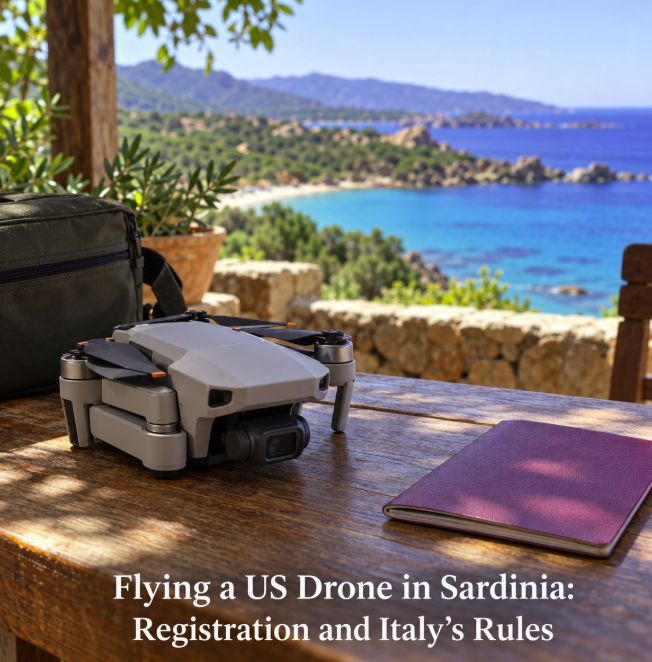
Bringing a drone from the United States to Sardinia requires more preparation than packing your FAA registration certificate. European operator registration, pilot competency and the conditions of the proposed flight are separate matters. A successful registration also does not mean that a beach, town or coastal viewpoint is available for flying.
FAA registration does not transfer automatically
EASA's travel guidance says a resident of a non-EASA country should register with the authority of the first EASA country where they intend to operate. Once obtained, that operator registration is valid across EASA member states; you do not repeat it simply because you later fly in Italy.
This concerns the first country of intended flight, not necessarily the airport where you enter Europe. If Italy is that country, use the Italian process. If you already hold a valid European operator registration from an earlier trip, check its status before applying again.
EASA's non-EU visitor FAQ also states that foreign drone qualifications are not currently recognised through mutual recognition. A US qualification should therefore not be treated as the required European competency certificate.
Registering through Italy
ENAC's operator guidance directs registration through d-flight and describes the European identification code, provided in QR format, to be placed on the drones used. It excludes qualifying toy drones and drones below 250 grams without cameras, microphones or other personal-data collection equipment from registration.
A lightweight camera drone is therefore not automatically exempt. Distinguish the operator's registration obligation from any simplified pilot-training requirements. Check your exact model, take-off configuration and documentation rather than relying on the word “Mini” or the weight of the bare aircraft.
Start the process before travelling. If an account form presents an identity or document problem, ask the official support service what information a non-resident should supply. Do not invent an Italian identity or copy an unofficial workaround. Use the current portal for charges and instructions rather than budgeting from an old online guide.
Check the drone and the pilot requirements separately
The EASA open-category guidance sets out different requirements according to the drone and operating subcategory. It advises checking the class mark and EU declaration of conformity. A US-market aircraft should not be assumed to have the same European classification as a similarly named model sold locally.
EASA's C0 explanation identifies simplified requirements, including no mandatory remote-pilot training for C0 operations. That exception is a reason to check the applicable category carefully, not to assume every visitor needs the same examination.
For an older aircraft without a European class mark, consult the current legacy-drone provisions. Do not attach a class label yourself or assume that buying a smaller battery resolves all eligibility questions. Where remote identification applies, verify the European requirements and configuration rather than assuming FAA compliance establishes equivalence.
Check the flight area in Sardinia
ENAC's airspace guidance requires adequate operator insurance and checking the proposed area on d-flight maps before each flight. Review the actual location, applicable conditions and any authorisations needed. A manufacturer's app is not a substitute for that check.
Do this for each Sardinian location on your itinerary. An attractive coastline does not establish permission, and an apparently empty place does not rule out restrictions. Check protected-area conditions, take-off access and privacy requirements separately where relevant.
Open-category operating limits include visual line of sight and a general 120-metre height limit; local geographical zones can impose tighter conditions. Do not interpret that number as permission to climb 120 metres everywhere. If the planned operation falls outside the open category, resolve the relevant authorisation requirements before travelling.
Keep registration, competency documents where required, insurance and aircraft information accessible. The practical sequence is to establish your operator status, confirm the aircraft and pilot requirements, then assess the exact flight. That preparation lets you decide whether to bring the drone—and when leaving it packed is the appropriate choice.


