
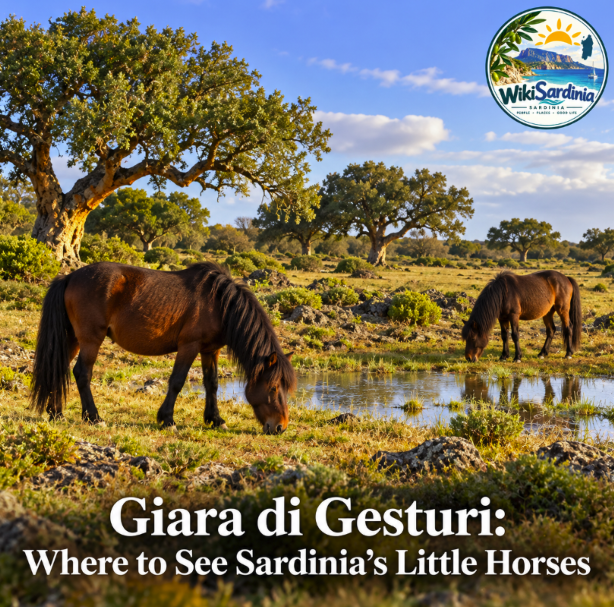
The cavallini della Giara are one of Sardinia’s most distinctive inland sights: small horses living freely across a plateau of cork oaks, scrub and seasonal pools. To look for them, head towards the Giara di Gesturi in central-southern Sardinia rather than the coast. A visit is a nature walk with the possibility of observing horses in their habitat, not a scheduled animal display or a guaranteed close encounter.
Where the Giara is and how to approach it
The regional Sardegna Sentieri guide places the plateau between Marmilla and Sarcidano and describes a basalt landscape shaped by volcanic activity. Although Gesturi gives it its familiar name, it is not a single village attraction. Several surrounding communities provide approaches to the wider landscape.
The regional guide identifies Gesturi, Genoni, Setzu and Tuili as places from which visitors can reach plateau parking areas by car and continue along paths on foot. Confirm the approach and any current restrictions before setting off, especially if you have booked a guide whose meeting point is at a particular entrance. A search for “Giara di Gesturi” alone may not direct you to the start of your chosen walk.
Once there, the plateau offers more than a horse photograph. Cork-oak woodland and Mediterranean scrub share the landscape with shallow depressions called paulis, where water collects during the wetter season. These habitats are part of the reason the visit rewards a slower pace: notice the terrain, vegetation and water as well as the animals.
Meet the cavallini without turning them into props
The Giara horses are a distinctive local equine population known for their small size. An archival natural-history account hosted by Sardegna Ambiente describes dark bay, chestnut and black coats, and horses living in family groups. It also discusses uncertainty around their early origins and the possibility of human introduction followed by a return to free-ranging life.
That history is more useful than calling them an untouched prehistoric species or the last wild horses in Europe. “Wild horses” is a familiar travel search, but it should not erase the distinction between a horse’s origins and its present way of living. For a visitor, the essential point is that these animals move around their environment rather than appearing on demand.
Observe quietly from a distance, leave their route clear and do not feed or try to touch them. Use binoculars or a camera zoom instead of moving in for a close-up. If horses approach, give them room rather than treating the moment as permission to interact. Children should understand that their small size does not make them pets.
What changes with the season
SardegnaTurismo’s description of the plateau explains how the paulis and surrounding vegetation change across the year. Spring brings flowering plants, while summer can leave many shallow pools dry. Autumn rain changes the landscape again. A photograph of horses beside a full pool therefore does not establish what you will find during your visit.
Choose the day using the current forecast and the kind of walk your group enjoys. Ask a local guide about recent conditions and a suitable route, rather than assuming one season guarantees a sighting. The experience may involve waiting, looking carefully and walking beyond the first viewpoint; it remains worthwhile when the landscape is allowed to be the subject too.
Plan a walk that suits your group
Before booking an excursion, ask for the exact meeting point, expected walking time, terrain and language of the visit. Explain any mobility needs or the ages of children so the provider can describe what is appropriate. Confirm the price and what happens if the weather changes. A regional listing of access routes does not establish that every path has the same difficulty or facilities.
For an independent visit, identify your route and return point in advance, use the designated parking and keep to the available paths. Bring water, suitable footwear and a layer appropriate to the forecast. Do not assume that food, toilets or other services are available along the walk; check the entrance you intend to use.
A guide can also help connect the horses with the plateau’s ecology and history, giving the outing more depth than a search for a single photo spot. Whether you visit independently or with someone local, allow enough time to observe without rushing. The Giara’s attraction is an encounter with a living landscape, whose animals and conditions are part of the experience rather than something to arrange for the camera.


