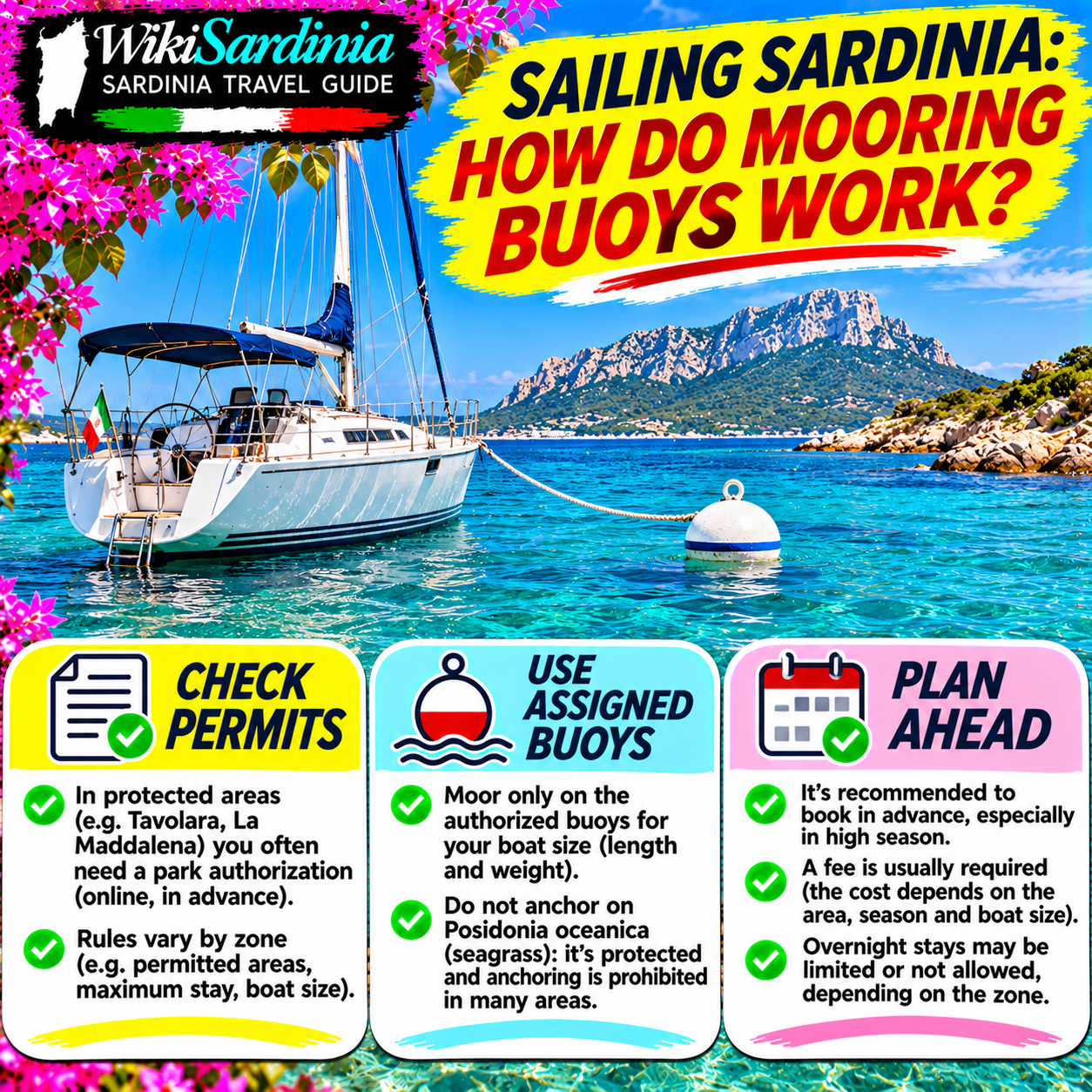
Mooring buoys (campi boe) are managed places where a sailboat can secure to an existing underwater mooring rather than dropping its own anchor. Around Tavolara–Punta Coda Cavallo and La Maddalena, they are especially important because seagrass meadows and other seabed habitats are protected. Each protected area has its own zones, permits, operators, boat-size limits and seasonal arrangements. A buoy visible from your cockpit is not automatically available for your charter yacht.
What is a campo boe?
A campo boe is a designated mooring field. Each authorized buoy connects through a line or chain to an underwater anchoring system designed for a particular load. Instead of deploying your anchor, you attach the yacht's mooring line or bridle to the designated pickup line or ring, following the field operator's instructions. This helps reduce damage from anchors and chains dragging across sensitive seabeds, particularly Posidonia oceanica meadows.
How do I use a mooring buoy?
Approach slowly, ideally into the prevailing wind or current, with fenders and lines prepared. Assign one crew member to handle the boat hook or pickup line while the skipper controls the yacht. Check that the buoy is authorized, suitable for the vessel's length and displacement, and assigned or available to you. Secure a proper bow bridle where instructed, verify chafe protection and clearance from neighboring boats, and monitor changes in wind and current. Never attach to a navigation mark, diving marker, fishing buoy or an unverified private mooring.
Do I need a permit at Tavolara?
Within the Tavolara–Punta Coda Cavallo Marine Protected Area, access, navigation, anchoring and mooring depend on the relevant protection zone and current regulations. Some activities require authorization from the managing authority. Do not assume that a charter booking or a normal boating license automatically includes protected-area permission. Before entering, consult the marine park's official zoning map, current boating rules and any active mooring service. Confirm the permitted buoy and whether overnight use is authorized.
How does La Maddalena differ?
La Maddalena is a national park with its own pleasure-boating access and permit arrangements. Depending on the zone and current operating rules, visitors may need to purchase an authorization, follow navigation corridors and use permitted mooring or anchoring locations. Some highly protected areas have stricter access restrictions. A permit to navigate in the park is not necessarily a guaranteed reservation of a particular buoy. Check the park's official current boating instructions rather than relying on an old charter-company blog.
Can I reserve a buoy online?
Only if the relevant park or authorized mooring operator offers that service for your chosen field and dates. Reservation systems and operating periods can change. Ask the charter company for the exact buoy-field operator, official booking method, availability, VHF or telephone contact, arrival window and cancellation terms. If reservations are not supported, follow the on-site assignment procedure and keep an alternative permitted harbor or anchorage in mind.
How much does a mooring buoy cost?
There is no single reliable price for all buoys around Tavolara and La Maddalena. Charges may depend on yacht length, season, duration, day versus overnight use, resident status and whether park access fees are separate. The price for a protected-area navigation permit should not be confused with the charge for a managed mooring. Request a current written quote from the authority or operator, stating your yacht's length overall and the intended date.
Can I stay overnight?
Not automatically. A buoy that can be used for a daytime stop may not be certified or authorized for overnight occupancy. Overnight mooring can be limited by park zone, weather, operating hours, boat dimensions and permit conditions. Confirm permission before sunset, and never rely on a buoy's mere presence as evidence that overnight mooring is safe or lawful.
Can I drop anchor if the buoys are full?
Only where anchoring is expressly permitted under the relevant protected-area rules and seabed restrictions. Posidonia meadows are sensitive to anchor damage; an apparently sandy patch may be near protected habitat or inside a restricted zone. Do not drop anchor simply because a mooring field is full. Use the official chart and zoning information, check the seabed and current notices, and divert to another authorized location when necessary.
What about Budelli, Spargi and the natural pools?
Popular La Maddalena locations can be subject to special access, navigation, swimming and anchoring restrictions. The Spiaggia Rosa at Budelli is particularly protected, and visiting the archipelago does not give unrestricted landing rights. Treat each bay as a separate navigational and regulatory decision. Verify the precise zone before planning a stop and never copy the anchoring position of another boat as proof that it is legal.
What should I ask the charter company?
Ask whether the yacht is eligible for the relevant protected-area permits, who is responsible for purchasing them, whether the company has arranged any buoy reservations, what the maximum permissible wind conditions are, and whether the vessel's insurance covers the intended navigation. Request up-to-date charts, contact details and the boat's exact length, beam and displacement. If you are using a skipper, clarify who handles permissions and payments.
What if the wind increases while on a buoy?
Monitor the forecast, line tension, chafe and surrounding traffic. A mooring buoy does not make an exposed bay safe in all conditions. If conditions exceed the field's rating or the yacht's safe operating limits, depart early for a suitable sheltered harbor or authorized anchorage. Do not attempt an improvised repair of the underwater mooring. Contact the operator if a buoy or pickup line looks damaged.
Useful Italian boating phrases
“È necessario prenotare il campo boe?” — Must I reserve the mooring field? “La boa è adatta a una barca a vela di dodici metri?” — Is the buoy suitable for a 12-meter sailboat? “Il pernottamento è consentito?” — Is overnight mooring allowed? “Il permesso del parco è incluso?” — Is the park permit included? “Dove è vietato dare ancora?” — Where is anchoring prohibited?
Frequently asked questions
Are all mooring buoys free to use?
No. Managed fields may require payment, authorization or assignment.
Does my charter contract include marine park permits?
Not necessarily. Confirm with the charter operator.
Can I tie to any white buoy?
No. Identify the official mooring and its vessel rating before attaching.
Is overnight mooring allowed everywhere?
No. Check the exact field, zone and operating conditions.
Can I anchor in Posidonia?
Do not anchor on protected seagrass. Follow the applicable protected-area rules and authorized anchoring zones.
Are La Maddalena and Tavolara permits interchangeable?
No. They are separate protected areas with separate management and regulations.
What if no buoy is available?
Use an alternative lawful anchorage or marina; do not improvise a mooring in a restricted zone.
The takeaway
Plan moorings before you set sail. For Tavolara and La Maddalena, check the official zoning map, permits, buoy availability, vessel limits, fees and overnight rules separately. Use authorized moorings correctly, avoid damaging Posidonia and keep a safe alternative stop for changing weather.
Official authorities to consult before departure: Area Marina Protetta Tavolara–Punta Coda Cavallo; Parco Nazionale dell'Arcipelago di La Maddalena; Italian Coast Guard — local maritime ordinances and safety notices.