You've just arrived at a beautiful holiday apartment in Sardinia. The kitchen has five small bins, a printed calendar is stuck to the fridge, and your host asks you not to leave rubbish outside on the wrong day. Welcome to raccolta differenziata, Italy's system of separating household waste for recycling and collection.
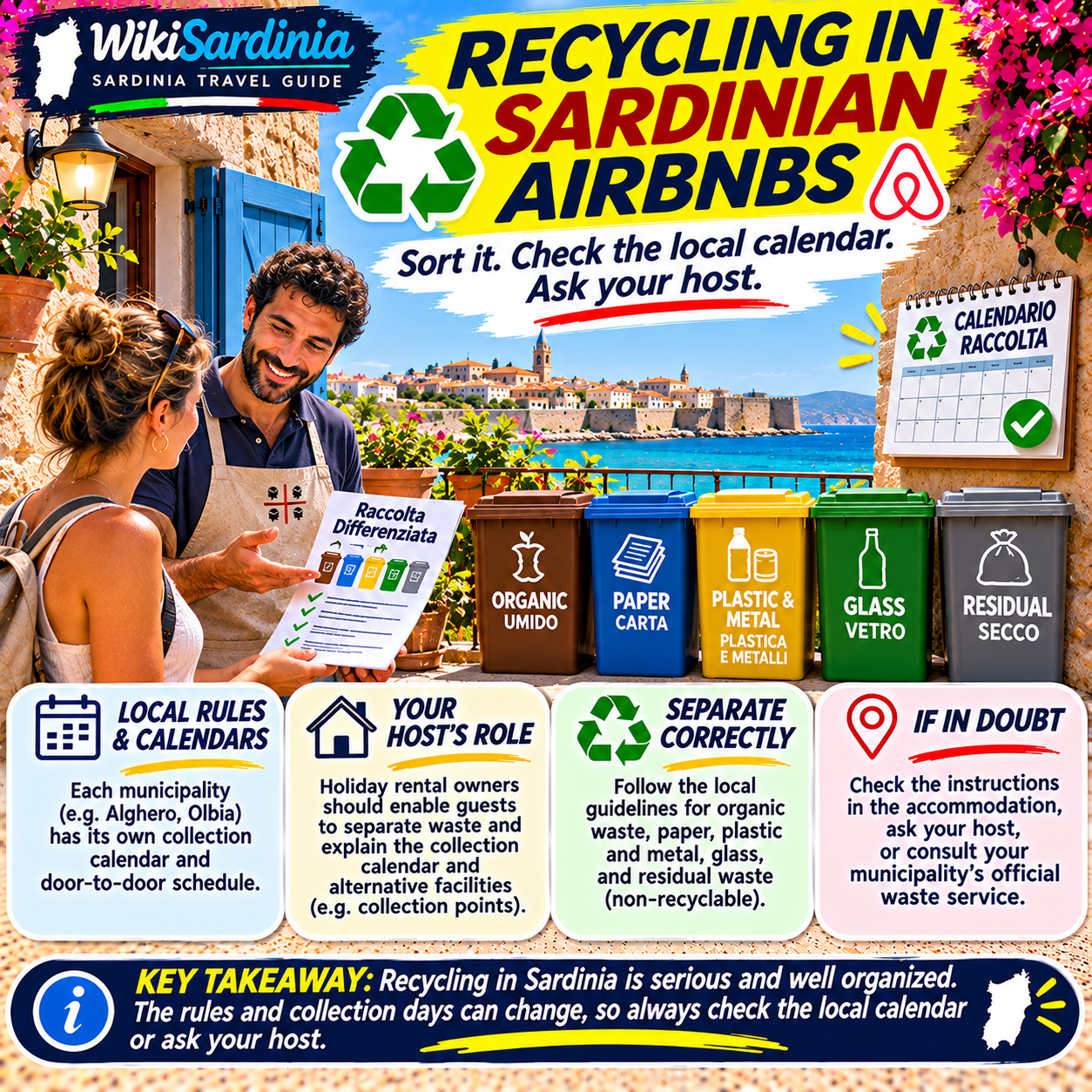
If you stay in a Sardinian Airbnb, holiday apartment or rental villa, you will normally need to separate rubbish into different categories and follow the collection arrangements for that specific address. Rules are set locally, so the schedule in Alghero may be different from the one in Olbia, Cagliari or even another district of the same town. The easiest approach is to ask your host for the current calendar and instructions when you check in.
What does “raccolta differenziata” mean?
The phrase literally means “separate collection.” Instead of putting everything into one general rubbish bag, households sort materials so they can be collected and processed appropriately. In Sardinia, many municipalities operate porta a porta, or door-to-door collection, with designated days for different waste categories. Other arrangements may include authorised collection points, ecological islands and municipal recycling centres.
The Sardinia Region's official tourism website advises visitors to check the disposal arrangements in their destination and warns that abandoning waste is prohibited.
What bins will you usually find in a Sardinian holiday rental?
Many homes provide separate containers for organic waste, paper and cardboard, packaging made from plastic and metal, glass, and non-recyclable residual waste. The exact number of bins, labels, colours and accepted items depend on the municipality.
| Italian label | English meaning | Typical examples |
|---|---|---|
| Umido / Organico | Food and organic waste | Food scraps, fruit peels, coffee grounds |
| Carta e cartone | Paper and cardboard | Clean paper, boxes, cardboard packaging |
| Plastica e metalli | Plastic and metal packaging | Plastic bottles, food trays, cans, tins |
| Vetro | Glass | Glass bottles and jars |
| Secco residuo / Indifferenziato | Non-recyclable residual waste | Items not accepted in separate streams |
These are common examples, not a universal island-wide sorting code. A particular town may collect glass with metal, separate cans differently or impose specific requirements for packaging. Always follow the instructions provided by the local waste service.
Do recycling bin colours mean the same thing everywhere?
Do not rely on colour alone. A brown bin commonly indicates organic waste, blue may indicate paper and yellow may indicate packaging, but the actual service can differ by municipality and building. Read the labels on the containers and the property's waste guide.
If a bin has no label, ask the host rather than guessing. A correctly sorted bag placed in the wrong container can still cause problems for collection.
How does door-to-door waste collection work?
Under a porta a porta system, the local operator collects particular categories on designated days. Guests or hosts place the correct bin or bag at the authorised location during a specified time window. The schedule may change by district, season, property classification or local service arrangements.
For example, the Municipality of Alghero announced a new domestic collection calendar effective 26 October 2026, covering urban homes and the surrounding countryside. In Olbia, new door-to-door calendars came into effect on 1 November 2026, with distinctions between domestic and non-domestic users and different areas.
Because calendars change, an old photograph of a timetable or a previous guest's notes may be wrong. Always request the version valid for your dates and your exact address.
Who is responsible for waste in an Airbnb or holiday rental?
Guests should follow the waste-sorting instructions given for the property. The host or property manager should explain the applicable collection system and provide a workable way to comply. The precise legal and administrative responsibilities vary by municipality and accommodation classification.
Alghero offers an especially clear example. The city's official waste-service guidance for tourists says that the property owner is responsible for the waste produced in a rented home and must enable guests to carry out separate collection during their stay. The owner must inform guests about the door-to-door calendar and alternatives such as mobile ecological islands and recycling centres.
That is an official Alghero rule and guidance; it should not be presented as identical legal wording for every municipality in Sardinia. Regardless of location, tourists should cooperate with their host and not leave rubbish in unauthorised places.
What should the host provide?
For a smooth stay, ask your host for labelled bins or bags, the current collection calendar, instructions on where and when to place waste outside, and a plan for disposal when the next collection is after checkout. In some areas, particular bags or containers are required.
Hosts may also supply an English-language sorting guide, a link to the local waste-service website or a contact number for questions. These are useful conveniences, but their availability varies by property.
What happens if I check out before collection day?
This is a common problem during short stays. If your last night falls just after a collection day, you may still have separated waste that cannot legally be left on the pavement until the next scheduled pickup.
Ask the host in advance what to do with the rubbish at checkout. Some properties have an authorised storage area or the manager collects it after departure. Some municipalities offer eligible users alternative drop-off services. Do not leave bags outside outside the permitted hours, put them into a neighbouring property's bins or abandon them beside public containers.
Can I use a public recycling island or ecocentro?
Sometimes, but access is not necessarily unrestricted. A municipal ecocentro is a designated collection centre, often for materials not handled through ordinary door-to-door pickup. An isola ecologica may be a fixed or mobile collection point. Eligibility, accepted materials, opening hours and identification requirements differ.
In Cagliari, the official municipal waste-service guidance includes specific arrangements for eligible tourist-rental properties. The city's Piazza Puglia mobile ecological island is described as a service for qualifying B&Bs, holiday homes and tourist lets, subject to its rules and quantity limits. This is not permission for every visitor to use it without checking eligibility.
In Olbia, the municipality's ecocentro information describes access arrangements that include occasional tourist users subject to identification and the centre's conditions. Confirm the current rules before travelling there.
Are there special rules in Alghero?
Yes, and Alghero is a good example of why you should check locally. The official Differenziamo Alghero website provides a collection calendar, a waste-sorting guide, information on recycling centres and dedicated tourist instructions. Its guide lists separate categories for residual waste, organic waste, paper and cardboard, plastic and cans, and glass.
The site also directs tourists to the host for collection instructions and information about alternatives. If you are staying in Alghero's historic centre or a rural district, do not assume your schedule matches a friend staying elsewhere in town.
What about Cagliari?
Cagliari has a door-to-door system and dedicated rules for certain extra-hotel accommodation. The municipality explains that access to ecological centres and mobile collection points depends on the user's relationship to the registered waste-tax account or qualifying tourist property.
For eligible occasional tourist lets, the city's published rules provide alternative collection opportunities for recyclable fractions and residual waste. The exact frequency and access conditions are service-specific. Ask your host whether your accommodation is registered for a dedicated tourist-rental service rather than trying to access it independently.
What about Olbia and Costa Smeralda holiday homes?
Olbia publishes collection calendars by district and user category, including central, coastal and rural areas. A property near Olbia may follow a different calendar from one in the historic centre or a coastal locality. Some surrounding Costa Smeralda destinations belong to other municipalities and may have entirely different arrangements.
Olbia introduced revised collection calendars on 1 November 2026, so travellers should be especially cautious about relying on older schedules. Use the exact municipal address of your accommodation to identify the right service.
How should I dispose of food waste?
In places with organic-waste collection, food scraps and other accepted compostable material generally go in the umido container. Use the type of bag specified by the local operator; many systems require certified compostable bags rather than ordinary plastic shopping bags.
Some materials that look biodegradable are not necessarily accepted. Check the local waste dictionary for coffee capsules, compostable packaging, tissues, shells, bones or pet litter rather than assuming all organic-looking items belong in the same bin.
Do pizza boxes and takeaway containers go in recycling?
It depends on the material and how contaminated it is. Clean cardboard packaging may belong with paper, while greasy or food-soiled portions may need different treatment under local rules. Plastic food containers should be emptied and sorted according to the local packaging rules.
For difficult items, use the municipality's ecodizionario, a searchable waste-sorting dictionary. Alghero's official waste website offers one.
What about glass bottles and aluminium cans?
Glass bottles and jars usually belong in a designated glass collection stream, while aluminium cans and steel tins may be collected with plastic packaging or in another mixed-material stream. The combination differs by service.
Do not place ceramics, drinking glasses, mirrors or light bulbs into a glass-packaging bin unless the local instructions explicitly allow them. These are different materials or waste categories.
Can I throw away batteries, medicines or electronics in normal bins?
Do not treat batteries, expired medicines or electronic equipment as ordinary residual waste. They require dedicated collection channels, which may include authorised retailers, pharmacies or municipal collection centres depending on the item and local service.
If you have an unusual item to dispose of during your holiday, ask your host or consult the local operator's official guidance.
Are there fines for getting recycling wrong?
Municipal waste regulations can provide sanctions for improper disposal, abandonment of rubbish or failure to follow authorised collection arrangements. The applicable offence, enforcement process and amount depend on local rules. It would be misleading to quote one fine as applying everywhere in Sardinia.
Do not leave rubbish bags beside roadside bins, on beaches, in the countryside or outside a property on the wrong day. Apart from possible penalties, abandoned waste harms the island's environment and creates problems for residents.
What if the bins are full or I cannot find the calendar?
Message the host promptly and ask where waste should be stored until the authorised collection time. Do not improvise by using private neighbouring bins or public litter baskets for household rubbish. If the host cannot help, consult the official municipal waste-service website or its customer-service number.
Keep organic waste contained to reduce smells and pests, especially during hot weather, while following the property instructions.
Useful Italian words and phrases
- Raccolta differenziata — Separate waste collection / recycling sorting
- Porta a porta — Door-to-door collection
- Umido / Organico — Food and organic waste
- Carta e cartone — Paper and cardboard
- Plastica e metalli — Plastic and metal packaging
- Vetro — Glass
- Secco residuo — Non-recyclable residual waste
- Calendario raccolta — Collection calendar
- Ecocentro — Municipal waste collection centre
- Quali giorni si espongono i rifiuti? — On which days should we put the bins out?
- Dove lasciamo i rifiuti al check-out? — Where should we leave the rubbish at checkout?
Frequently asked questions
Do I have to recycle in a Sardinian Airbnb?
Yes, you should follow the applicable local waste-separation and disposal rules. Ask your host for the instructions for the property.
Are recycling rules the same throughout Sardinia?
No. Municipalities set their own collection calendars and service arrangements, sometimes with different schedules by neighbourhood.
Does the Airbnb host have to provide bins?
Local responsibilities vary, but hosts should give guests a workable way to follow the local rules. Alghero's official tourist guidance explicitly places responsibility on the property owner to enable proper waste separation.
Can I leave rubbish outside when I check out?
Only if it is the authorised collection time and location. Otherwise, follow the host's checkout arrangements.
Can tourists use municipal recycling centres?
Access depends on the municipality and facility. Some services accept eligible temporary visitors with identification; others require a registered property or host arrangement.
Where do plastic bottles go?
Usually with plastic packaging, but follow the municipality's specific instructions for that address.
What if I do not understand the bin labels?
Ask your host for an English guide or consult the municipality's official waste dictionary.
What happens if I put the wrong rubbish out?
The collection may be refused, and local regulations may provide penalties. Correct the sorting and contact your host if necessary.
Are collection calendars different in summer?
They can be. Some services have seasonal schedules or change calendars, so always check the dates that apply to your stay.
Does the cleaning fee mean I can ignore recycling?
No. A cleaning fee does not automatically exempt guests from local waste rules. Follow the booking agreement and municipal instructions.
The bottom line
Recycling in a Sardinian vacation rental is usually straightforward once you know the local system: separate the waste, use the correct bins and put them out only at the authorised times. The important detail is that there is no single collection calendar for the entire island. Ask your host for the current instructions, especially if you are leaving before the next pickup. A few minutes of preparation keeps your stay hassle-free and helps protect Sardinia's towns, beaches and countryside.
Official sources and further reading
- SardegnaTurismo — Official Recycling Advice for Visitors
- Differenziamo Alghero — Official Waste Sorting and Calendars
- Differenziamo Alghero — Information for Tourists and Property Owners
- Municipality of Alghero — Collection Calendar from 26 October 2026
- Municipality of Cagliari — Ecological Islands and Tourist Rental Access
- Cagliari Porta a Porta — Extra-Hotel Accommodation Service
- Municipality of Olbia — Waste Collection Calendars by Area
- Municipality of Olbia — Ecocentro Access