You're driving from Alghero toward Sardinia's interior, following a beautiful road between hills and stone villages. Your map works perfectly—until the blue dot freezes and your phone drops to one bar. Is that normal? And can you rely on 4G or 5G while hiking in the Supramonte or exploring secluded beaches?
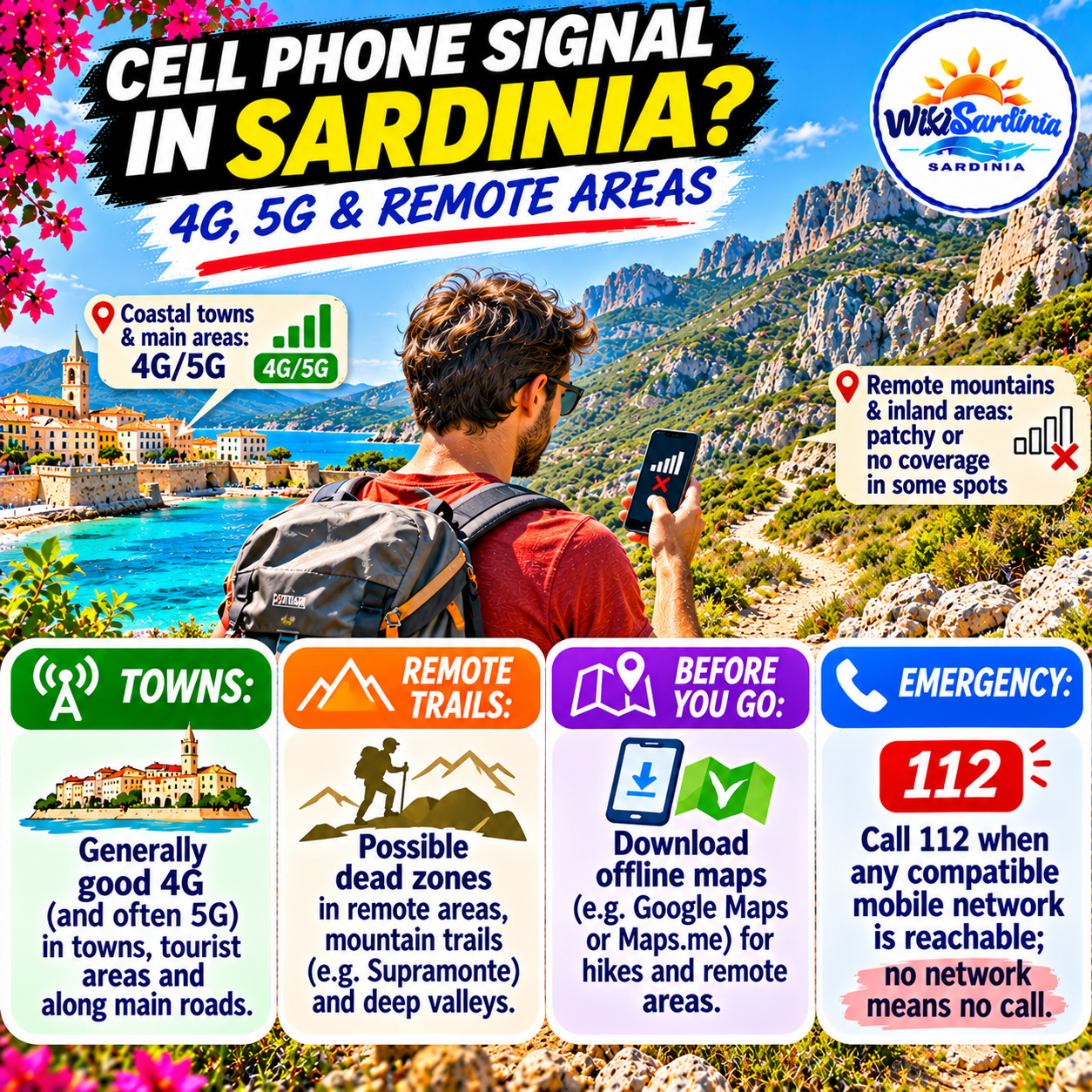
The short answer is that mobile coverage is generally much better in Sardinian towns and developed coastal areas than in remote mountains, valleys and sparsely populated countryside. 4G is widely available across inhabited areas, and 5G is present in many locations, but neither technology can be assumed to work everywhere. Some isolated places still have weak reception or no usable signal at all.
Does Sardinia have good 4G and 5G coverage?
Yes in many populated areas, but the picture changes with terrain. In cities such as Cagliari, Sassari, Alghero and Olbia, visitors can generally expect ordinary mobile connectivity, subject to their network, plan and exact location. Tourist towns and major roads often have usable 4G, with 5G available in parts of the island. However, coverage can differ significantly between providers and even between neighbouring streets or beaches.
For an official overview, Italy's communications regulator AGCOM provides a Broadband Map with a dedicated mobile-network section. The map should be checked for your actual destination rather than treating an islandwide coverage claim as a guarantee. National infrastructure company Infratel also publishes mobile coverage mapping and forecasts.
What happens in remote areas?
Remote parts of the Gennargentu, Supramonte, Barbagia and other mountainous or rural landscapes can have weak or absent mobile service. Deep valleys, steep limestone walls, wooded terrain and distance from cellular sites can all reduce signal quality. Some secluded coves may also be poorly served, even if a nearby resort town has excellent coverage.
A European regional-development publication in 2025 described urban Sardinia as generally well connected while identifying weaker or missing mobile coverage in rural and remote areas. This is a geographic problem rather than a blanket statement about every inland village: a small mountain town may have a good signal in its centre, while a trail a few kilometres away has none.
Are there still roads without signal?
Yes. On 29 August 2026, the Autonomous Region of Sardinia publicly acknowledged inadequate mobile coverage in parts of the island, including reported problems along sections of state road SS 125 and in tunnels on the eastern route. The regional government announced an additional €3 million for 2026–2027 to support telecommunications infrastructure in underserved areas.
This matters to travellers because a gap in coverage is not just an inconvenience for navigation or messaging. It can also make it harder to contact emergency services after a road incident. Do not assume that a major road has uninterrupted reception throughout its length.
How serious is Sardinia's mobile coverage gap?
A report published by la Repubblica on 26 October 2026, drawing on Infratel and AGCOM data reported by La Nuova Sardegna, said that approximately 804 square kilometres of Sardinia were without mobile coverage at the end of 2024. It also cited an earlier mapping estimate that 5G covered 66.8% of the island's geographic area, compared with 71.7% nationwide. These are dated mapping figures, not measurements of the network at every location today.
The important distinction is between coverage of people and coverage of land. A provider may serve nearly all residents while leaving large uninhabited areas with little or no signal. Those uninhabited areas are exactly where visitors may want to hike, climb, drive or find a quiet beach.
Which network is best: TIM, Vodafone, WindTre or Iliad?
There is no trustworthy single winner for every corner of Sardinia. Network performance changes by location, device, technology and ongoing infrastructure upgrades. One operator may have service in a valley where another does not, while the pattern reverses on a nearby ridge.
Before choosing a SIM or eSIM, compare coverage maps for the places you will actually visit. Start with the AGCOM mobile map, then consult the individual operators' published maps. Where available, user-measured maps can add context, but crowdsourced measurements have gaps and should not be treated as a guarantee.
Will my American or British phone work in Sardinia?
Usually, provided the phone is unlocked or your home provider supports international roaming, and the device supports the relevant Italian mobile bands. Sardinia uses Italy's national mobile networks, not a separate island telephone system.
For travellers from the United States, international roaming charges can be expensive depending on the plan. An Italian or international travel eSIM may be useful if your phone supports it. Travellers from the United Kingdom should check current roaming terms rather than assuming EU-style roaming is included. Visitors from other EU countries generally benefit from EU roaming rules subject to fair-use conditions and plan exceptions.
An eSIM does not create coverage where the underlying partner network has no signal. Ask which Italian network the eSIM uses, especially if you plan to travel inland.
Does 5G matter for a Sardinian road trip?
Not as much as reliable basic coverage. For navigation, messaging and checking information, a stable 4G connection is usually more useful than a brief 5G signal that disappears outside town. In remote areas, the crucial question is whether your phone can connect at all—not whether it displays a 5G icon.
Even when a map shows 5G coverage, real-world speed can be affected by network congestion, buildings, terrain and device capabilities.
Download offline maps before you leave
Offline navigation is one of the simplest precautions you can take. Download maps for your entire driving area while connected to Wi-Fi, and test that the app can display your route without mobile data. Keep your phone charged and carry a power bank or car charger.
Remember that offline maps may not include live traffic, closures or updated route information. For serious hiking, use reliable trail-specific navigation and a suitable backup; ordinary road maps are not a substitute for mountain route-finding skills.
What about hiking in the Supramonte or Gennargentu?
Plan as though you might have no mobile coverage for part—or all—of your walk. Share your route and expected return time with a trusted person, carry sufficient water and safety equipment, and choose trails within your ability. A guide is strongly recommended for complex or technical routes.
For remote expeditions, consider whether a dedicated satellite communication or emergency device is appropriate, and learn its capabilities and limitations before departure. Do not rely on smartphone satellite features unless you have confirmed your specific model, service availability and regional support.
Can you call 112 if your phone shows 'No Service'?
In Italy, 112 is the emergency number. According to the Sardinian regional government's guidance, emergency calls can be made free of charge, including without a SIM or phone credit, when a compatible mobile network is reachable. Your phone may sometimes connect to another available network for an emergency call even if your own provider has no usable signal.
But there is an essential limitation: if no compatible terrestrial network is reachable, a conventional cellular emergency call cannot go through. 'No Service' does not automatically mean an emergency call is impossible, but neither does the 112 number guarantee connectivity in a complete dead zone. The same limitation can apply to location-sharing applications that need a network connection.
Learn your route, carry appropriate equipment and do not treat a phone as your only safety plan.
Will hotel and agriturismo Wi-Fi solve the problem?
Many hotels and guesthouses offer Wi-Fi, but the quality of a fixed internet connection is separate from outdoor mobile reception. A property may have good broadband while the nearby hiking trail has no signal, or vice versa.
If you need reliable connectivity for remote work, ask the property about its actual connection and backup options before booking. Do not assume that an accommodation's Wi-Fi will help once you leave the building.
Practical checklist before visiting remote Sardinia
- Check AGCOM and your mobile operator's coverage maps for your actual route and destination.
- Download offline driving maps and, where appropriate, hiking maps.
- Save essential addresses, booking details and emergency contacts offline.
- Carry a charged power bank and a car charger.
- Tell someone your planned route and expected return time before remote hikes.
- Consider a second network or suitable satellite device for higher-risk trips, while understanding its limits.
- Never depend on uninterrupted 5G or mobile reception in remote valleys, gorges or isolated roads.
Frequently asked questions
Is there 5G in Alghero, Cagliari and Olbia?
5G is available in parts of Sardinia's urban areas, but availability varies by street, operator and device. Check current provider maps for the exact location.
Does 4G work in Sardinian mountain villages?
Often it does in village centres, but surrounding roads and trails may have weak reception or no service. There is no single rule for every village.
Will Google Maps work without signal?
Downloaded offline maps can provide useful navigation without mobile data, although live updates and some features will be unavailable. Download and test the relevant areas before travelling.
Does an eSIM improve coverage?
Not automatically. It depends on the network used by the eSIM provider and whether that network has coverage at your location.
Can I call emergency services without my provider's signal?
Sometimes, if another compatible network is available for an emergency call. If no network is reachable, a normal cellular call will not work.
Which parts of Sardinia have the weakest signal?
Some remote mountains, deep valleys, isolated coves and rural roads are more likely to have gaps. Check location-specific maps rather than assuming every part of a named region is uncovered.
The verdict: stay connected where you can, prepare for where you cannot
Sardinia is not digitally isolated: its towns and many tourist destinations have ordinary mobile connectivity. But the island's dramatic landscapes create real gaps, and official authorities continue to invest in improving coverage. If your plans include remote hiking, hidden beaches or long drives through the interior, take the simple precautions that matter most: verify coverage, download offline maps, keep your battery charged and have a plan that still works when your phone does not.
Sources and further reading
- AGCOM — Official Broadband Map, including mobile coverage
- Infratel Italia — 2024 Mobile Network Mapping Results
- Autonomous Region of Sardinia — Mobile Coverage Investment Announcement, 29 August 2026
- Autonomous Region of Sardinia — How Emergency Number 112 Works
- la Repubblica — Sardinia Mobile Coverage Gaps, 26 October 2026