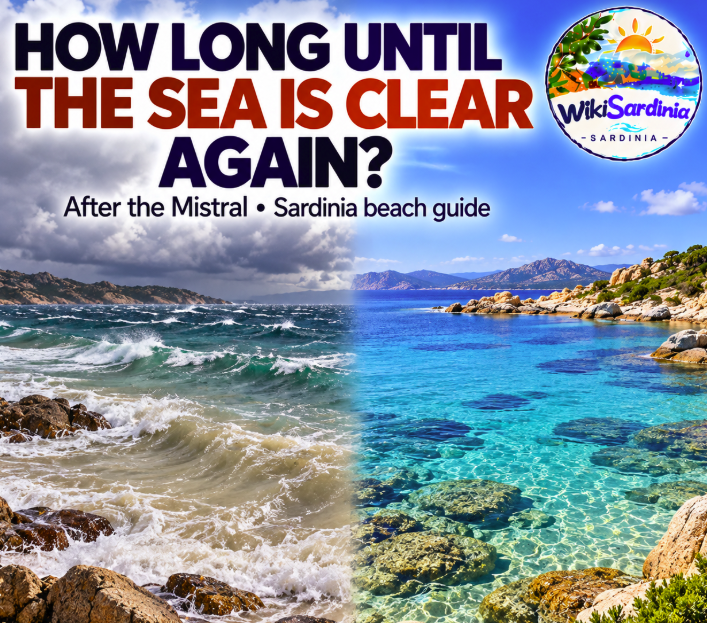
You arrive at a Sardinian beach expecting crystal-clear turquoise water, but after a strong Mistral the sea looks cloudy, sandy or even brownish near the shore. Is the water dirty? Will it clear by tomorrow? And should you choose a different beach?
Quick answer: storm-stirred seawater can improve within hours after the waves settle, but a visibly sandy beach may need a day or two, and some locations can remain murky for several days or longer. There is no reliable island-wide countdown. Wind, swell, sediment size, seabed type, runoff and the shape of the bay all affect recovery. Clear-looking water is not automatically safe for swimming.
Why does the sea turn cloudy after the Maestrale?
The Maestrale (Mistral) is a northwesterly wind that can create strong waves along Sardinia's exposed western and northern coasts. Breaking waves stir sand and finer seabed particles into the water, making it harder to see through. Coastal erosion and runoff after rain can add further sediment. Ocean-observation examples published by NOAA show that storm-driven waves and currents increase suspended material and that clarity can gradually improve as particles settle. NOAA CoastWatch: suspended matter after a storm.
Fine silt and clay can remain suspended longer than coarse sand. In shallow bays, even modest returning waves may stir settled material up again.
How long does it take for Sardinia's sea to become clear again?
| Conditions after the storm | What to expect |
|---|---|
| Short windy spell, little sediment, waves quickly subside | Visible improvement may happen within hours |
| Moderate surf over a sandy beach | Clarity may return over roughly one or two calmer days |
| Repeated waves, fine sediment or enclosed bay | Cloudiness can persist for several days |
| Major storm, heavy rainfall, river discharge or prolonged swell | Recovery can take longer and water-quality concerns may also arise |
These are illustrative scenarios, not measured recovery times for specific Sardinian beaches. A beach may look clear in the shallows while the seabed remains disturbed farther out—or vice versa.
Why can the water stay murky when the wind has stopped?
Wind speed on the beach is only one part of the story. Waves generated offshore may keep arriving after local winds weaken. Residual swell can continue to churn the seabed, and fine particles take longer to settle. Currents may also carry cloudy water along the coast. Check wave forecasts as well as the wind before assuming the sea has recovered.
Which Sardinian coast clears first after the Mistral?
There is no single coast that always clears first. During northwesterly winds, exposed western beaches may remain rough while eastern or southeast-facing shores are calmer. But each bay has its own orientation, bottom type and exposure. The official Sardinia tourism website highlights Rena di Ponente and Rena di Levante at Capo Testa as two beaches where choosing the side according to wind direction can help find calmer conditions. SardegnaTurismo: Rena di Levante and Rena di Ponente.
Near Alghero, the enclosed stretches of Porto Conte may offer alternatives to more exposed beaches, although local wind, swell and sediment still determine actual clarity. In northeast Sardinia, beaches around the Olbia and San Teodoro coast may be less directly exposed to the northwesterly Mistral than open west-facing shores. Always check the conditions at the particular beach.
Sand cloudiness versus polluted water: know the difference
Storms can affect the sea in two very different ways. Physical turbidity is caused by suspended sand, silt or other particles. Contamination may involve runoff, wastewater or microorganisms, especially after heavy rain near drainage outlets and river mouths. You cannot reliably distinguish them by color or smell alone.
If heavy rain accompanied the storm, check official bathing-water notices and local restrictions. Avoid swimming near visibly discharging drains or river mouths, and do not enter the water when authorities have issued a warning. Even beautiful transparent water can contain hazards, while naturally cloudy water is not necessarily polluted.
When should you avoid swimming?
- When red flags, bathing bans or official warnings are in place.
- When breaking waves, strong currents or poor visibility make entry and exit unsafe.
- After heavy rainfall near streams, storm drains or wastewater outlets until conditions and official guidance are satisfactory.
- When floating debris, unusual discoloration or suspicious discharges are visible.
- When you are unsure of the depth, rocks or seabed conditions beneath turbid water.
Do not swim simply because the wind has stopped; waves and currents can remain dangerous.
How to find clearer water tomorrow
- Check the wind direction: a northwest wind often makes west-facing shores more exposed.
- Check wave height and swell: these may matter more than current wind speed.
- Look at beach orientation: a bay sheltered by land may be calmer than an open beach.
- Consider seabed material: sandy shallows can become cloudy as waves stir them; rocky coves may behave differently.
- Check rain and river runoff: a beach close to a stream mouth may stay turbid longer.
- Use recent local observations: beach webcams and reports can help, but do not replace official safety notices.
- Have a backup beach: Sardinia's varied coastline often allows a change of direction without abandoning the day.
Is it better to go to the beach in the morning?
Sometimes. Morning conditions can be calmer before local afternoon sea breezes develop, but this is not guaranteed after a major Mistral event. If residual swell is still entering the bay, an early start will not magically restore visibility. Use the forecast and the conditions you can see, not a fixed rule about the hour.
Can you snorkel immediately after a storm?
Reduced underwater visibility makes it harder to judge rocks, depth, currents and marine life. Wait for calm conditions and suitable visibility, choose a protected location and avoid snorkeling alone. If the water is unusually cloudy or the sea remains rough, postpone the activity.
FAQ
Does Sardinia's sea become clear again the day after the Mistral?
Sometimes, especially after a brief windy spell followed by calm seas. Other beaches can stay cloudy for several days because of lingering swell or fine sediment.
Why is the sea brown after a storm?
Suspended sand, silt, coastal erosion or rain-driven runoff can change the water's color. Brown water alone does not identify its cause or prove it is safe.
Can the sea be calm but still cloudy?
Yes. Fine particles may remain suspended after surface waves subside, and currents can carry turbid water into an otherwise calm bay.
Are east-coast beaches always clear when the Mistral blows?
No. They may be more sheltered from northwesterly conditions, but local exposure, swell, rain and seabed characteristics still matter.
How can I tell whether the water is safe to swim in?
Consult official bathing-water information, beach flags and local warnings, and assess waves and currents. Visual clarity alone is not a safety test.
WikiSardinia's recommendation
After a strong Mistral, give the sea time to settle and choose your beach according to the current wind and wave direction. A sheltered bay may look beautiful while an exposed beach remains cloudy, but neither water clarity nor calm appearance should replace basic swimming safety checks. The best Sardinian beach after a storm is the one that is both inviting and safe on the day you visit.
Sources
NOAA CoastWatch — suspended matter after storm conditions; SardegnaTurismo — choosing Capo Testa beaches by wind direction.