
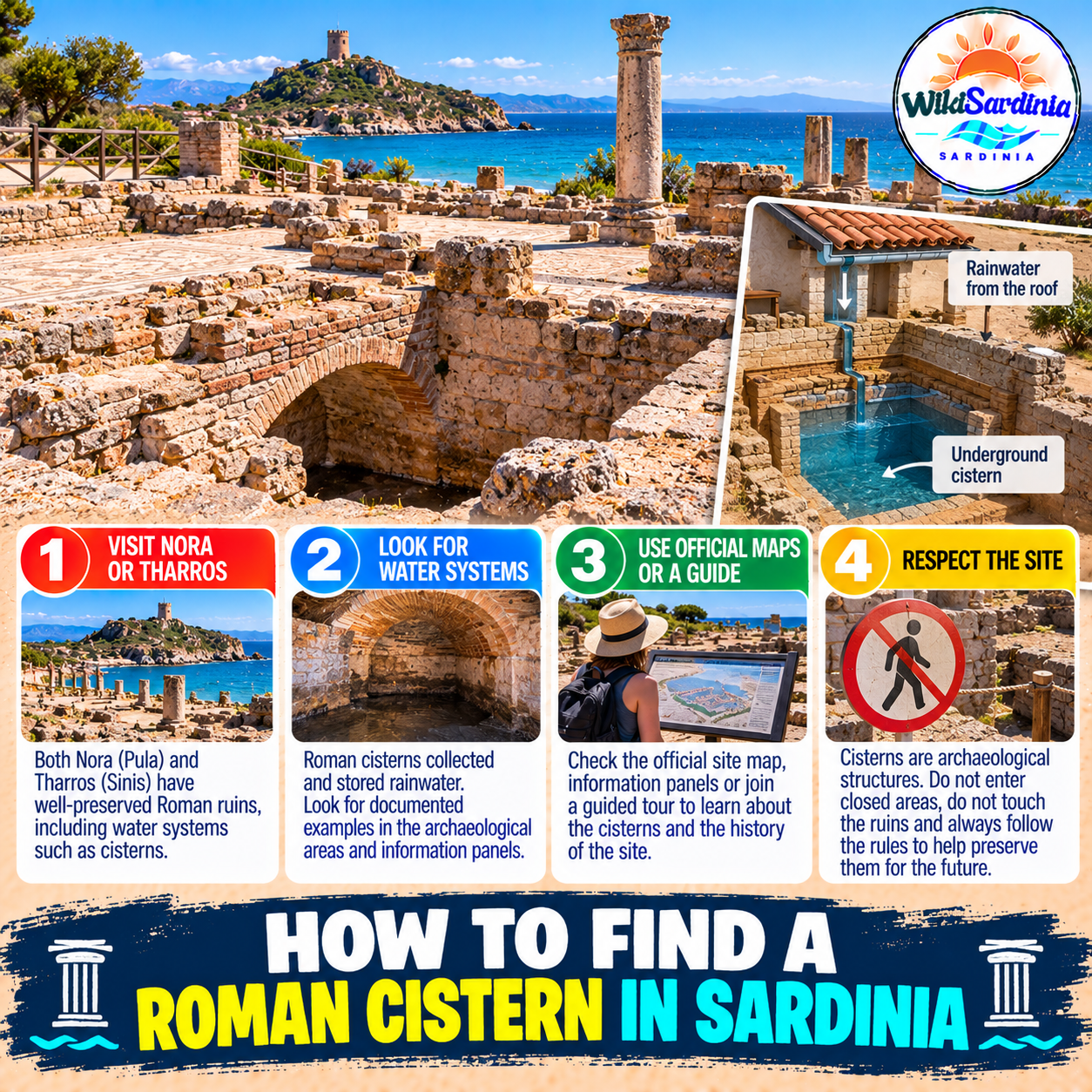
Some of Sardinia’s most fascinating Roman remains are not grand temples or theatres, but the systems that made daily life possible. Water had to be collected, stored and distributed, and ancient towns used wells, cisterns, aqueducts and reservoirs for that purpose. If you want to learn about these structures, two rewarding archaeological sites are Nora, near Pula, and Tharros, on the Sinis peninsula near Cabras.
Start at Nora: look for cisterns in the residential remains
Nora was a Phoenician, Punic and later Roman town. Archaeological documentation notes that private houses often had wells and cisterns, while an aqueduct later supplemented the traditional water supply. As you walk through the excavated residential areas, use the official site map and information panels to understand how these features fitted into the layout of a Roman home.
Not every cistern is an obvious open tank. Some remains may be difficult to distinguish from other masonry, and not every feature is accessible to visitors. Look for documented examples rather than trying to locate an unmarked “secret” entrance.
Then explore Tharros: follow the ancient water infrastructure
Tharros, on the Sinis peninsula, preserves evidence of a complex Roman town, including an aqueduct and the castellum aquae—a distribution tank associated with the water system. These are useful features to look for if you are interested in how water reached and circulated through an ancient settlement.
Tharros and Nora are different sites, so do not assume that every visible water structure is a cistern. At Tharros, the documented aqueduct and distribution tank are particularly helpful clues to the broader water network.
What did a Roman cistern do?
A cistern stored water, often collected from rainfall or supplied through a local water system. In houses, it could form part of a domestic arrangement alongside a courtyard, well or drainage feature. Larger public infrastructure served different purposes and connected to the wider needs of the settlement. The exact design varied according to the building, period and local water supply.
How to recognise a water structure
- Use the official map: identify the documented buildings and water-system remains before your visit.
- Read the site panels: they can explain whether a feature is a cistern, well, channel, aqueduct or distribution tank.
- Look at the context: domestic cisterns may be associated with house remains, while aqueducts and distribution structures belong to a broader network.
- Join a guided visit: a qualified guide can help distinguish features that are not obvious from ground level.
Do not identify a structure as Roman based on appearance alone. Archaeological interpretation depends on excavation, documentation and expert study.
Visit responsibly—there are no shortcuts into hidden ruins
Stay on authorised visitor routes and respect barriers, ropes and closed areas. Never climb into a cistern, enter an underground space, lift covers or move stones to investigate. These structures can be unstable, dangerous and protected archaeological remains. If a feature is not accessible, use the official maps, photographs or guided interpretation instead.
Plan your visit
Check the official opening hours, ticket information and any access restrictions for Nora and Tharros before travelling. Both are outdoor archaeological sites, so wear comfortable shoes, bring water and sun protection, and allow time to explore without rushing. Some remains may be hard to interpret without a map or guide.
Two sites, one ancient challenge
Nora offers documented examples of domestic cisterns and evidence of an aqueduct; Tharros preserves parts of an aqueduct and its castellum aquae. Together, they show how important water management was to life in ancient Sardinia. Rather than searching for a secret opening, use the official visitor information to discover the structures that archaeologists have documented and preserved.
Official sources: Nora archaeological project — Roman aqueduct; SardegnaTurismo — Ancient city of Tharros.