Some of the most memorable sunsets in Sardinia are not the ones with a queue of people waiting for the same photo. They are the quiet moments when the sea turns gold, the wind drops and you have time to enjoy the view. If you want to get away from the most heavily shared spots, try a simple local approach: ask someone who spends time on the coast, such as a fisherman, and be ready to explore a little beyond the obvious viewpoint.
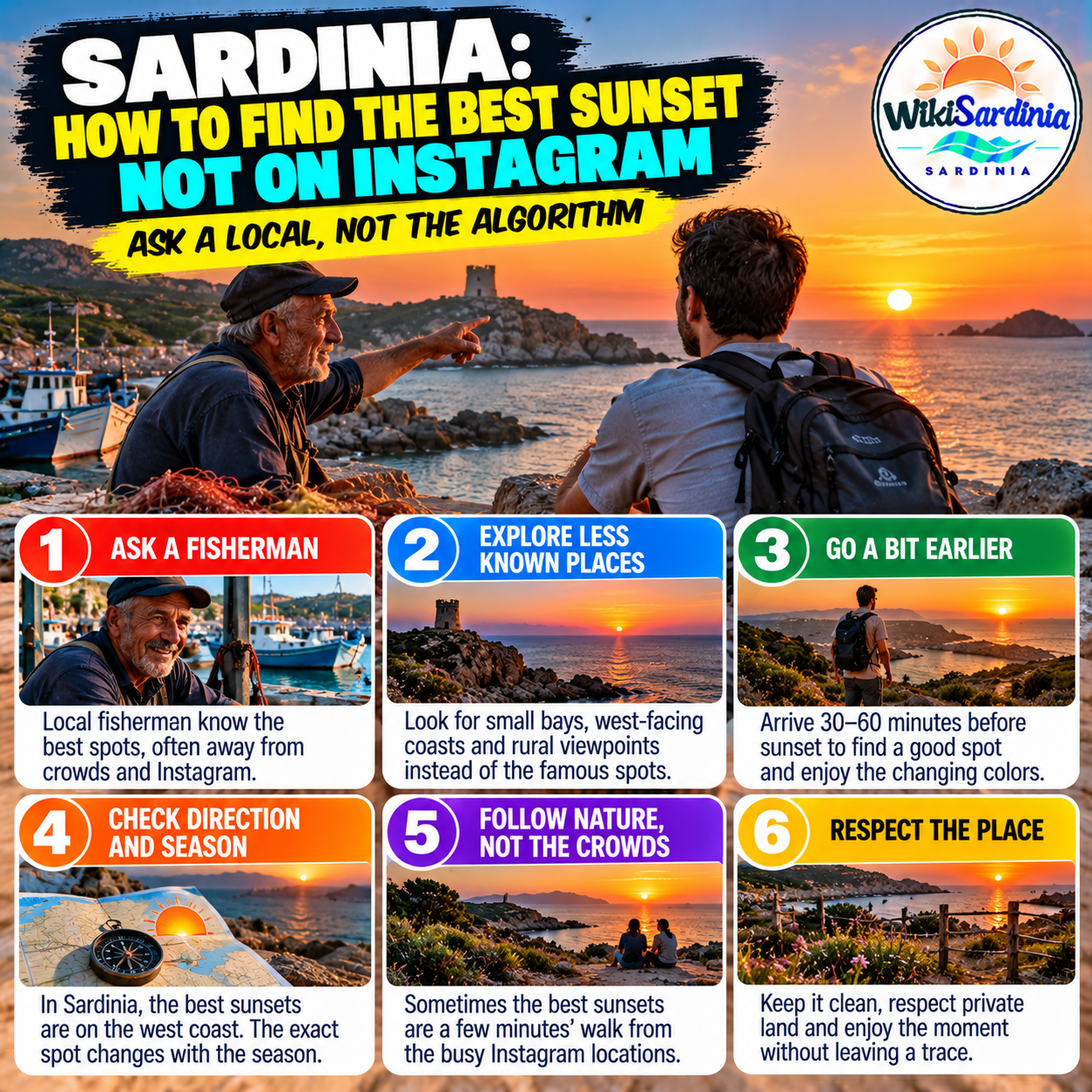
1. Ask a local fisherman
Fishermen often know how the coastline changes with wind, season and sea conditions. If you see someone at a harbour or working near their boat, ask politely whether they can recommend a safe place to watch the sunset. Choose a quiet moment when they are not busy preparing gear or working, and do not expect anyone to share a secret location if they would rather keep it private.
You can ask in Italian: “Mi consiglia un posto tranquillo per vedere il tramonto?” (“Can you recommend a quiet place to watch the sunset?”) You can add: “Un posto sicuro, raggiungibile senza fare escursioni difficili.” (“Somewhere safe, reachable without a difficult hike.”)
2. Look towards the west-facing coast
For a classic view of the sun setting over the sea, start by looking at Sardinia’s western coastline. The exact view depends on the season, the shape of the coast and the direction of the horizon, so a west-facing beach or headland is a useful starting point rather than a guarantee. On the east coast, the sun may set behind hills or inland ridges, creating a different but still beautiful evening scene.
Check a map before you leave and use a sunset-time forecast or a compass app to understand where the sun will appear to meet the horizon. Avoid assuming that every famous beach will have an unobstructed sea sunset.
3. Arrive 30–60 minutes early
Getting there before sunset gives you time to find a comfortable place, notice the light and leave if the access is unsafe or crowded. It also helps you avoid rushing along unfamiliar paths in fading light. Bring water, a light layer for the breeze and a charged phone, but do not rely on mobile coverage in remote areas.
4. Choose quiet, accessible viewpoints
Look for public promenades, established viewpoints and accessible paths a short distance from busy car parks or well-known photo spots. A small bay or a rural viewpoint may be peaceful without being truly hidden. Do not climb fences, cross private land, walk along unstable cliff edges or follow unmarked paths just to get a better picture.
Before travelling, check access restrictions, parking rules and any local notices. Protected areas can have special rules, and a place that appears open on social media may be closed or unsafe at certain times.
5. Follow nature, not the crowd
Instead of copying a viral location, look for the conditions you want: an open horizon, a safe place to sit, a short walk and a route back that remains easy to follow after dark. Sometimes the best alternative is simply another section of a public beach or a viewpoint a few minutes away from the busiest gathering point.
Keep expectations flexible. Clouds, haze and wind can change the colours dramatically, and an overcast evening can still be beautiful. The goal is to enjoy the landscape, not to reproduce someone else’s photograph.
6. Respect the place and the people who live there
- Take all rubbish with you and leave plants, rocks and wildlife undisturbed.
- Keep noise low, especially near homes and small villages.
- Respect private land and follow signs in protected areas.
- Do not block farm tracks, harbour access or residents’ driveways.
- If a local recommends a quiet place, visit responsibly and avoid turning it into a crowded attraction.
What to say when asking for a recommendation
A friendly question can be more useful than scrolling through dozens of photos. Try asking a fisherman, your accommodation host or someone at a local café: “Dove andrebbe lei per vedere un bel tramonto tranquillo?” (“Where would you go to see a beautiful, peaceful sunset?”) Mention whether you are travelling by car, walking or with children so they can suggest something suitable.
Your best sunset may not be a secret spot
You do not need a hidden beach or a viral location to enjoy a memorable Sardinian sunset. Ask someone local, check the direction of the coast, arrive with enough daylight and choose a place that is safe and open to the public. The best view is often the one you can enjoy calmly—and leave exactly as you found it.