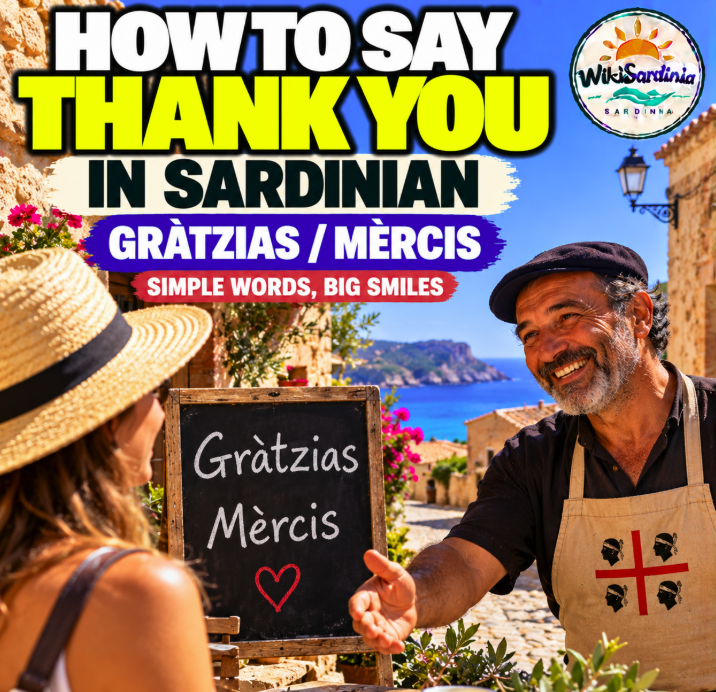
How do you say “thank you” in Sardinian? Two expressions visitors may encounter are gràtzias and mèrcis. Sardinian is not simply Italian spoken with an island accent: it is a Romance language with its own history and considerable regional variation. The spelling, frequency and preferred form of a word can vary between communities and written conventions.
For a traveler, gràtzias is a useful, recognizable Sardinian way of expressing thanks. Mèrcis is another form associated with Sardinian usage, though it should not be presented as the universal everyday choice in every village. Italian grazie is also understood almost everywhere on the island.
Thank you in Sardinian: the short answer
Gràtzias — thank you.
Mèrcis — thanks or thank you, encountered in Sardinian usage, with regional and speaker variation.
In real life, you may hear different pronunciations or local forms. There is no need to pretend that every Sardinian speaker uses the same spelling or expression.
How do you pronounce gràtzias?
As a broad learner's guide, pronounce it with the stress near the beginning: GRAHT-see-ahs. The exact sound of consonants and vowels varies by dialect and speaker. If a local person offers a different pronunciation, follow theirs rather than insisting on a single standardized version.
The written accent in gràtzias can help show stress, but orthographic practices differ. You may also see gratzias without the accent.
What about mèrcis?
Mèrcis is another word for thanks associated with Sardinian. Its resemblance to French merci can make it easy for visitors to remember, but that does not mean it is French spoken in Sardinia. Language contact, local history and variation have shaped the island's vocabulary.
Do not assume mèrcis is equally common in every part of Sardinia. If your goal is to speak naturally, listen to what people around you actually say.
Is Sardinian the same as Italian?
No. Sardinian, or sardu, is a distinct Romance language with varieties traditionally grouped under labels such as Logudorese and Campidanese. Italian is the national language and is widely used in schools, businesses and tourism, while Sardinian remains an important part of the island's cultural identity.
Other languages and linguistic varieties are also present on the island, including Algherese Catalan in Alghero, Gallurese in the northeast and Sassarese in the northwest. These should not all be treated as interchangeable forms of Sardinian.
Can I say grazie in Sardinia?
Absolutely. Italian grazie is understood throughout Sardinia and is the simplest option in hotels, restaurants, shops and tourist services. Trying a Sardinian expression can be a friendly gesture, but nobody expects travelers to know the local language.
Use Sardinian respectfully, without assuming that every person speaks it or prefers it to Italian.
When to use gràtzias
You can use gràtzias when someone helps you find a beach, recommends a restaurant, gives directions or explains a local tradition. Smile and keep it natural.
If the person answers in Italian, continue in Italian. A single sincere word is better than an elaborate phrase assembled from uncertain dialect forms.
Do Sardinians appreciate visitors learning local words?
Many people appreciate respectful interest in local language and culture, although reactions vary from person to person. Ask how a word is said in that town, and be willing to learn a different form.
For example, you might ask in Italian: “Come si dice ‘grazie’ in sardo, qui?” — “How do you say ‘thank you’ in Sardinian here?” That question recognizes local variation rather than treating the entire island as linguistically uniform.
Is there one standard Sardinian spelling?
Written Sardinian has several traditions and proposed standards, including the Limba Sarda Comuna used in certain institutional contexts. Local authors and speakers may use other orthographies. You may therefore see different spellings of the same or similar words online.
For an everyday visitor's guide, it is more helpful to identify the form and acknowledge variation than to declare one spelling the only correct version for all of Sardinia.
Why Sardinian words are worth learning
Learning even one word opens a door to the island's history. Sardinian reflects centuries of local continuity and Mediterranean connections. Its vocabulary and sounds differ noticeably from standard Italian, and its regional forms are an important part of community identity.
Language is also part of travel: a conversation with a market vendor, an artisan or a local guide can teach you more than a memorized list of phrases.
Can I use gràtzias in Alghero?
Yes, it may be recognized, but remember that Alghero has its own Catalan linguistic tradition. You may also encounter Catalan gràcies alongside Italian grazie and other local speech. Avoid describing Algherese Catalan as a Sardinian dialect.
In tourist settings, Italian is a reliable common language. If you are interested in Alghero's linguistic heritage, ask a local speaker which form they use.
What about northern Sardinia?
The linguistic landscape of northern Sardinia is especially varied. Logudorese Sardinian, Sassarese, Gallurese and other local speech traditions coexist across different areas. That is another reason to avoid a one-size-fits-all claim about the most common way to say thank you.
When in doubt, use grazie or ask the person you are speaking with how they would say it locally.
How to write thank you in a travel message
If you are leaving a short note to a host, you can write “Gràtzias!” as a friendly gesture. A longer message is usually best written in a language you know well unless a local speaker has checked the wording.
For a public post or a printed sign, especially one claiming to represent a specific Sardinian variety, consider having a native speaker review the text.
Should you use accents?
For a short informal message, readers may encounter both accented and unaccented forms, such as gràtzias and gratzias. Accents can help indicate pronunciation, but orthography is not identical across all regional traditions.
The safest approach for a culturally sensitive project is to choose a consistent written convention and, where possible, ask a speaker of the variety you are using.
Five practical situations for saying thank you
- At a café: after receiving your coffee, a simple gràtzias can be a friendly gesture.
- At a market: thank someone for explaining a local product.
- On a hiking trail: thank someone who points you toward the correct path.
- At a guesthouse: thank your host for local advice.
- During a cultural tour: ask the guide how thanks is expressed in the local variety.
Common mistakes to avoid
Don't call Sardinian “broken Italian.” It is a language in its own right.
Don't assume all islanders speak Sardinian. Language use differs by family, age, place and context.
Don't treat gràtzias and mèrcis as the only possible forms. Regional variation is real.
Don't confuse Sardinian with Algherese Catalan, Gallurese or Sassarese. The island's linguistic heritage is diverse.
Don't overcomplicate a polite moment. Italian grazie is always a practical choice.
Frequently asked questions
How do you say thank you in Sardinian?
Gràtzias is a useful Sardinian expression for “thank you.” Mèrcis is another form encountered in Sardinian usage.
Is it gràtzias or gratzias?
Both accented and unaccented spellings may appear, depending on the writing convention.
Does mèrcis mean thank you?
Yes, it is associated with expressions of thanks, although its usage and familiarity vary locally.
Is Sardinian a dialect of Italian?
No. Sardinian is a distinct Romance language.
Will people understand grazie?
Yes. Italian is widely spoken and understood throughout Sardinia.
What language do people speak in Alghero?
Italian is widely used, and Alghero also has a historic Catalan language variety, Algherese.
Do all Sardinians say gràtzias?
No. The island has regional linguistic variation, and many people use Italian grazie in everyday interactions.
How do I ask a local person for the right word?
Ask: “Come si dice ‘grazie’ in sardo, qui?”
Can I use gràtzias on a postcard?
Yes, as a friendly informal expression. For longer or formal texts, consider checking with a local speaker.
What's the best word for tourists to learn?
Gràtzias is a memorable starting point; Italian grazie remains universally practical.
The bottom line
If you want to say “thank you” in Sardinian, start with gràtzias. You may also encounter mèrcis. Both belong in a discussion of Sardinian expressions of thanks, but neither should be presented as the sole form used everywhere on the island. Learn the word, listen to local speakers and enjoy discovering Sardinia's linguistic diversity.
Further reading
Regione Autonoma della Sardegna — regional information and language-policy resources; SardegnaTurismo — island culture and travel information; UNESCO — linguistic diversity. Editorial note: regional spellings and pronunciations should be checked with a qualified local speaker before being used in formal teaching materials.