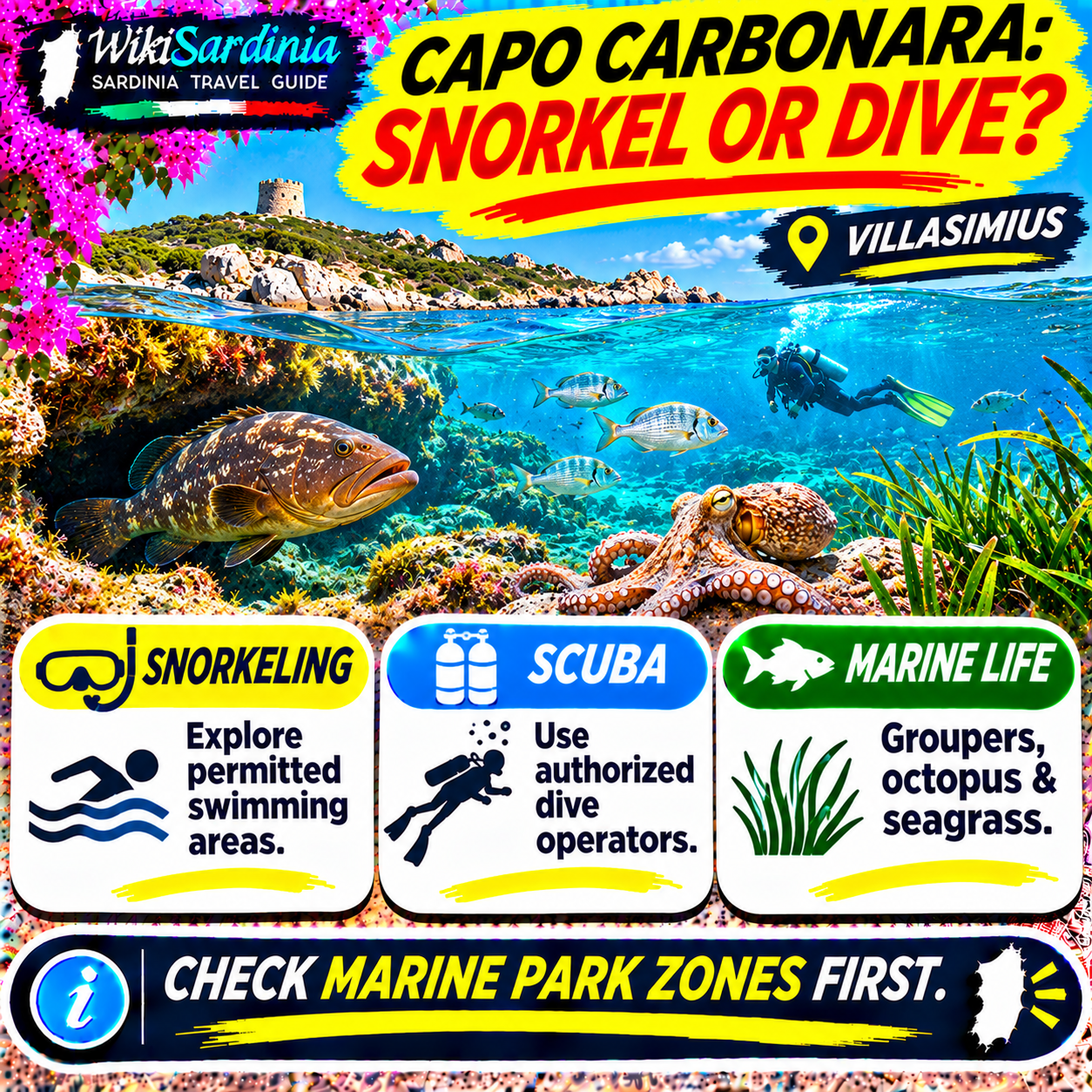
Yes. Capo Carbonara, at Villasimius on Sardinia’s southeastern coast, is an excellent destination for snorkeling and scuba diving. Its protected waters contain granite reefs, underwater crevices, seagrass meadows and a wide variety of Mediterranean marine life. You may see groupers, seabream, octopuses, moray eels and schools of fish; more unusual encounters are possible but never guaranteed. The essential detail is that Capo Carbonara is a marine protected area: you cannot assume that swimming, snorkeling, scuba diving and boat access are permitted everywhere under the same rules.
Why is Capo Carbonara good for underwater exploration?
The Area Marina Protetta Capo Carbonara extends around the Villasimius coast, including Isola dei Cavoli, Serpentara and several offshore shoals. Its habitats include rocky seabeds, granite formations, caves and crevices, and Posidonia oceanica meadows. Official Italian tourism information identifies groupers, dentex, greater amberjack, seabream, octopus, moray eels and other species. Marine biodiversity is the attraction, not the certainty of seeing any one animal. Italia.it — Capo Carbonara Marine Protected Area.
Is it better for snorkeling or scuba diving?
Both are worthwhile, but they suit different visitors. Snorkeling lets you enjoy clear shallow water, fish and seagrass without tanks, from beaches or permitted coastal access points. Scuba diving with a qualified operator allows access to deeper reefs, walls, shoals and specialist sites, depending on certification, sea conditions and park authorizations. You do not need scuba certification to enjoy snorkeling, but you should be comfortable swimming and understand local conditions. Beginners should choose a sheltered area and, ideally, a guided introduction.
Where can you snorkel near Villasimius?
Potential shore-based starting areas include the rocky margins of Cala Caterina, Porto Giunco and other accessible beaches around Villasimius, where swimming is currently permitted. These are suggestions for choosing a suitable public access area, not promises that every rock or offshore reef can be reached safely from shore. The best place on the day depends on wind direction, waves, visibility, boat traffic and the exact protected-area zone. Ask the marine park or a local guide about a safe entry and exit point. Avoid swimming across channels or toward offshore islands.
What about Isola dei Cavoli and Serpentara?
Isola dei Cavoli and Serpentara are among the area's iconic marine landscapes, but they are not unrestricted islands where visitors can land, anchor or snorkel wherever they like. Parts of their surrounding waters are subject to stricter zoning, including integral-protection sectors. If you want to see the offshore reefs, book a properly authorized guided excursion and ask exactly which site and activity the trip includes. A sightseeing boat cruise does not necessarily include snorkeling, and a snorkeling trip does not automatically include scuba diving.
Which scuba sites are famous?
Official SardegnaTurismo information highlights the Variglioni for schools of barracuda and the Secca di Cala Caterina for large groupers and other fish. The marine park's official technical material also identifies designated dive and seawatching sites around the reserve. A local dive center will select a site based on the day's weather, your qualifications and the applicable permits. Do not attempt an offshore dive based only on a place name from a travel blog. SardegnaTurismo — Capo Carbonara.
What marine animals might you see?
Common or documented marine life includes groupers, seabream, damselfish, wrasse, salema, octopuses, moray eels and other rocky-reef fish. Offshore reefs may also attract barracuda, amberjack and dentex. Seagrass meadows shelter small fish and invertebrates. Dolphins are occasionally reported in the broader area, but they should be treated as an exceptional sighting rather than an advertised guarantee. Seeing animals depends on season, depth, habitat, visibility and chance. Never chase, feed or touch marine life to improve a photograph.
How do the marine protected area's zones work?
The park divides its waters into Zones A, B, C and D, each with different protection and activity rules. Zone A is the strictest: ordinary swimming and snorkeling are not permitted, and access is tightly controlled. Zones B, C and D generally permit swimming and breath-hold activity subject to park rules and any additional restrictions. Scuba diving with tanks is more tightly regulated, and the rules for recreational individual dives differ from authorized guided operations. Never treat the entire reserve as one open-access diving site. Consult the official zoning overview and activities-permitted rules before entering a specific area.
Can you scuba dive independently?
Do not assume you can. The national execution regulation places significant restrictions on scuba diving in different zones and requires authorization in the areas where certain independent dives are permitted. Guided dives by authorized operators follow specific conditions and designated sites; some protected sectors allow only narrowly defined authorized activities. The safest practical choice for visitors is to use a local dive center authorized to operate in the marine protected area, confirm the actual site and follow its briefing. Being a certified diver does not exempt you from marine park rules. Italian Ministry of the Environment — execution regulation.
Do you need permission just to snorkel?
For ordinary surface swimming and snorkeling in permitted Zones B, C and D, the published national regulation generally allows swimming, subject to local orders and site-specific restrictions. Zone A is different and ordinary bathing is prohibited. Specialized organized seawatching, boat-based activities and access to certain designated sites may have separate authorization requirements. Check the park map and signage rather than relying on the assumption that any clear-water cove is open. Official marine protected area map.
Are beginners welcome at scuba centers?
Many diving centers offer introductory experiences for non-certified visitors as well as guided dives for certified divers, but availability, minimum ages, medical screening and maximum depth depend on the provider and training standards. Ask whether an experience is a supervised introductory dive or a certified-diver excursion, what equipment is included and whether the operator is authorized for the intended marine park site. If you have never dived before, do not book an advanced deep-water site simply because it looks spectacular in photos.
What should certified divers ask before booking?
Tell the operator your certification level, number of recent dives, last dive date and comfort with currents or boat entries. Ask about the planned dive site, depth, duration, group ratio, equipment rental, insurance, marine park permissions and cancellation policy. Some sites require more experience than others. Carry any certification evidence requested by the center and follow its fitness-to-dive screening. The operator may change the site on the day if weather or conditions make the original plan unsuitable.
Is snorkeling suitable for children?
Yes, in an appropriate calm, shallow swimming area and with close adult supervision. Choose a beach with a straightforward entry, no strong current and good visibility; children should not be encouraged to swim out to offshore reefs. Properly fitted masks and buoyancy aids can help, but they do not replace supervision. Be aware of rocks, sea urchins, occasional jellyfish and boat traffic. A guided family snorkeling experience can be useful when you are unfamiliar with local conditions.
When is the best season for diving and snorkeling?
Late spring through early autumn is a popular period for sea activities, with generally warmer water in summer and early autumn. Diving may be offered outside this period by operators when conditions permit, but availability and water temperature vary. The key factor for visibility and safety is often the day's wind and sea state, not just the month. The Villasimius coast can be exposed to changing conditions, so ask a local operator which side of the promontory is sheltered that day.
How clear is the water?
Capo Carbonara is known for clear Mediterranean water, especially in settled conditions. However, visibility can change with wind, waves, suspended sediment and recent weather. Do not promise a fixed underwater visibility distance. If photography or spotting marine life is your main priority, ask a local diving center for the current conditions and whether a morning or afternoon outing is preferable.
Can you touch the seabed, collect shells or feed fish?
No wildlife encounter should involve touching, collecting or disturbing protected habitats. Keep fins clear of the seabed, avoid standing on seagrass or fragile organisms, do not handle octopuses or starfish, and never feed fish. Take nothing from the sea. Spearfishing is prohibited throughout the marine protected area, and other fishing activities have specific rules. If you use a boat, do not anchor on Posidonia meadows or ignore designated moorings. Responsible snorkeling is about observing, not interacting physically with the animals.
Are there wreck dives?
The wider Capo Carbonara area has a rich maritime history and documented underwater archaeological remains. However, the presence of wrecks does not mean tourists may dive on or enter every wreck. Archaeological protection, site zoning, depth and technical requirements may apply. Ask an authorized operator which wreck or heritage dives are legitimately offered for your certification and date. Never remove artifacts or enter an overhead environment without appropriate training and authorization.
How much does a dive cost?
There is no single official price for scuba diving or snorkeling across Villasimius. Costs vary with boat transport, number of dives, equipment rental, instruction, park-related charges and season. Request a clear quote stating whether the price includes wetsuit, tanks, weights, guide, boat transfer, insurance and any applicable authorization fees. Avoid comparing a shore snorkel rental with a fully guided offshore scuba excursion as if they were the same product.
Where should you stay?
Villasimius is the most convenient base for the Capo Carbonara marine protected area, with access to beaches, the marina and local excursion services. Staying near Porto Giunco or Cala Caterina may appeal to travelers focused on the coastline, but exact transport and walking access depend on the accommodation. If you are based in Cagliari, a day trip is possible by road, although a morning dive departure may make an overnight stay more comfortable. Confirm the dive center's meeting point before booking lodging.
How do you book a responsible underwater excursion?
- Choose your activity: shore snorkeling, guided seawatching, introductory scuba or a certified dive.
- Check the official marine park rules: identify the zone and whether the planned activity needs authorization.
- Contact a local authorized operator: provide ages, swimming ability or dive certification and preferred dates.
- Confirm the details: departure point, equipment, language, price, duration, cancellation terms and weather policy.
- Follow the guide and protect the habitat: never enter closed areas, touch marine life or anchor on seagrass.
Useful Italian phrases
“Vorrei fare snorkeling a Capo Carbonara.” — I'd like to go snorkeling at Capo Carbonara. “Siete autorizzati a operare nell'area marina protetta?” — Are you authorized to operate in the marine protected area? “Quali siti sono adatti ai principianti?” — Which sites suit beginners? “L'attrezzatura è inclusa?” — Is equipment included? “Serve un'autorizzazione per immergersi?” — Is a diving permit required? “Com'è la visibilità oggi?” — How is visibility today?
Official sources and contacts
Area Marina Protetta Capo Carbonara — official website; Official permitted activities; Official marine park zones; Official zoning map; Italian Ministry of the Environment — detailed regulations; SardegnaTurismo — Capo Carbonara; Italia.it — snorkeling and marine life. Park office: Via Roma 60, 09049 Villasimius; telephone +39 070 790234; email info@ampcapocarbonara.it. Confirm current rules, any temporary closures and operator authorizations before travel.
The WikiSardinia takeaway
Capo Carbonara is a superb choice for both snorkeling and scuba diving, especially if you want to see Mediterranean reef fish and seagrass habitats in protected waters. Beginners can enjoy permitted shallow swimming areas in calm conditions, while qualified divers can explore specialist sites through properly authorized operators. The one rule to remember: check the marine park zone first. A beautiful reef is not automatically open to every activity.