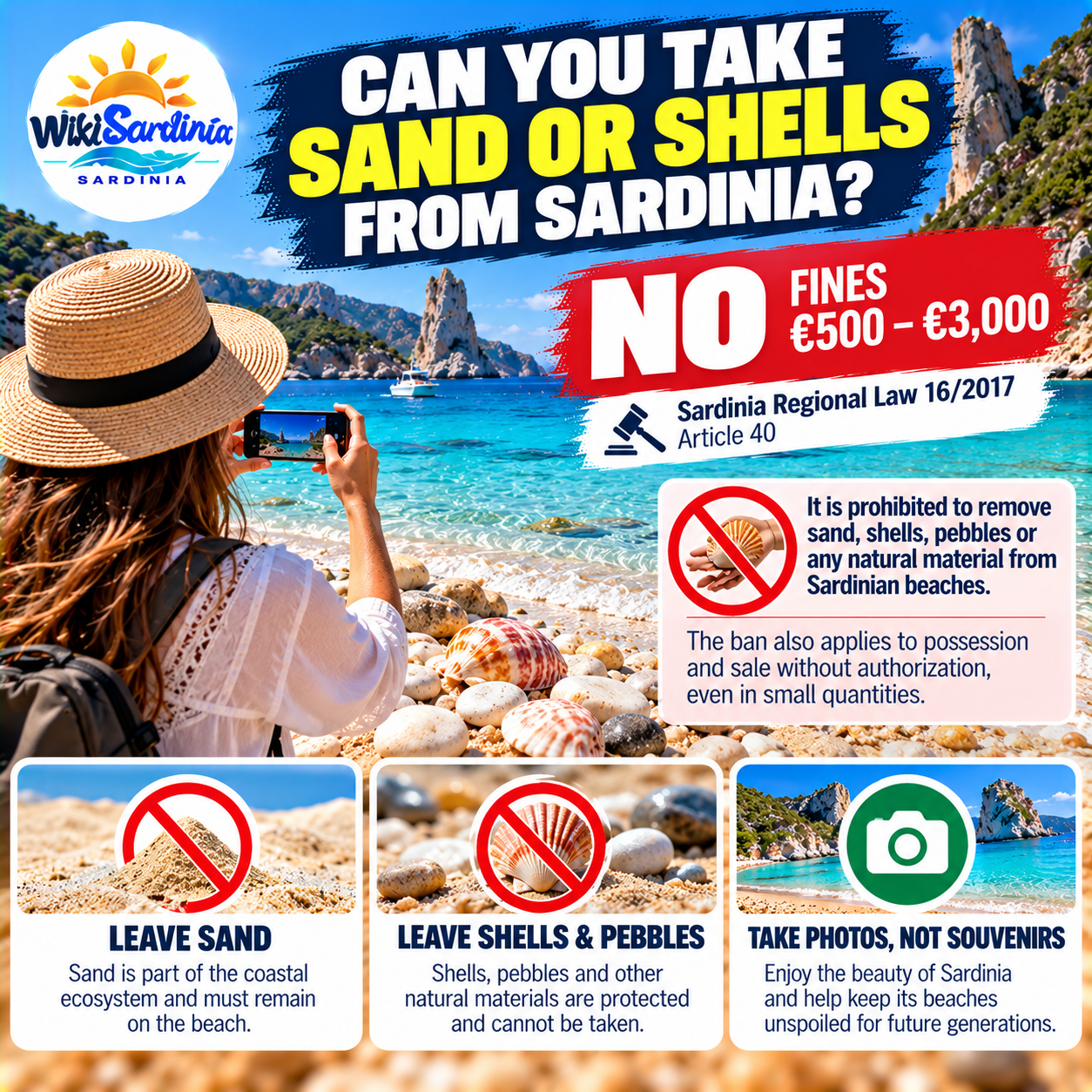
It may look like the perfect souvenir: a tiny bottle of white sand, a handful of shells or a smooth pebble picked up on a beautiful Sardinian beach. But taking sand, seashells, pebbles or stones from Sardinia's coastline without authorisation is prohibited, and the administrative fine can range from €500 to €3,000. This is not an internet myth. It is an established regional rule, reaffirmed by the Sardinian authorities in 2026.
For American and other international visitors, the most useful advice is simple: enjoy the beach, photograph it, but leave its natural materials where they belong.
Is taking sand from Sardinian beaches actually illegal?
Yes. Article 40, paragraph 2, of Sardinia's Regional Law No. 16 of 28 July 2017 provides an administrative penalty for anyone who, without the required authorisation or concession, removes, possesses or sells even small quantities of sand, pebbles, stones or shells originating from the coast or sea.
The law explicitly includes small quantities. There is no general exemption in the provision allowing visitors to take a little sand in a jar or a few shells for personal memories. The same rule is not limited to commercial collectors or people selling souvenirs.
The Autonomous Region of Sardinia reiterated the prohibition in a July 2026 beach-protection notice, which sets out the €500–€3,000 penalty range in both Italian and English.
How much is the fine for taking sand or seashells?
The regional administrative penalty is €500 to €3,000. That is the statutory range, not a promise that every visitor will receive the same amount or that every case automatically attracts the maximum fine. The competent authorities assess and enforce violations under the applicable rules.
The law covers taking, possessing and selling protected coastal materials without authorisation. Visitors should therefore not assume that a bag of sand becomes legal simply because it has already been packed into luggage or taken away from the beach.
Are seashells illegal to collect too?
Yes. The regional provision expressly lists shells alongside sand, pebbles and stones. This is a common point of confusion because collecting an empty shell may seem harmless compared with taking a large quantity of sand. But the regional rule does not create a blanket souvenir exception for empty shells.
Shells are also part of coastal ecosystems. They can contribute to beach sediments and provide material or shelter for organisms. Some shells may come from protected species, which can raise additional conservation concerns. For an ordinary beach visit, the safest approach is to leave all shells in place.
What about a single pebble or a tiny bottle of sand?
Even small amounts are covered by the wording of Article 40. You should not interpret the rule as applying only to people filling buckets, suitcases or commercial containers. A souvenir bottle may be small, but multiplied by many visitors the cumulative removal can be substantial.
The Sardinian Forestry Corps has explained that beaches take extremely long periods to form and that widespread souvenir collecting can remove large amounts of natural material over time. A visitor who takes a tiny quantity may not notice any immediate change, but the environmental impact accumulates.
Why is Sardinia so strict about beach souvenirs?
Sardinia's beaches are a major part of the island's environmental and cultural heritage. Their sand is shaped by local geology, shells and other natural processes. Some beaches have distinctive colours or grain sizes that cannot be replaced quickly once removed.
There is also a practical enforcement problem: if every visitor assumes that taking “just a little” is acceptable, the total can become significant. Rules that prohibit removal altogether are clearer than rules requiring authorities to judge whether each individual souvenir is sufficiently small.
The aim is conservation rather than punishing curiosity. You can appreciate the unusual sand, photograph it and learn how it formed without taking it home.
Do authorities actually enforce the ban?
Yes. Controls have taken place on beaches and at transport departure points, including airports and ports. Sardinia's Forestry Corps, municipalities and other authorised bodies can participate in monitoring and enforcement.
In October 2025, ANSA reported that more than 900 kilograms of sand, shells and pebbles had been seized in the Olbia port and airport area over the 2020–2025 period. The report cited 198 violation notices and a total of €110,000 collected in penalties during that period.
These are reported figures for that area and period, not island-wide annual totals. They nevertheless show that the ban is enforced in practice rather than existing only on signs.
Can you be stopped at the airport or ferry terminal?
Yes. Authorities have reported seizures involving people preparing to leave Sardinia. Materials may be discovered during controls at ports or airports, and being on your way home does not make possession lawful.
For example, Rai News reported in May 2026 that a traveller was stopped at Porto Torres with approximately 40 kilograms of sand, pebbles and shells allegedly taken from the Stintino coast. The materials were seized and the applicable regional penalty range was cited.
Visitors should not view such cases as an invitation to test how much they can carry unnoticed. The lawful and environmentally responsible choice is not to remove the material in the first place.
Is it only forbidden at famous beaches such as La Pelosa?
No. The regional rule concerns materials originating from Sardinia's coast or sea, not only its most photographed destinations. A quieter or less-developed beach is not automatically exempt. Local protected areas may also impose additional restrictions.
Whether you are visiting La Pelosa, the beaches near Chia, the Costa Smeralda, the Gulf of Orosei or a secluded cove, assume that sand, shells and pebbles should stay where they are unless a competent authority has explicitly authorised their removal.
Can you buy Sardinian sand as a souvenir?
The regional provision also addresses selling coastal materials without proper authorisation. A product offered for sale is not automatically legal just because a shop or online listing describes it as a souvenir.
If you want something to remember the island by, choose locally made ceramics, textiles, food products or other goods sold through legitimate businesses rather than natural material removed from the coastline.
What if sand accidentally sticks to your shoes or towel?
Ordinary beach visits naturally leave a little sand on clothing and belongings. The sensible precaution is to shake towels, rinse feet and empty shoes before leaving, rather than deliberately collecting or packing beach material.
The law should not be sensationalised into a claim that every microscopic grain accidentally carried away automatically results in a fine. The clear issue for travellers is the unauthorised removal or possession of coastal material, including intentionally collected small quantities.
What other beach rules should tourists know?
The Sardinian Region's 2026 public-information campaign also highlighted rules intended to protect dunes, prevent littering and regulate camping. Its published summary listed fines of €100–€1,000 for prohibited dune access or vehicle access, and separate penalties for littering and unauthorised camping.
Specific rules can vary by protected area and municipality, so always read local signs. Staying on marked paths, avoiding fragile vegetation and respecting nesting areas are important even where entry to the beach itself is free.
Why do people sometimes talk about Sardinia's pink sand?
Some of Sardinia's most famous coastal landscapes include unusual sand colours associated with natural mineral and biological fragments. The appeal of these places can make souvenir collecting particularly tempting. Yet the very features that make the beaches distinctive are the ones that need protection.
Photographs, sketches and memories are much better souvenirs than a jar of irreplaceable sand. Do not remove material from a beach simply because it looks unusual, pink, white or particularly fine.
What should you do if you already collected sand or shells?
Do not attempt to sell, conceal or transport the material off the island. If you are still nearby, avoid causing further disturbance and seek guidance from the relevant local authority or Forestry Corps about appropriate handling. In particular, do not assume that returning material to an arbitrary beach is environmentally harmless: moving sediments between locations can itself be undesirable.
For future visits, keep your beach bag free of collected natural souvenirs.
The verdict: are the huge fines real?
Yes. Sardinia prohibits unauthorised removal, possession or sale of even small quantities of sand, shells, pebbles and stones from its coastline, with administrative fines ranging from €500 to €3,000. The rule is grounded in Regional Law 16/2017 and was publicly reaffirmed by the Region in 2026. Enforcement cases demonstrate that the prohibition is real.
The best souvenir is a photo—and the knowledge that the beach will still be there for the next visitor to enjoy.