At the edge of Alghero, where the old town gives way to the open sea, stands a building that seems to belong to another age. With its crenellated roofline, secluded gardens and walls overlooking the waves, Villa Las Tronas could pass for the private castle of a forgotten royal family. Its real history is even more interesting: a nineteenth-century hunting retreat, a radical architectural makeover, guests from Europe's ruling dynasties, and a second life as one of Sardinia's best-known historic hotels.
But there is one important distinction. Villa Las Tronas was never a medieval royal castle. Its association with royalty comes from the people who visited it, not from its original purpose or ownership. Understanding that makes the story more, rather than less, extraordinary.
A nineteenth-century beginning: a hunting lodge above the sea
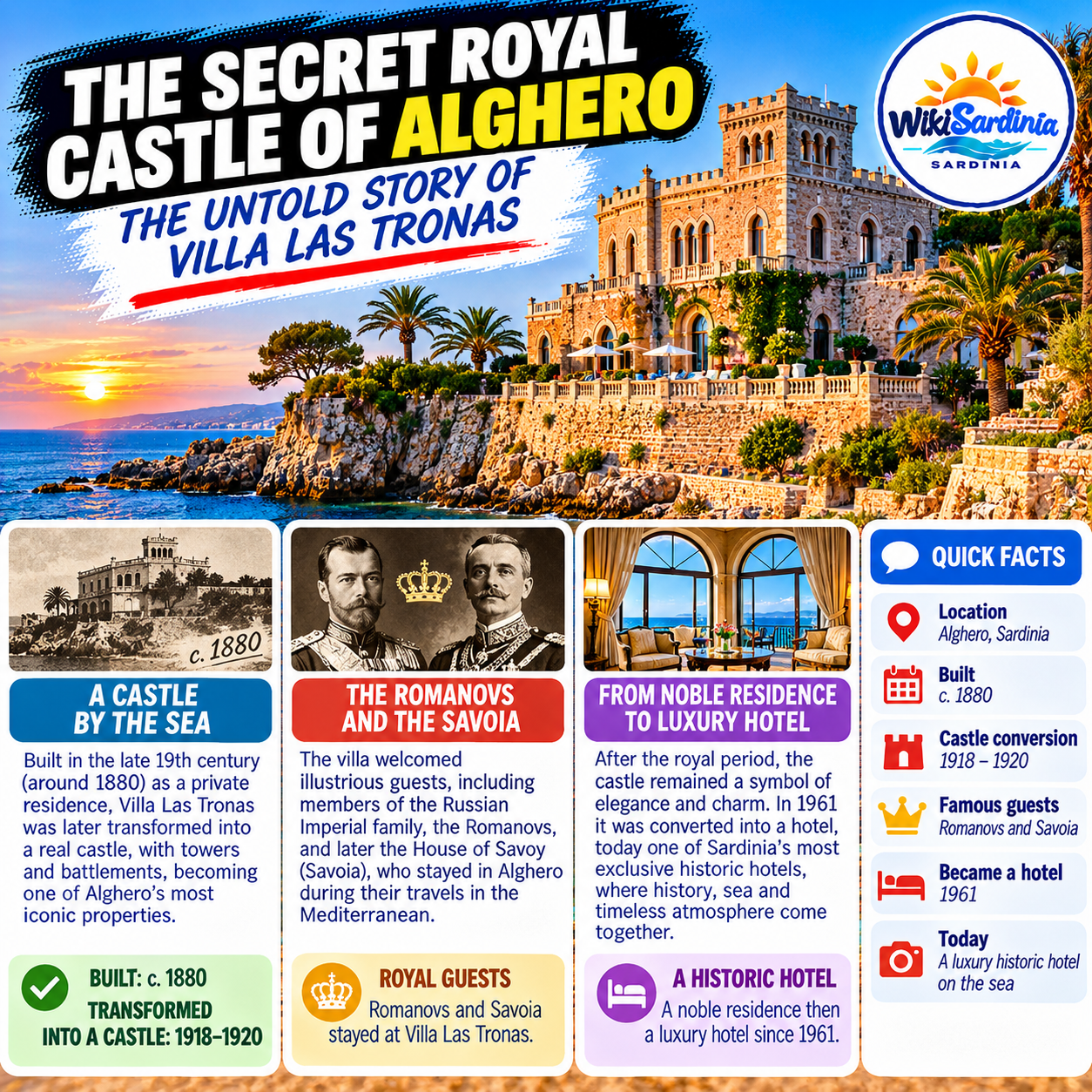
According to accounts published by the villa itself and by local heritage organisations, the property began around 1880 under Alessandro, third Count of Sant'Elia. The residence was built on the site of an older coastal watchtower and was initially intended as a hunting lodge. Its dramatic setting—a promontory between Cala Lavatoio and Cala Capone—gave it privacy and uninterrupted views across Alghero's gulf.
The name Las Tronas is traditionally translated from the Algherese language as “the pulpits”, referring to the shapes of rocks around the promontory. Much of that rocky outline has been altered by the action of the sea, but the name survives as a reminder that this place was recognised long before the hotel became famous.
How a private villa became a castle
The towers and battlements that visitors recognise today do not date to the Middle Ages. The most important transformation took place between 1918 and 1920 under Don Luigi Arborio Mella, fourth Count of Sant'Elia. The villa's own historical account attributes a central role in the project to his English wife, Lady Rosamond Marke Wood.
The design followed a fashion familiar in aristocratic Europe: country residences and seaside retreats were remodelled with romantic references to medieval fortresses. Pointed arches, crenellations and a picturesque turret turned a practical private dwelling into a theatrical landmark. SardegnaCultura, the regional cultural heritage portal, likewise describes Villa Sant'Elia as an example of the medieval-castle model employed in noble residences of the nineteenth and twentieth centuries.
It was therefore a castle in appearance, not in medieval military function. That distinction separates architectural history from the tempting but misleading idea of an ancient fortress.
The Romanovs and the House of Savoy: what is documented?
The royal connection is real, although it is important not to exaggerate it. Fondazione Alghero records that members of the Italian House of Savoy and of the Russian imperial Romanov family stayed at the property. The villa's official history describes Romanov princesses and Italian royals among its recurring aristocratic guests, visiting for sea bathing in summer and hunting in winter.
That does not mean the Russian imperial family owned the castle, or that the Italian monarchs built it. The estate belonged to the Sant'Elia family. Nor do the public sources cited here establish a complete guest register, exact dates for each royal stay, or a dramatic secret diplomatic meeting. The evidence supports an impressive social history without the need to invent one.
The hotel also preserves a particularly evocative claim: two sitting-room sets displayed in its Pink Room were gifts from the Romanovs to Don Luigi. This detail comes from the property's own account and offers a tangible link between the villa's interiors and its aristocratic past.
An Alghero that welcomed elite travellers long before mass tourism
Villa Las Tronas makes more sense when viewed as part of Alghero's changing waterfront. The city's museum network notes that aristocratic tourism was developing here from the second half of the nineteenth century. By the early twentieth century, wealthy families were commissioning residences around the seafront, creating an architectural landscape that combined picturesque villas, gardens and Art Nouveau influences.
The villa stands apart because of the way its rocky site projects into the water. Rather than sitting along a conventional street of mansions, it occupies its own promontory, within sight of the city but seemingly separate from it. This geography helped create the aura of a private world.
From a noble residence to a celebrated hotel
The twentieth century brought a decisive change of ownership and purpose. SardegnaCultura records the villa's sale in 1959 for conversion into a hotel. A historical press account issued by Villa Las Tronas names the buyers as Leonardo Masia and Giuseppina Fonnesu and explains that further building work in 1961 shaped the property into the hotel that followed. The official hotel site identifies 1961 as the start of its hotel life.
The new chapter brought a different set of celebrated visitors. Historical accounts associated with the villa mention playwright Samuel Beckett and film stars Elizabeth Taylor and Richard Burton, alongside other cultural figures. The older aristocratic retreat had become a place where cinema, literature and international tourism intersected.
Is Villa Las Tronas a real royal castle?
Not in the literal sense. It is a historic noble residence built around 1880 and remodelled to resemble a castle in the early twentieth century. The Romanov and Savoy associations are tied to documented visits, not to its original ownership as a royal palace. This is precisely why the building is unusual: it tells the story of an age when Alghero's coast was an elite retreat before Sardinia became an internationally recognised holiday destination.
How to see Villa Las Tronas today
Villa Las Tronas remains a privately operated hotel at Lungomare Valencia 1, Alghero. It is not a public medieval castle with unrestricted access to rooms, grounds or terraces. Visitors can appreciate its striking silhouette and setting from public viewpoints along the nearby waterfront, while anyone hoping to enter the property should check arrangements directly with the hotel.
For a broader perspective, combine a walk along the Lungomare with Alghero's real medieval and early-modern defensive walls. The contrast is a useful reminder: the old city fortifications were built for defence, while Las Tronas adopted the romantic language of fortresses centuries later.
The real secret is the history itself
The image of a secret royal castle is irresistible, but Villa Las Tronas does not need invented passages, missing crowns or fictional intrigue. Its true timeline is rich enough: a hunting lodge above the sea, the ambitions of the Sant'Elia counts, an English aristocratic influence on its architecture, visitors linked to the Romanovs and Savoy dynasty, and a remarkable transition to hospitality.
Standing on the Alghero waterfront and looking out to its battlements, you are not looking at a forgotten medieval kingdom. You are looking at a rare surviving stage set for an extraordinary chapter of Sardinia's modern social history.
Frequently asked questions
When was Villa Las Tronas built?
Its origins date to approximately 1880, when Alessandro, third Count of Sant'Elia, established a hunting residence on the promontory.
Did the Romanovs visit Villa Las Tronas?
Yes. Fondazione Alghero and the villa's own historical account identify Romanov family members among its distinguished guests. Publicly available descriptions do not establish an exhaustive list of names and visit dates.
Was Villa Las Tronas owned by the House of Savoy?
The sources cited here describe visits by members of the House of Savoy, not ownership of the villa by the royal dynasty. The property belonged to the Sant'Elia family before its twentieth-century sale.
Why does it look medieval?
Major alterations in 1918–1920 gave the residence a romantic, castle-like appearance inspired by medieval architecture.
Can tourists tour the castle?
It is a private hotel, not an open-access public monument. Check directly with the hotel for any permitted visits or reservations.