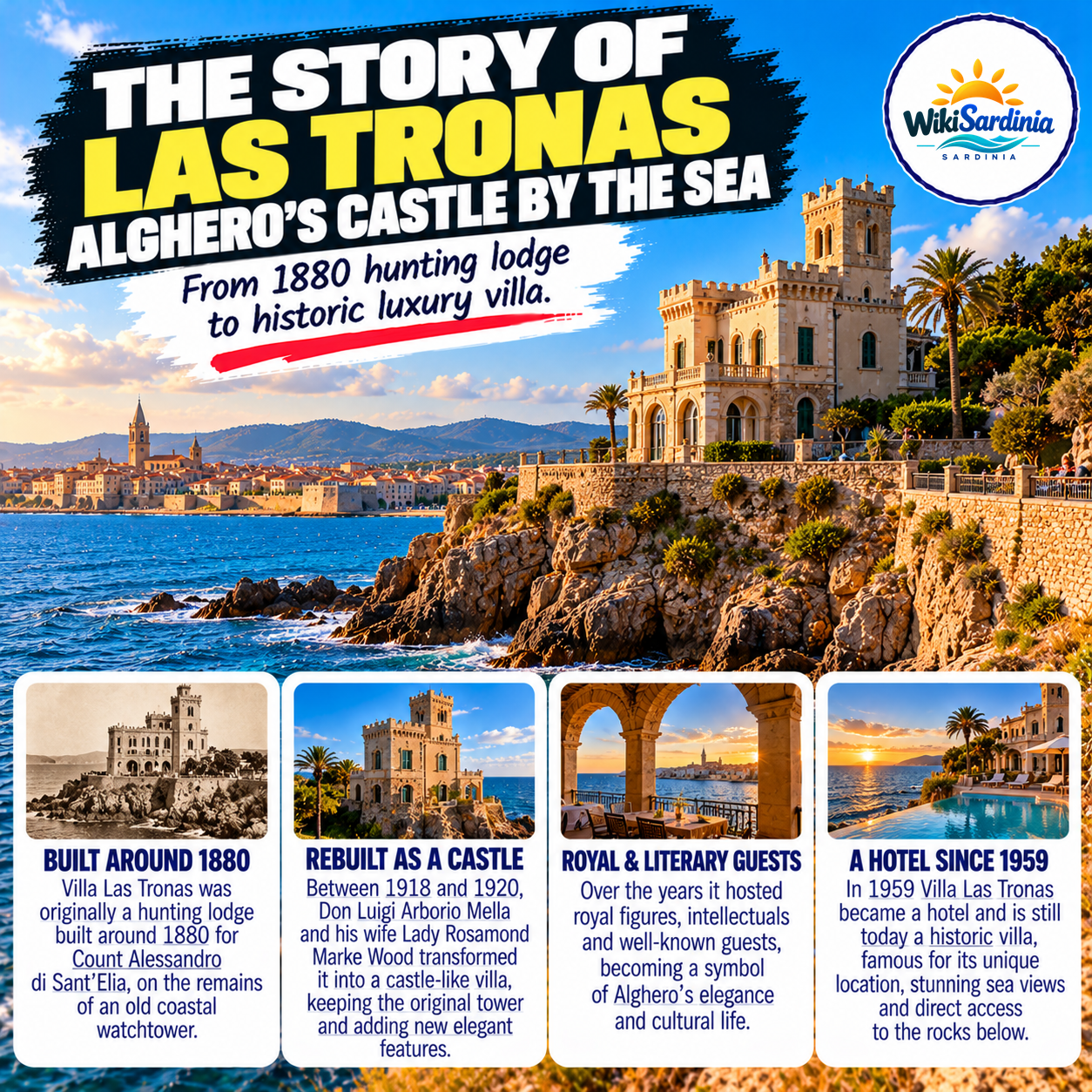
Perched on a rocky promontory just beyond Alghero’s historic centre, Villa Las Tronas looks like a small castle rising straight from the sea. Its towers, battlements and dramatic setting have made it one of the most recognisable landmarks on the Riviera del Corallo. Yet the building is not a medieval fortress: its story belongs largely to the late nineteenth and early twentieth centuries.
Why is it called Las Tronas?
The name Las Tronas is linked to the Algherese word traditionally interpreted as “the pulpits,” referring to the shape of the rocks that rise from the sea near the promontory. The villa stands between small coves along Lungomare Valencia, in a position that feels secluded while remaining close to the city.
It began as a hunting lodge around 1880
The story of the villa begins around 1880, when Alessandro, the third Count of Sant’Elia, had a residence built on the remains of an older coastal watchtower. It was initially intended as a hunting lodge, reflecting a time when wealthy families were beginning to use the Sardinian coast for leisure and seasonal retreats.
The original building did not yet have the full castle-like appearance that visitors recognise today. That look developed through later renovations, inspired by the romantic taste for medieval forms that was popular in grand villas and aristocratic residences of the era.
The transformation into a castle-like villa
Between 1918 and 1920, Don Luigi Arborio Mella, the fourth Count of Sant’Elia, and his English wife, Lady Rosamond Marke Wood, carried out a major renovation. The villa acquired towers, battlements and other architectural details that gave it the appearance of a small medieval castle overlooking the water.
Luigi was connected to the royal court, and Las Tronas became a place for aristocratic guests and society figures. Members of the House of Savoy and the Russian imperial Romanov family were among the visitors associated with the villa in its years as a private residence.
War, history and Antoine de Saint-Exupéry
During the Second World War, the property was used first by the German air command and later by the Allied air command. The villa’s wartime history adds a more complex chapter to its image as a glamorous seaside retreat. The French writer and aviator Antoine de Saint-Exupéry, best known for The Little Prince, also spent time in the Alghero area and is associated with Las Tronas in local historical accounts.
From aristocratic residence to hotel
In 1959, the villa was sold to Leonardo Masia and Giuseppina Fonnesu, who turned it into a hotel. Further work in 1961 helped shape the building’s present appearance. The property welcomed guests from the worlds of literature, theatre and cinema, including playwright Samuel Beckett and actors Virna Lisi, Ugo Tognazzi, Elizabeth Taylor and Richard Burton, according to historical accounts of the hotel.
Over time, Villa Las Tronas became a symbol of high-end hospitality in Alghero, known for its position above the sea, its gardens and its distinctive architecture. Its identity as a hotel grew alongside the city’s development as a destination for visitors from Italy and abroad.
Is Villa Las Tronas really a castle?
In appearance, it certainly evokes one. Historically and architecturally, however, it is better described as a nineteenth-century villa remodelled in a castle-like style. SardegnaCultura identifies it as Villa Sant’Elia and notes that later additions changed its original volume and appearance. The medieval details are part of the architectural language chosen during the renovation, not proof that the building dates from the Middle Ages.
Can you visit it?
Villa Las Tronas is a private hotel, so access to the interior is generally reserved for guests and authorised visitors. You can still appreciate its setting from public areas along Lungomare Valencia and enjoy views of the promontory and nearby coves. Respect private property and check with the hotel before assuming that its gardens or interior are open to visitors.
A landmark that tells Alghero’s story
Villa Las Tronas brings together several chapters of Alghero’s history: aristocratic leisure in the late nineteenth century, the romantic architecture of the early twentieth century, wartime use and the rise of luxury tourism. Its story is not that of an ancient medieval castle, but of a remarkable seaside villa transformed into one of the city’s most distinctive landmarks.
For further reading, see the official SardegnaCultura entry on Villa Sant’Elia, the Fondazione Alghero description of the Las Tronas itinerary and the local historical account at Storie di Alghero.