Walk through the historic centre of Alghero, on Sardinia's northwestern coast, and you may notice something unexpected: street names, cultural events and local conversations that sound Catalan rather than Italian or Sardinian. This is no recent tourist invention. Alghero, known in Catalan as l'Alguer, has preserved a distinctive form of Catalan for more than six centuries. The reason lies in a dramatic medieval conquest, the movement of settlers and the city's enduring links with the western Mediterranean.
Before Catalan: Alghero's Genoese beginnings
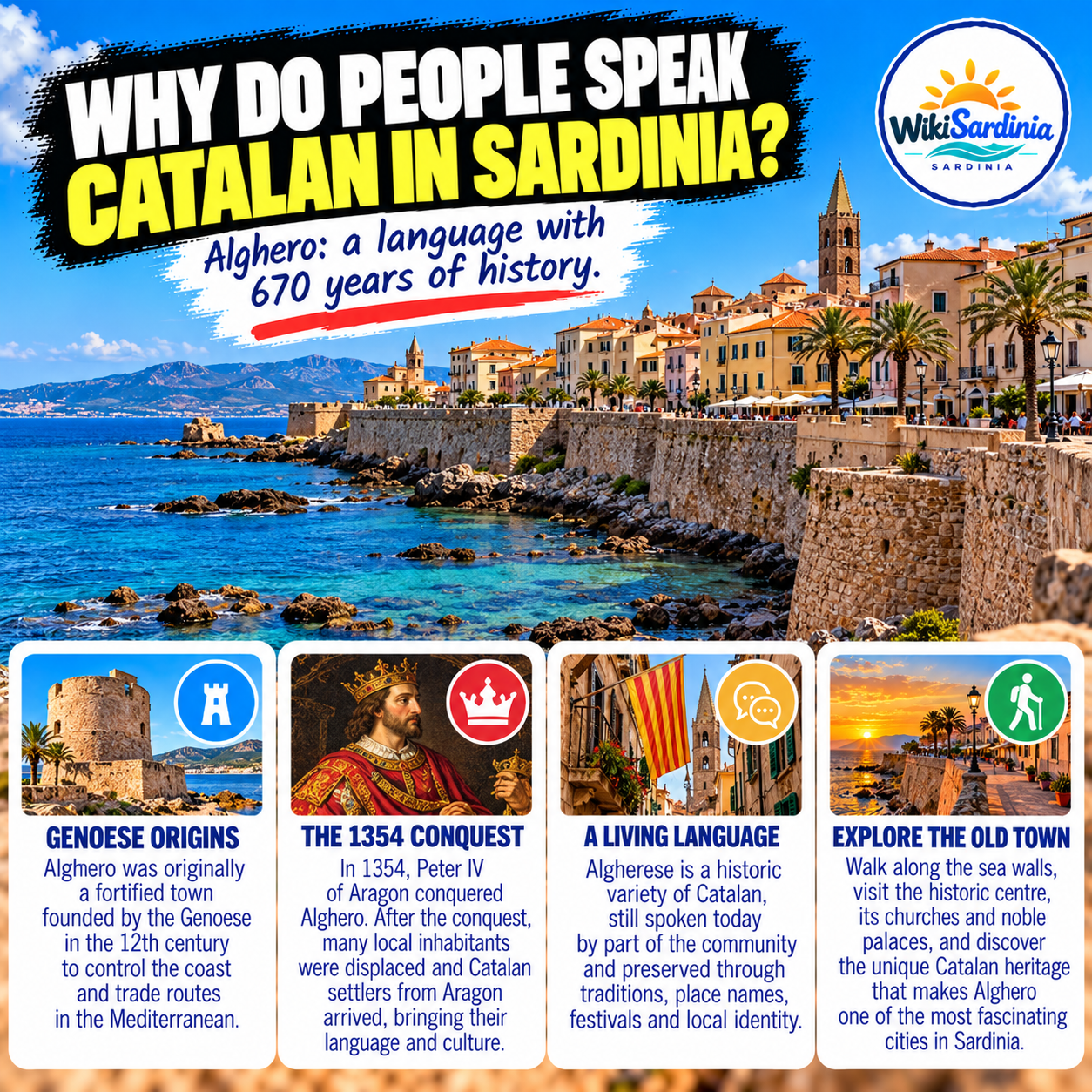
Alghero did not begin as a Catalan town. Its medieval development is associated with the Doria, a powerful Genoese family that established a fortified maritime settlement on the coast during the twelfth and thirteenth centuries. The harbour and defensive walls made the town strategically important for shipping, trade and military control. The first fortifications were later altered considerably, so the bastions tourists admire today represent several historical phases rather than a single medieval construction campaign.
1354: the conquest that changed the city's identity
In the fourteenth century, the Crown of Aragon sought control of Alghero. An initial Catalan-Aragonese victory in 1353 did not secure lasting possession. After renewed fighting and a siege, King Peter IV of Aragon took the town in November 1354. What followed was not simply a change of flag: Sardinian and Ligurian inhabitants were expelled or displaced, and the Crown encouraged settlers from Catalan-speaking territories, including Catalonia and Mallorca, to move into the fortified city.
The new arrivals brought their language, customs and institutions. The policy was coercive and disruptive for the previous population, an essential part of the story often omitted from romantic descriptions of Alghero as 'Little Barcelona'.
Why did Catalan survive for so long?
Alghero became an important royal and maritime stronghold. For generations, the settlement community used Catalan in everyday life, while the city's relative separation from its Sardinian-speaking hinterland helped maintain a distinct linguistic identity. The language remained even as political control changed, including the transition from Spanish rule to the House of Savoy in the eighteenth century. The survival of Catalan in Alghero reflects community continuity, not an uninterrupted period of rule by Catalonia.
Is Algherese the same as Catalan spoken in Barcelona?
Algherese (alguerès) is a historical variety of Catalan, but it is not identical to the Catalan heard in Barcelona. Centuries of local development and contact with Sardinian and Italian have influenced its vocabulary and pronunciation. Linguists study it as a distinctive minority variety with features shaped by both its medieval origins and the multilingual life of Sardinia.
Does everyone in Alghero still speak Catalan?
No. Italian is the dominant language of public life and is widely used by younger generations. Algherese survives among part of the community and in literature, cultural associations, music, public signs and language-preservation initiatives. It is recognized and protected under Italian legislation on historical linguistic minorities. Its future depends on transmission, education and actual opportunities to use it, not merely on its visibility to visitors.
How to experience Catalan heritage in Alghero
Begin at the old town's defensive walls and follow the seafront bastions toward the historic streets. The medieval street pattern, later churches, towers and palaces reveal a city shaped by centuries of Mediterranean connections. Look for bilingual place names and local cultural initiatives; the Catalan name l'Alguer is one of the most immediately recognizable signs of this heritage. Visit the Cathedral of Santa Maria and the surrounding historic quarter, and consider local museums and cultural events to understand how language, trade and maritime history intersect.
More than a picturesque nickname
Alghero is sometimes called Barceloneta, or 'Little Barcelona', but its story is uniquely Sardinian. Its Catalan language grew out of a violent fourteenth-century conquest, endured centuries of political change and became part of a local identity that continues to evolve. That is what makes Alghero so fascinating: a town firmly rooted in Sardinia, yet carrying an unmistakable linguistic memory of Catalonia.