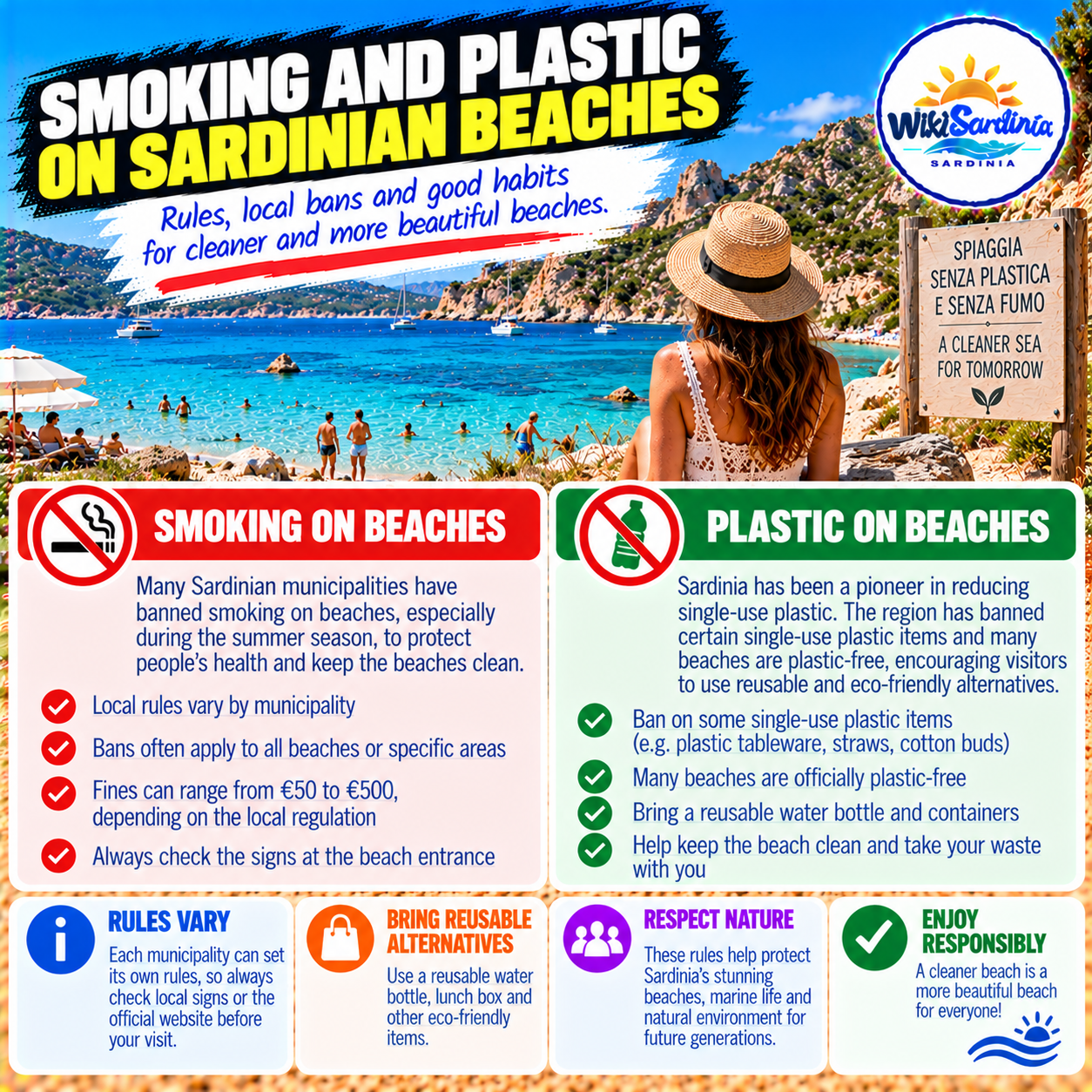
Can you smoke on Sardinia's beaches? And are plastic bottles, cups or disposable containers allowed? The answer depends partly on where you are. Sardinia has rules against littering, Italy restricts the marketing of certain single-use plastic products, and individual municipalities can introduce stricter beach ordinances. A rule that applies in one coastal town should not automatically be treated as an island-wide ban.
For visitors, the simplest approach is to check the signs at the beach entrance, respect any designated smoke-free zones, and avoid disposable plastic whenever possible. Above all, never leave cigarette butts, packaging or other rubbish on the sand.
Is smoking banned on every beach in Sardinia?
Not under one identical blanket rule covering every beach. Several Sardinian municipalities have introduced smoking restrictions, but their boundaries, dates, exceptions and penalties can differ. You should therefore verify the current ordinance for the specific beach rather than assume that smoking is always permitted—or always forbidden—everywhere on the island.
Local authorities may regulate cigarettes and, depending on the ordinance, electronic smoking devices as well. A beach club can also have rules for its own facilities. Signs reading divieto di fumo mean “no smoking.”
Which Sardinian beaches have smoking restrictions?
There are documented municipal examples. In Domus de Maria, whose territory includes the popular Chia coastal area, the municipality announced a smoking ban on all beaches within its territory for the period 1 June to 31 October 2026. Its official notice also prohibited the abandonment of smoking-related waste.
In Arzachena, on the Costa Smeralda, the municipality's beach guidance refers to an ordinance prohibiting smoking on the beach outside designated smoking areas. The municipality also describes separate restrictions on single-use plastic.
These examples show why the specific municipality matters. They do not establish that every beach in Sardinia has the same smoking rules or that a 2026 ordinance will necessarily remain unchanged in a future season.
Can you be fined for dropping a cigarette butt?
Yes. Discarding cigarette butts is littering, even on a beach where smoking itself is not prohibited. In its July 2026 beach-protection campaign, the Autonomous Region of Sardinia listed fines of €30 to €150 for small litter, including cigarette butts, receipts, chewing gum and tissues. The campaign also cited substantially higher fines for other categories of waste abandonment.
These are published regional public-information figures. The legal classification and applicable penalty depend on the conduct and the rules in force. Never treat the lower range for small litter as a universal penalty for every smoking-related violation; a separate municipal smoking ordinance may carry its own sanctions.
Why are cigarette butts such a problem on beaches?
Cigarette filters are often made from cellulose acetate, a plastic-based material. When discarded on beaches, they can persist in the environment, break into smaller fragments and release contaminants. Wind and waves can carry them into the sea, where removing them becomes difficult.
That is why smoke-free beach policies are often presented as both public-health and environmental measures. Even where smoking is allowed, responsible disposal is essential. Never bury a butt in the sand or leave it beside a bin.
Are plastic bottles banned on Sardinian beaches?
There is no reason to assume that every ordinary reusable or disposable plastic bottle is prohibited on every Sardinian beach. Restrictions differ between national product rules and local beach-use ordinances. Some municipalities regulate the introduction or use of particular disposable plastic items in their coastal areas.
For example, Arzachena's official municipal guidance references an ordinance restricting single-use plastics on beaches. Visitors should read the exact current local rules, because a ban on certain disposable items is not automatically a ban on all objects made of plastic, such as a reusable bottle, waterproof bag or medical device.
What does Italy's single-use plastic law actually ban?
Italy implemented the EU Single-Use Plastics Directive through Legislative Decree No. 196 of 8 November 2021. Among other measures, Article 5 restricts placing specified single-use plastic products on the market, subject to the law's detailed conditions and exceptions. The listed products include certain plastic cutlery, plates, straws, drink stirrers and other items.
This is an important legal distinction: a national restriction on placing a product on the market is not automatically a rule making it illegal for a tourist to possess any plastic object on a beach. Local ordinances may separately restrict the use or introduction of particular products in beach areas.
Are plastic cups, plates and straws allowed?
Because Italy's national legislation regulates specific single-use products and local coastal ordinances may impose additional restrictions, the answer depends on the item and location. A reusable lunch box or durable water bottle is generally a better choice than disposable cutlery or cups, both for convenience and waste prevention.
If you are visiting a beach with a local plastic-free rule, read the posted wording carefully. “Plastic-free” may describe a campaign, a municipal prohibition concerning specific products, or a voluntary initiative by a beach establishment; those are not necessarily legally identical.
What about vaping and electronic cigarettes?
Do not assume that a no-smoking sign automatically tells you everything about vaping. Some local ordinances expressly include electronic smoking devices, while others use different language. If the rule is unclear, ask beach staff or the local authority, and avoid using the device near other beachgoers.
Disposable vaping products also create waste-management problems. Batteries and electronic components should never be abandoned on a beach or placed casually in ordinary sand-side litter.
Do the rules apply to free public beaches as well as beach clubs?
They can. A municipal ordinance may apply across the beaches and shorelines of a municipality, including spiagge libere (free public beach areas). A private beach club or stabilimento balneare may additionally regulate smoking within its managed space.
Paying for a sunbed does not exempt you from environmental rules. Likewise, choosing a free beach does not mean there are no restrictions. Look for signs at access paths and entrances.
How do you check the rules before visiting?
Start with the website of the municipality responsible for the beach, then check the latest ordinanza balneare (beach ordinance) and any specific smoking or plastic regulations. On arrival, read posted notices and follow the instructions of authorised staff.
Rules may be seasonal, apply only to certain zones, or include designated smoking areas. A travel article or social-media post written the previous summer may not reflect the latest ordinance. This is especially important when planning a trip for a future year.
What fines could tourists face?
There is no single fine that applies to every smoking or plastic violation on every Sardinian beach. A municipal smoking ban may establish its own penalty range, while littering is covered by separate legal provisions. The Sardinian Region's July 2026 public campaign identified €30–€150 for small litter such as cigarette butts, and €1,000–€10,000 for general waste abandonment.
Avoid relying on a generic internet claim that all beach smoking incurs a €500 fine. The precise amount requires checking the relevant local ordinance and the facts of the violation.
What should you bring for an environmentally responsible beach day?
- A reusable water bottle: refill it before leaving your accommodation.
- A reusable food container: avoid unnecessary disposable packaging.
- A small rubbish bag: take waste away if bins are unavailable or full.
- Suitable sun protection: bring a hat and an umbrella where local rules permit.
- An offline copy of local rules: helpful at remote beaches with limited mobile coverage.
Remember that protecting Sardinia's coast also means staying off fragile dunes and leaving sand, shells and pebbles where they are. Those environmental protections are separate from the rules on smoking and plastic.
What if there are no signs?
The absence of an obvious sign does not guarantee that a restriction does not exist. If you are unsure, ask a lifeguard, beach operator or municipal information office, or check the municipality's official website. When in doubt, avoiding smoking and disposable packaging is the easiest way to respect other visitors and the environment.
Are these rules just for tourists?
No. Municipal beach ordinances and environmental laws generally govern conduct in the areas they cover, rather than applying only to foreign visitors. The aim is to protect shared coastal spaces, reduce pollution and make beaches more comfortable for everyone.
Residents and visitors alike benefit when cigarette butts, food packaging and other rubbish stay out of the sand and sea.
The verdict: can you smoke or use plastic on Sardinian beaches?
Smoking rules vary by municipality, and some Sardinian beaches are smoke-free or permit smoking only in designated areas. Littering with cigarette butts is prohibited regardless of whether smoking is otherwise allowed. Italy also restricts specified single-use plastic products, while individual municipalities can impose additional beach-specific plastic rules.
For a worry-free day, check the current local ordinance, bring reusable supplies and leave no waste behind. Sardinia's extraordinary coastline is worth the extra care.