Is Sardinian a dialect of Italian, or a language in its own right? The short answer is that Sardinian is a distinct Romance language. It is related to Italian because both ultimately developed from Latin, but it did not emerge as a regional version of modern standard Italian. Its sounds, vocabulary, grammar and historical development give it an identity of its own.
That distinction matters far beyond linguistics. Sardinian is part of the island's cultural heritage, heard in family conversations, songs, poetry and local traditions. At the same time, most visitors will use Italian to communicate across the island, and the linguistic reality is more varied than a simple choice between two languages.
Why is Sardinian considered a language rather than an Italian dialect?
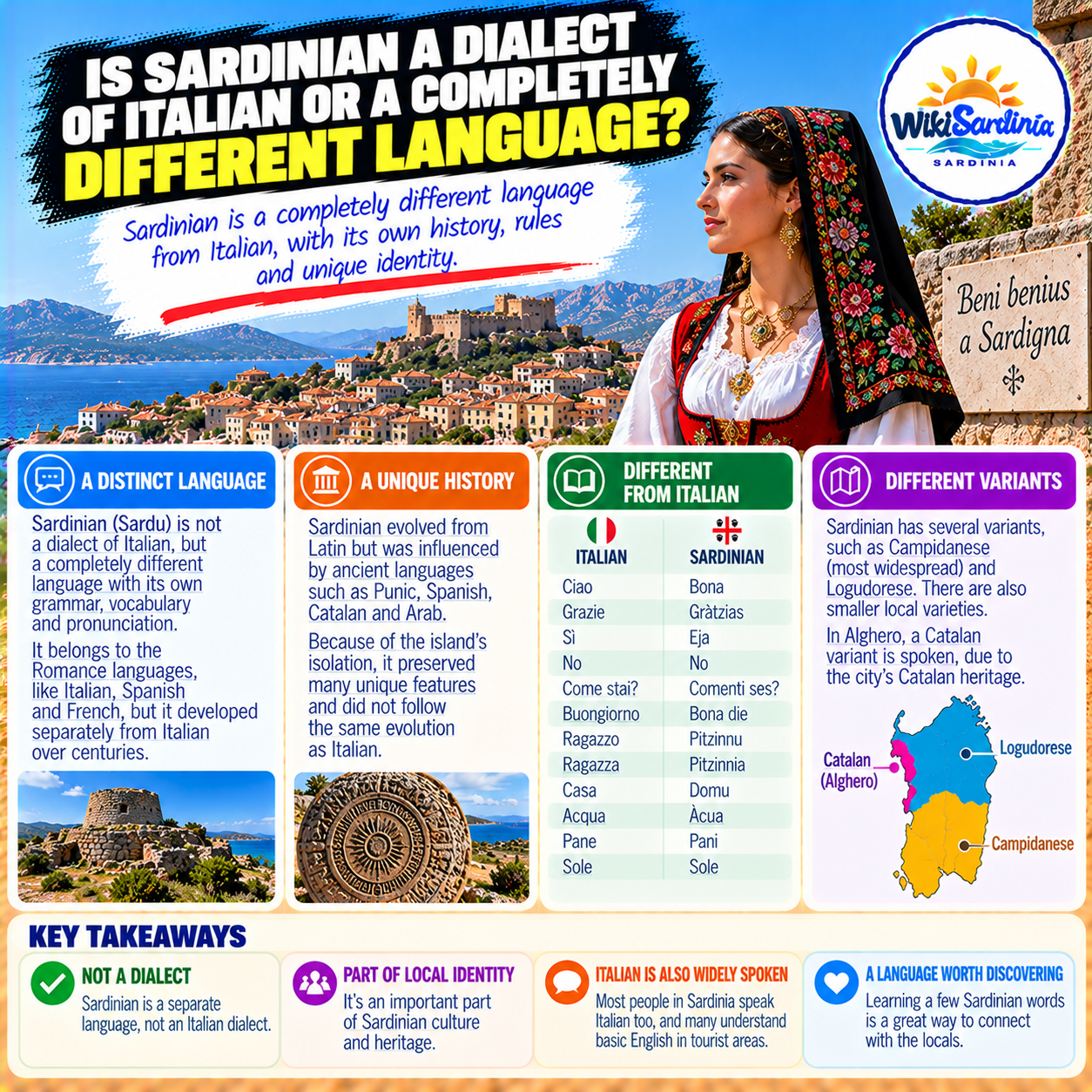
In everyday speech, people sometimes use the word “dialect” for almost any local language. Linguists use more precise distinctions. Sardinian, often called sardu, belongs to the Romance language family, alongside Italian, Spanish, French, Catalan and others. It developed from the Latin spoken on the island over many centuries, following its own trajectory.
Its differences from Italian are systematic, not merely a handful of local expressions. Sardinian varieties have characteristic sounds, vocabulary and grammatical structures that cannot simply be explained as Italian with an accent. Italian and Sardinian are related languages, not identical ones.
Does Sardinian come from Latin?
Yes. Like Italian, Sardinian developed from forms of spoken Latin introduced during Roman rule. The languages changed over time in different regions. Sardinia's geography and history contributed to linguistic developments that differ from those of mainland Italy.
Sardinian is often noted for preserving certain features that linguists consider conservative relative to other Romance languages. But calling it “the closest language to Latin” without defining the comparison is an oversimplification. Languages can preserve some older features while innovating in other ways; no living Romance language is simply unchanged Latin.
Can Italian speakers understand Sardinian?
Not automatically. An Italian speaker may recognise individual words, particularly when they share Latin roots, but a full conversation in Sardinian can be difficult to follow without prior exposure. Understanding also depends on the variety being spoken and the listener's familiarity with other Romance languages.
Likewise, someone who speaks Sardinian will usually encounter Italian throughout daily life, but that does not make the two languages interchangeable. Bilingualism and frequent contact can influence how people speak without erasing the distinction.
Are there different types of Sardinian?
Yes. Sardinian is not spoken identically across the island. Two broad groupings commonly discussed are Logudorese, associated with central and northern areas, and Campidanese, associated with much of the south. Within and around these labels there are many local varieties, with differences in pronunciation, words and grammatical patterns.
These categories are useful for explaining linguistic geography, but they should not be treated as rigid borders. Language use changes gradually across communities, and speakers may identify strongly with their town's particular way of speaking.
What about Gallurese, Sassarese and Algherese Catalan?
Sardinia's linguistic landscape includes more than Sardinian and Italian. Gallurese, spoken in parts of the northeast, and Sassarese, spoken around Sassari and nearby areas, have their own histories and linguistic characteristics, often discussed in relation to Corsican and other Italo-Romance varieties. They should not simply be presented as identical to Logudorese or Campidanese.
In Alghero, a local variety of Catalan is part of the city's heritage. In communities such as Carloforte and Calasetta, Tabarchino, a Ligurian variety, is also historically rooted. These traditions illustrate why “everyone on Sardinia speaks Sardinian” is an inaccurate description of the island.
Is Sardinian officially recognised?
Yes. Italy's Law 482 of 1999 recognises and protects a number of historic linguistic minorities, including Sardinian. Regional measures also support the island's linguistic heritage. Recognition, however, does not mean Sardinian has replaced Italian in national administration or that every public service is available in Sardinian.
Italian remains the language visitors will most consistently encounter in official communication, transport information, schools and many public settings. Sardinian's recognition is important for cultural preservation, education and opportunities for use in local life.
Is Sardinian still spoken today?
Yes, but use varies widely. Some families and communities use Sardinian regularly, while others primarily use Italian. People may understand Sardinian without speaking it fluently, or use it only with certain relatives and friends. Language practices differ across generations, locations and personal circumstances.
It is important not to romanticise rural communities by assuming that all older residents speak only Sardinian or that every young person has abandoned it. The reality is diverse, and language revitalisation initiatives coexist with the pressures that favour Italian in many everyday contexts.
How different do Sardinian and Italian sound?
Differences can be heard in pronunciation and rhythm as well as vocabulary. Even familiar-looking words may sound different when spoken in a local Sardinian variety. One frequently cited example is the Sardinian word domu for “house,” compared with Italian casa. But individual examples should never be taken as universal across every Sardinian variety.
Visitors may also hear speakers moving between Italian and Sardinian within a conversation. That is a normal feature of multilingual communities, not evidence that Sardinian is merely informal Italian.
Is there one standard written Sardinian?
Written Sardinian has a long and varied history, and debates about spelling and standardisation remain important. The Limba Sarda Comuna is a reference orthographic proposal used in certain regional administrative contexts, but it should not be described as a universally accepted replacement for local writing traditions.
Different authors, institutions and communities may use different conventions. This diversity reflects the challenge of representing a living language with substantial regional variation.
Do tourists need to learn Sardinian?
No. For a typical holiday, basic Italian is far more practical. In popular tourist areas, you may also find English-speaking staff, especially in hotels, guided activities and some restaurants. Learning a few Sardinian expressions can be a thoughtful way to show interest in local culture, but it is best to ask local speakers about the words used in their area rather than assume one expression works everywhere.
For example, greeting someone politely in Italian with buongiorno is always a safe starting point. If someone shares a Sardinian phrase, listening and asking about its meaning can open a memorable conversation about the island.
Why does this distinction matter for Sardinian identity?
Calling Sardinian “just an Italian dialect” can unintentionally obscure centuries of independent linguistic development. Its literature, oral traditions, place names and songs form part of Sardinia's cultural history. At the same time, recognising Sardinian as a language does not imply that Italian is foreign to Sardinian life: the two coexist in many communities.
Language identity is personal as well as historical. People may identify with Sardinian, Italian, a local variety or several traditions at once. Respecting those differences is more informative than insisting that everyone on the island speaks in the same way.
The verdict: a different language, but a related one
Sardinian is not a dialect derived from Italian. It is a distinct Romance language that developed from Latin, as Italian did. The two are related, but Sardinian has its own historical development, regional varieties and cultural significance. Sardinia is also home to other linguistic traditions, including Algherese Catalan, Gallurese, Sassarese and Tabarchino.
For travellers, this means two things: Italian is the most useful everyday language, and Sardinia's linguistic heritage is one more reason the island feels unlike anywhere else in Italy.