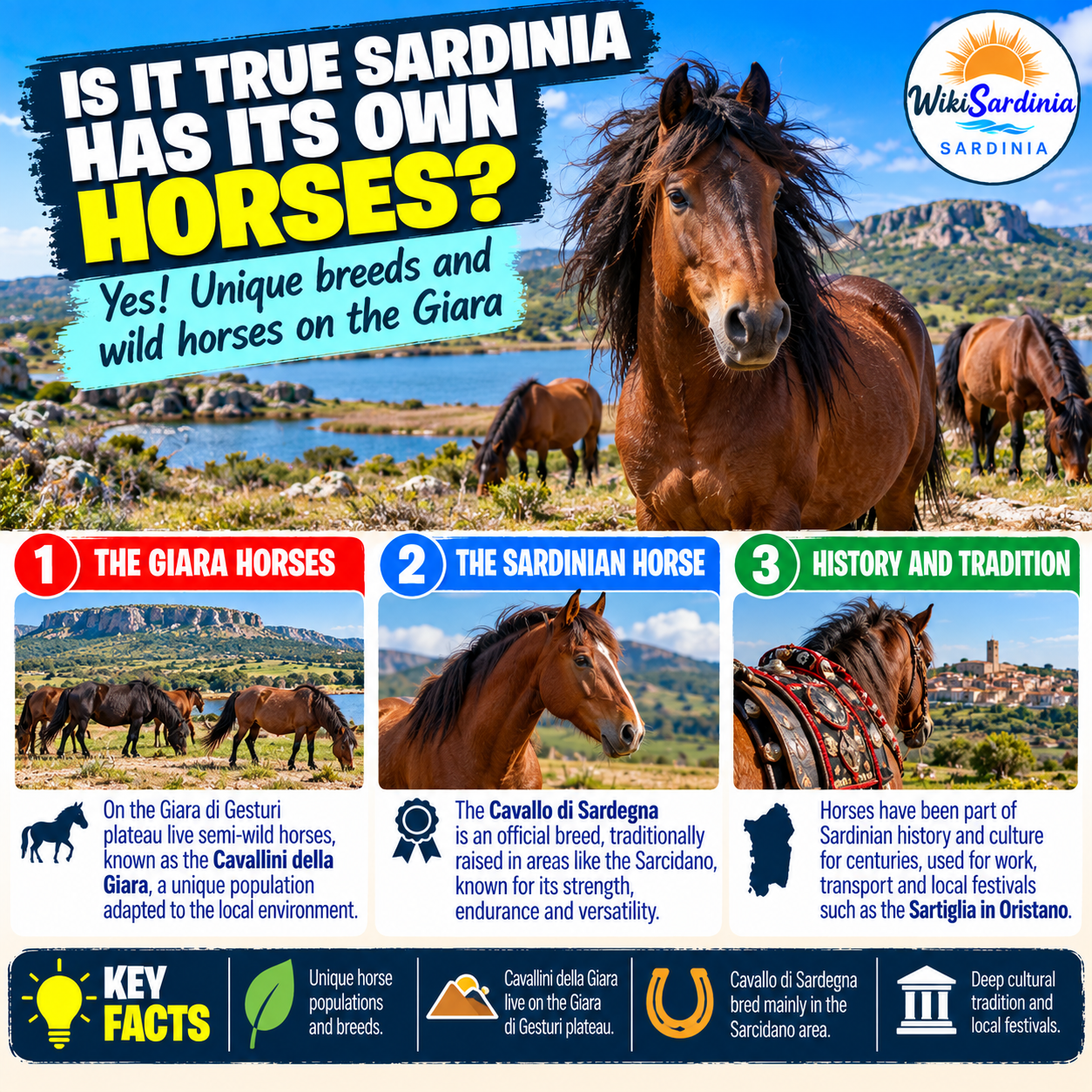
Yes! Sardinia has distinctive native horses, especially the Giara horse and the rare Sarcidano. They are not simply imported riding horses: both are closely associated with the island’s landscape and rural history, although they are different populations and should not be described as one identical breed.
The Giara horse: a small horse of the high plateau
The Giara horse, often called cavallino della Giara in Italian, is known for its compact build and dark coat. It lives on the Giara di Gesturi, a basalt plateau in south-central Sardinia, where open grassland, Mediterranean scrub and seasonal pools shape the habitat.
These horses are often described as wild, but their history is connected to people and livestock management as well as to the landscape. Today, the plateau is the best-known place to learn about them in their natural setting. Seeing them is never guaranteed, and visitors should observe from a respectful distance rather than approach or feed them.
The Sarcidano horse: a rare native breed
The Sarcidano is another distinctive Sardinian horse, associated with the area around the Sarcidano plateau in the island’s interior. It is recognised as a rare indigenous breed and is known for its hardiness and adaptation to local conditions. Compared with the Giara horse, it is a separate population with its own history and characteristics.
Because numbers and conservation arrangements can change, anyone hoping to see Sarcidano horses should check current information from local farms, breeders or official agricultural and conservation organisations before travelling.
Are the Giara and Sarcidano the only Sardinian horses?
No. Sardinia has many horses used for riding, farming, sport and other activities, and horses from different origins are raised across the island. Giara and Sarcidano stand out because of their particular connection to Sardinia and their conservation or heritage value, not because they are the only horses found there.
Where can you see Giara horses?
The Giara di Gesturi is the most famous area for observing the Giara horse. The plateau is also known for its distinctive landscape, cork oaks, Mediterranean vegetation and seasonal wetlands. Plan your visit around local access rules and weather conditions; parts of the terrain can be uneven, and summer heat can make walking uncomfortable.
- Keep your distance: do not try to touch, chase or feed the horses.
- Stay on permitted routes: respect signs, gates and protected areas.
- Bring water and sun protection: exposed paths can be hot, especially in summer.
- Be patient: horses move freely, so sightings depend on the day and season.
Why these horses matter to Sardinia
Native livestock populations preserve part of the island’s biological and cultural heritage. The Giara horse is strongly associated with a particular plateau and its traditional pastoral landscape, while the Sarcidano represents a rare local breed that deserves careful conservation. Both are reminders that Sardinia’s heritage includes not only archaeological sites and traditions, but also animals shaped by generations of life on the island.
A living part of the island’s identity
So the answer is yes: Sardinia is home to its own distinctive horses. Start with the Giara horse if you want to explore the plateau’s open landscapes, and learn about the Sarcidano through reliable local or conservation sources. In both cases, responsible observation helps protect these animals and the places they call home.