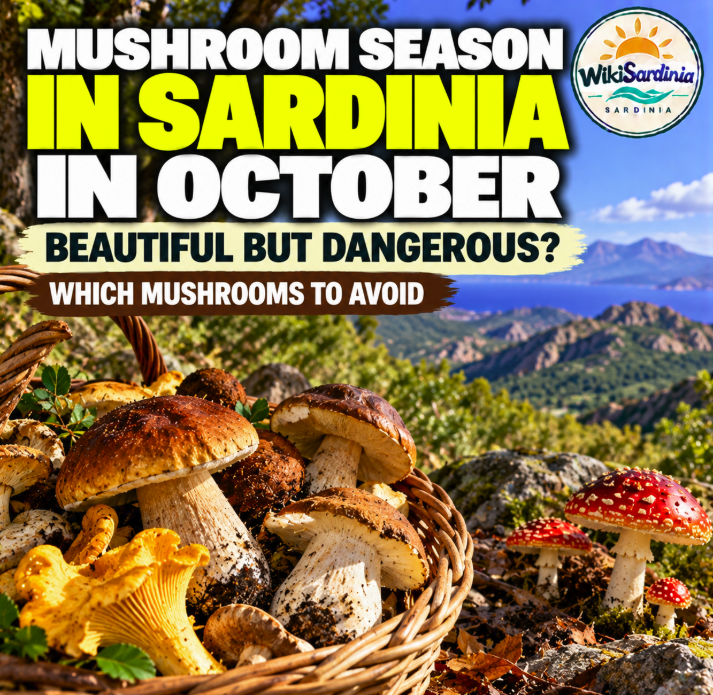
October can be an excellent time to see wild mushrooms in Sardinia, but mushroom foraging can be dangerous. Autumn rain and mild temperatures often encourage fungi to appear in woodlands and countryside. Some species are edible, others cause serious illness, and a few can be deadly. Never eat a wild mushroom based on a photograph, an app, a simple color rule or advice from an unqualified person.
For visitors, the safest way to experience Sardinia's autumn mushroom season is to enjoy a guided nature walk without collecting for food, or to buy mushrooms from a legitimate food retailer. If you intend to eat mushrooms you have gathered, seek inspection by an appropriately qualified mycologist through the local ASL Ispettorato Micologico before consumption.
Is October mushroom season in Sardinia?
Yes, October is part of the traditional autumn mushroom period in Sardinia. Actual growth depends on rainfall, humidity, temperatures, habitat and recent weather. A dry October may produce relatively few mushrooms; a wet spell can lead to more fruiting bodies in suitable locations.
Forested areas in central and northern Sardinia, including parts of Barbagia, the Gennargentu region and other woodland districts, can offer interesting autumn fungi. This is not a guarantee that any particular species will be present on a specific day.
Why can mushroom hunting be dangerous?
The principal danger is misidentification. Poisonous and edible mushrooms can share broad features such as pale caps, brown caps, gills or a ring on the stem. Important identifying characteristics may be hidden underground, altered by age or damaged during collection.
Some dangerous mushroom toxins can cause severe liver or kidney injury. Symptoms may be delayed for many hours, creating a false sense of safety. Cooking, freezing, drying or soaking does not reliably neutralize all mushroom toxins.
Which poisonous mushrooms should visitors know about?
The examples below are provided as hazard awareness, not a field identification guide. A list of features is not sufficient to decide whether a specimen is edible. Species distribution varies, and the presence of a name on this list does not confirm that it grows at your chosen location.
Amanita phalloides — death cap
Amanita phalloides, commonly called the death cap, is among Europe's most dangerous poisonous mushrooms. It contains amatoxins that can cause life-threatening liver injury. Cap color is variable, so a greenish appearance is not a reliable standalone identification method. Young or damaged specimens can be especially confusing.
Its toxins are not made safe by normal cooking. Even a small amount can cause severe poisoning. Anyone who may have eaten a death cap needs urgent medical assessment, even if they initially feel well.
Amanita verna and other highly toxic white amanitas
Some white Amanita species are extremely poisonous and may resemble edible white mushrooms to nonexperts. Identification requires expert examination of the entire specimen and its characteristics. The presence or absence of a single visible feature should never be used as a home safety test.
Galerina marginata — deadly galerina
Galerina marginata is a small brown mushroom associated with decaying wood and contains dangerous amatoxins. It illustrates why the informal category “little brown mushrooms” is particularly unsuitable for casual identification.
Cortinarius orellanus and related toxic webcaps
Some Cortinarius species contain orellanine, a toxin associated with serious kidney injury. Symptoms may appear only after a prolonged delay. Brownish coloration or a woodland habitat does not distinguish a safe species from a dangerous one.
Other mushrooms that can cause poisoning
Not every poisonous mushroom is deadly. Some cause severe gastrointestinal symptoms, neurological effects or other illness. Risk also depends on individual sensitivity, preparation and whether a species was correctly identified. A mushroom can be unsuitable for eating even if it is not among the most notorious deadly species.
Can you identify poisonous mushrooms by color?
No. There is no reliable rule such as “bright mushrooms are poisonous” or “plain brown mushrooms are edible.” Dangerous mushrooms can be white, brown, greenish or other colors, while harmless species can also be vividly colored.
Likewise, the absence of an unpleasant smell does not prove safety. Neither insect damage nor evidence that an animal has eaten a mushroom makes it safe for humans.
Can you test a mushroom with garlic, silver or milk?
No. Popular kitchen myths—including testing mushrooms with garlic, a silver spoon, milk or an onion—cannot detect mushroom toxins. Do not use these methods to decide whether wild fungi are edible.
Will cooking destroy mushroom poison?
Not reliably. Some dangerous toxins, including amatoxins, are heat-stable under ordinary cooking conditions. Boiling or frying an unidentified mushroom does not make it safe. Drying and freezing are not substitutes for professional identification.
Is a mushroom identification app enough?
No. Image-recognition apps may suggest names, but lookalike species, lighting, partial photographs and variations between specimens can produce dangerous mistakes. Apps can be useful for learning about fungi, but they should never be treated as authorization to eat a wild mushroom.
What is an Ispettorato Micologico?
In Italy, local health authorities operate mycological inspection services to help protect the public from mushroom poisoning. In Sardinia, these services are associated with the relevant ASL. Depending on the district, qualified mycologists may inspect wild mushrooms intended for private consumption and provide guidance.
Services, opening hours, appointments and procedures vary. Before collecting mushrooms for food, contact the ASL serving the area where you are staying and ask for the current Ispettorato Micologico details.
Useful Italian question: “Buongiorno, dove posso far controllare da un micologo i funghi spontanei raccolti? Quali sono gli orari dell'Ispettorato Micologico?”
How should collected mushrooms be transported for inspection?
Ask your local inspection service for its instructions before collecting. In general, a qualified mycologist needs specimens that are sufficiently intact for examination, not just chopped pieces or photos. Do not mix mushrooms from uncertain species into a meal.
A breathable container is generally preferable to a sealed plastic bag that traps moisture and accelerates deterioration. Keep different collections identifiable, and do not taste mushrooms during collection.
Most importantly: an incomplete, spoiled or poorly preserved specimen may be impossible to identify safely. If inspection cannot establish safety, do not eat it.
What if you accidentally eat a poisonous mushroom?
Seek urgent medical advice immediately if you suspect mushroom poisoning—even if symptoms have not started. In Italy, call 112 for emergencies. Explain that wild mushrooms may have been eaten, when the meal occurred, how many people ate it and whether anyone has symptoms.
Keep leftover mushrooms, cooked food and any photographs or packaging available for medical professionals, if possible. Do not delay calling for help while trying to identify the species yourself.
Do not induce vomiting or attempt home remedies unless instructed by a healthcare professional or poison center.
What are the symptoms of mushroom poisoning?
Possible symptoms include nausea, vomiting, abdominal pain, diarrhea, dizziness, confusion and other neurological effects. Serious poisoning can also involve liver or kidney damage, sometimes after an initial period with few or no symptoms.
Delayed symptoms are particularly concerning. Feeling well shortly after eating a mushroom does not rule out a dangerous exposure. Anyone who shared the meal should tell medical staff, even if only one person feels ill.
Can children or pets touch wild mushrooms?
Teach children not to pick up or taste unknown mushrooms. Supervise young children and pets in woodland areas, gardens and parks, especially after rain. If a child or pet may have swallowed a wild mushroom, seek prompt professional advice. For pets, contact a veterinarian or emergency veterinary service.
Touching an intact mushroom is not generally equivalent to eating it, but hands should be washed after handling wild fungi, and unknown mushrooms should never be placed in the mouth.
Are there rules for mushroom picking in Sardinia?
Yes, collection may be subject to regional and local rules, land access restrictions, protected-area regulations and any applicable permits or quantity limits. Requirements can change and may differ between locations.
Do not assume that mushrooms growing in a forest are free for anyone to collect. Before foraging, check current guidance from the relevant municipality, regional authorities and park management. Respect private property and never enter restricted land.
How to enjoy Sardinia's mushroom season safely
- Choose a nature walk or an educational excursion led by a qualified local expert.
- Photograph mushrooms in place rather than collecting them for a meal.
- Buy edible mushrooms from established food businesses with appropriate controls.
- If you gather mushrooms for consumption, arrange professional inspection through the ASL.
- Never rely on folk tests, social media comments or AI identification for edibility.
- Stay on suitable paths and prepare for changing mountain weather.
- Do not damage woodland habitats or remove mushrooms from protected areas where collection is prohibited.
Are restaurant mushroom dishes safe?
Restaurants and food businesses are subject to food safety obligations, but diners should still choose reputable establishments. If you have allergies or concerns about ingredients, ask staff what type of mushrooms are being served and how they were sourced.
Do not assume that every dish described as “wild mushrooms” contains the same species or has the same preparation.
FAQ
Is October a good month for mushrooms in Sardinia?
Often, yes, especially after suitable autumn rainfall. Actual growth varies with weather and habitat.
Are poisonous mushrooms common in Sardinia?
Dangerous species can occur in Sardinian habitats. Never assume that a mushroom is edible because it grows near a village or alongside familiar species.
Which mushroom is the most dangerous?
Amanita phalloides, the death cap, is among the most dangerous European species because its toxins can cause fatal liver injury.
Can I identify edible mushrooms from a photo?
No. Photographs and apps cannot provide a reliable safety clearance for eating wild mushrooms.
Does boiling make poisonous mushrooms safe?
No. Some dangerous toxins survive ordinary cooking.
Where can I have mushrooms checked in Sardinia?
Contact the local ASL and ask for its Ispettorato Micologico service and current inspection procedures.
What should I do if someone feels ill after eating wild mushrooms?
Seek urgent medical advice. Call 112 in an emergency, preserve any leftovers and do not wait for symptoms to worsen.
Can I pick mushrooms in any Sardinian forest?
No. Check land access, regional and local rules, and any protected-area restrictions first.
Are white mushrooms safe?
No. Some highly toxic mushrooms are white. Color is not a reliable test of edibility.
Can I join a guided mushroom walk without eating mushrooms?
Yes. An educational walk focused on ecology and photography is an excellent way to experience the season without the risk of consuming unidentified fungi.
The bottom line
October is mushroom season in Sardinia, but it is not a safe invitation to eat whatever you find. Some poisonous species can resemble edible ones, and severe symptoms may be delayed. Enjoy the autumn woods, learn from qualified experts and have any mushrooms intended for consumption inspected by the local ASL's mycological service. If poisoning is suspected, seek medical help immediately.
Sources and safety references
Italian Ministry of Health — official health information; Istituto Superiore di Sanità — national public health institute; Sardegna Salute — regional health services; 112 — emergency number information. Check the current ASL service details and applicable local mushroom-picking rules before travel.