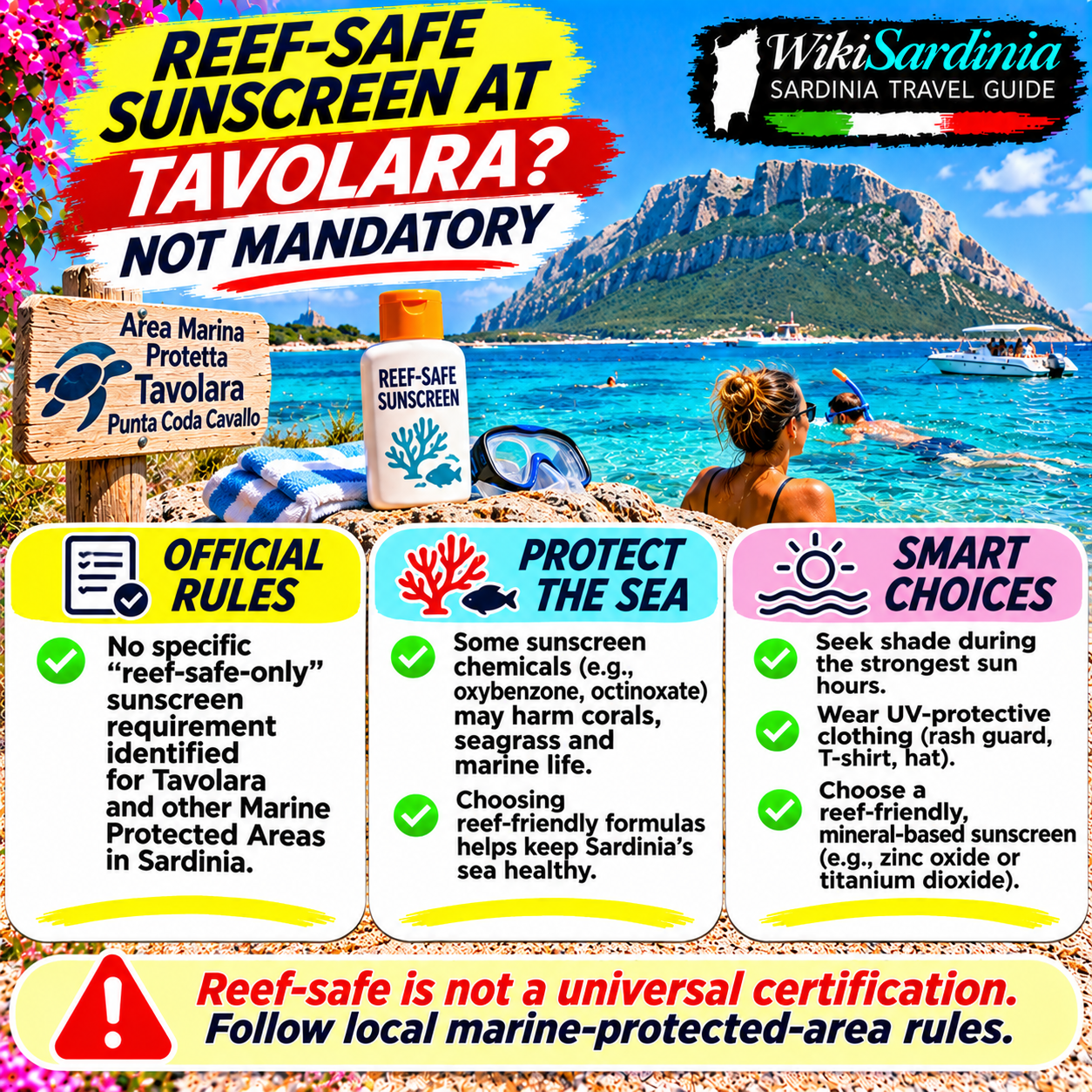
No. Based on the official rules reviewed for 2026, swimmers are not legally required to use a product labeled “reef-safe” in the Tavolara–Punta Coda Cavallo Marine Protected Area. The protected area does, however, warn about potentially harmful chemicals in sunscreens and encourages responsible behavior. Choosing a product with a lower environmental impact is sensible, but that recommendation must not be confused with a specific legal obligation.
What do the official Tavolara rules actually say?
The Marine Protected Area's official implementation regulation, approved by ministerial decree, addresses where visitors can swim, dive, navigate and anchor. Article 15 states that swimming is prohibited in Zone A, the integral reserve, while swimming is freely permitted in Zones B and C subject to the competent maritime authority's ordinances. The regulation does not specify that visitors must wear only reef-safe sunscreen or ban a named sunscreen ingredient as a condition of swimming.
The managing authority publishes additional regulations and seasonal ordinances. Always check the latest version before your trip: a particular operator or destination may issue extra requirements. The absence of a sunscreen-only rule in the documents reviewed is not a promise that no future local restriction could be introduced.
Why is sunscreen discussed in marine conservation?
The Tavolara Marine Protected Area itself warns that pollution from some sunscreen chemicals can threaten corals and gorgonians. These animals form part of Sardinia's underwater ecosystems. Research into the environmental effects of ultraviolet filters examines chemical concentrations, exposure conditions and possible effects on marine organisms. The degree of harm varies by substance and context, so it is misleading to claim that every sunscreen ingredient has the same impact.
What does “reef-safe” actually mean?
“Reef-safe” and “reef-friendly” are marketing descriptions, not a single universally recognized certification proving that a product is harmless to marine ecosystems. Some products marketed this way exclude particular organic UV filters, such as oxybenzone (benzophenone-3) or octinoxate (ethylhexyl methoxycinnamate), but that alone does not establish that the entire formula is environmentally harmless. Claims should be assessed by ingredient list, evidence and testing rather than by a label alone.
Are mineral sunscreens better?
Mineral UV filters, commonly zinc oxide or titanium dioxide, can be useful options for visitors trying to choose different formulations. However, mineral-based does not automatically mean zero environmental impact: particle size, coatings, concentration and other ingredients can matter. Choose a broad-spectrum sunscreen with appropriate SPF and good water resistance, and apply it according to the instructions. Do not sacrifice protection against sunburn in an attempt to find a supposedly perfect eco-label.
How can visitors protect themselves and the sea?
- Wear a UV-protective rash guard or swim shirt, especially during long snorkeling sessions.
- Use a wide-brimmed hat, sunglasses and shade when out of the water.
- Apply an appropriate broad-spectrum sunscreen to exposed skin and reapply as directed, especially after swimming or toweling.
- Consider formulations with transparent ingredient information instead of relying on unverified “reef-safe” claims.
- Avoid leaving any packaging, wipes or plastic behind on the beach or boat.
- Respect the protected area's zones, anchoring restrictions and wildlife protection rules.
Can I swim at Tavolara with ordinary sunscreen?
Where swimming is permitted, the official regulation reviewed does not impose a reef-safe-only sunscreen condition. However, you cannot swim in Zone A regardless of which sunscreen you use. In Zones B and C, follow the maritime authority's current rules and any additional site-specific notices. Check the official zoning map if you are arriving by boat or snorkeling near the reserve boundary.
What about Cala Brandinchi, Lu Impostu and nearby beaches?
Beaches in the San Teodoro area are within or near the protected coastal landscape and have their own visitor-management rules. The Municipality of San Teodoro directs visitors to the Marine Protected Area's regulations and beach entrance signs. A beach reservation or visitor cap is separate from a sunscreen requirement. Do not assume a reef-safe label substitutes for booking, access permissions or environmental rules.
Do other Sardinian marine protected areas require reef-safe sunscreen?
No verified universal reef-safe sunscreen mandate has been identified across all Sardinian marine protected areas. Each protected area has its own zoning, regulations and management rules. If you are visiting Asinara, Capo Carbonara, Sinis–Mal di Ventre or La Maddalena, check that area's current regulations individually rather than extrapolating Tavolara's rules to the entire island.
Useful Italian phrases
“È obbligatoria una crema solare specifica nell'area marina protetta?” — Is a particular sunscreen required in the marine protected area?
“In questa zona è consentita la balneazione?” — Is swimming allowed in this zone?
“Ci sono restrizioni sui filtri solari?” — Are there restrictions on sunscreen filters?
Frequently asked questions
Will I be fined for using a normal sunscreen at Tavolara?
The official regulations reviewed do not establish a specific fine for using a sunscreen that lacks a reef-safe label. Other protected-area violations can carry penalties, so follow the actual posted rules.
Is oxybenzone banned at Tavolara?
No ingredient-specific prohibition was identified in the official Tavolara rules reviewed. This is different from saying the ingredient has no potential environmental effects.
Does reef-safe sunscreen make swimming legal in Zone A?
No. Swimming is prohibited in Zone A regardless of sunscreen choice.
Can I rely on a “reef-friendly” logo?
Not as proof of zero environmental impact. Look for meaningful ingredient information and independent evidence.
Should I stop using sunscreen to protect the sea?
No. Sun protection remains important. Combine suitable sunscreen with shade and protective clothing, which can reduce the amount of skin requiring sunscreen.
The bottom line
Reef-safe sunscreen is an environmental choice, not a documented legal requirement for swimming at Tavolara in 2026. The Marine Protected Area's official rules focus on zoning and activities such as swimming, diving and anchoring. Use effective sun protection, consider the environmental impact of your products and respect the current regulations of the exact protected area you visit.
Official sources
- Tavolara–Punta Coda Cavallo Marine Protected Area — official regulations
- Tavolara Marine Protected Area — implementation regulation, Article 15
- Tavolara Marine Protected Area — corals, gorgonians and environmental threats
- Tavolara Marine Protected Area — zoning
- Municipality of San Teodoro — beaches and local environmental rules