
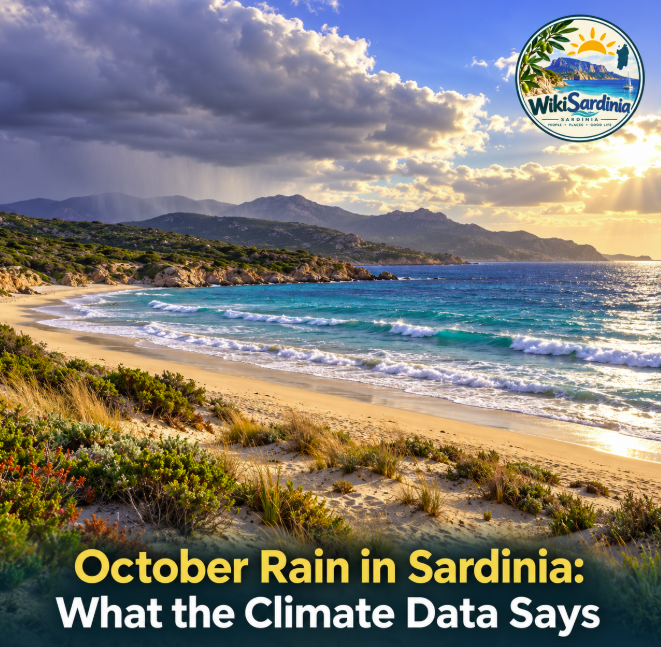
Yes, October falls within Sardinia’s wetter part of the year, but “rainy season” should not be read as a promise of uninterrupted rain. For a traveller, the useful distinction is between the island’s seasonal climate and the weather during a particular week. An October holiday needs flexibility and a local forecast; a monthly rainfall chart cannot tell you which days your beach walk or vineyard visit will be possible.
The regional climate description places the typical wetter period from October to April and the drier period from May to September. It also stresses that rainfall varies substantially across space and time. That supports preparing for autumn rain without assuming the same conditions everywhere on the island.
Reading the rainfall chart correctly
The accompanying chart uses the mean series in Figure 15 of the ARPAS technical report covering its 2021 climate work. Its preliminary 1991–2020 station-normal summary gives July 8.5 mm, September 50.0 mm, October 65.5 mm and November 115.9 mm. The report selected 137 precipitation stations using completeness and record-length criteria.
These are means across selected station normals, not an area-weighted estimate for the entire island, a resort forecast or a count of rainy days. The preliminary status matters. Use the graphic to understand the seasonal pattern, rather than to assign a precise rainfall amount to your hotel or interpret it as an October 2026 prediction.
Millimetres describe accumulated precipitation. They do not indicate how many mornings will be wet, how long each shower will last or whether rain will arrive overnight. Two months with the same total can have very different implications for a holiday. Dividing a monthly total by 31 does not create a daily forecast.
One October can differ sharply from another
A useful example comes from ARPAS’s October 2025 report. It describes relatively few disturbed episodes, with localised but intense rain. Much of Sardinia received below-normal totals, while San Pantaleo recorded 203.0 mm and San Teodoro 123.4 mm. Those observations concern that particular month and those locations, not the conditions of an upcoming trip.
The lesson is to avoid choosing a destination from one island-wide number. When comparing Cagliari, Alghero, an inland village or an eastern coastal resort, look for a named location and a clearly stated reference period. A climate average from another station may be useful context, but it should not silently become your accommodation’s weather outlook.
Likewise, a rainy symbol on a forecast deserves a closer look. Check its time window, expected amount and accompanying wind information before changing the whole day’s plan. Rainfall, rough seas and mountain conditions are different questions, even when the same weather system affects them.
Build an October itinerary that can move with the weather
Keep weather-sensitive outings on flexible dates where possible. A coastal walk, boat trip or mountain hike should follow the latest conditions and any operator decisions. Reserve a few alternatives that do not depend on being outdoors all day, such as a museum visit, a confirmed cooking class or a booked winery tasting.
Before relying on an indoor alternative, check opening hours and booking requirements for your actual date. Autumn availability can differ from summer listings. An old photograph of an open ticket office or a restaurant terrace is not confirmation that the service is operating when you arrive.
Pack a lightweight waterproof layer, shoes suitable for wet ground and a way to protect your phone or camera. For excursions, ask the organiser about weather cancellations and rescheduling before paying. That makes the plan adaptable without turning every uncertain forecast into a lost booking.
Use ARPAS’s meteorological portal for local weather information and check relevant official warnings before heading out. Review the forecast close to the activity, then reassess on the day. October brings a greater need to plan around rain than summer, while the experience of your individual trip will depend on the weather that actually develops.


