Cheese is one of Sardinia’s most delicious souvenirs. At a local market you may find two famous names side by side: Pecorino Romano DOP and Pecorino Sardo DOP. Both are made from sheep’s milk, but they are not the same cheese. And if you are flying home to the United States, you may be wondering whether a vacuum-sealed wedge can travel in your luggage.
Many commercially packaged hard or aged cheeses can be brought into the United States for personal use, subject to current USDA animal-product import restrictions and customs inspection. Vacuum sealing is helpful for packing, but it does not make a prohibited product legal. All agricultural and food products must be declared when entering the US.
What is Pecorino Romano?
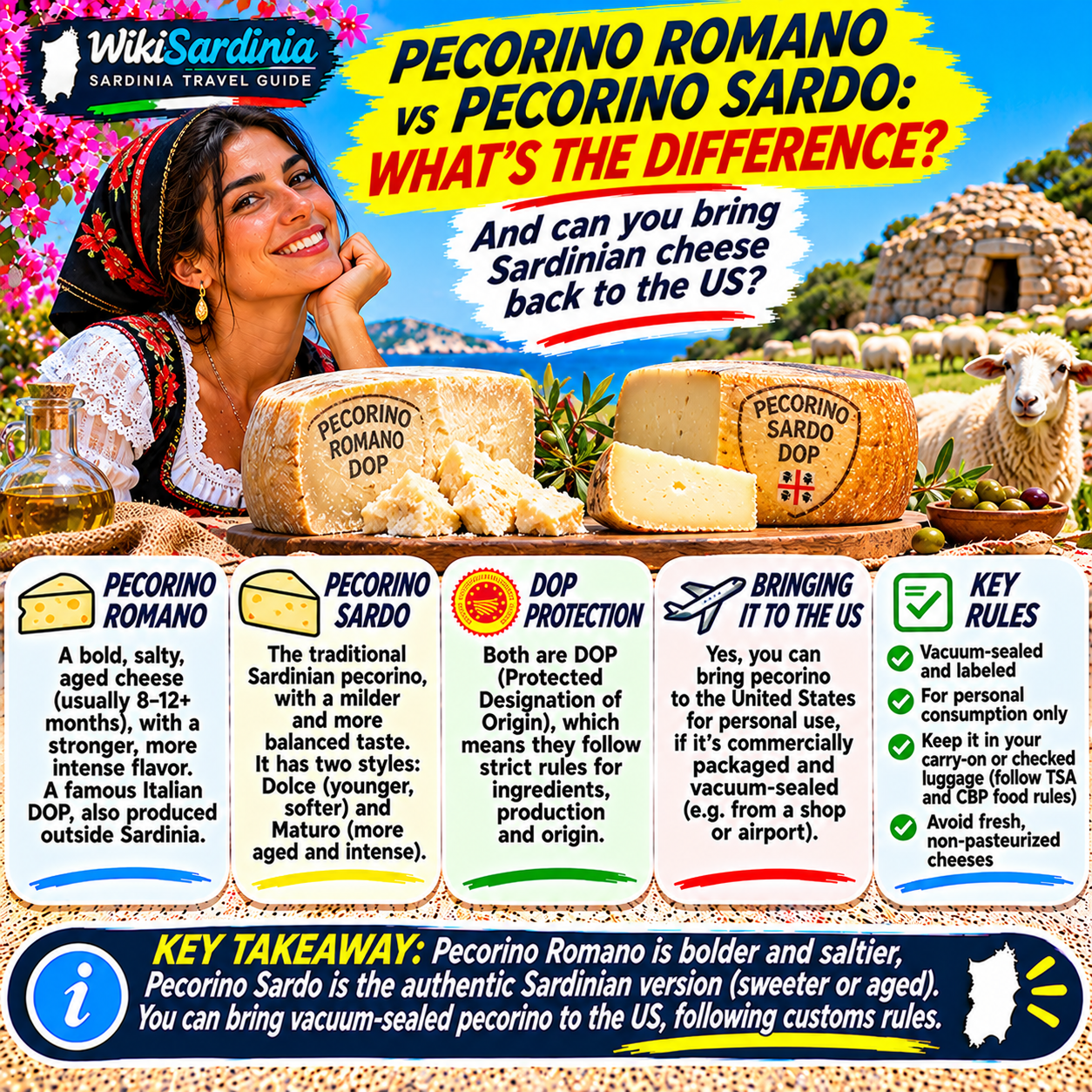
Pecorino Romano DOP is a firm, characteristically salty sheep’s-milk cheese with a pronounced flavor. Despite the name “Romano,” a substantial share of its production takes place in Sardinia, which is one of the authorized production areas under its protected designation. It is widely grated over pasta, although it can also be eaten as a table cheese. Under the PDO specification, the minimum maturation period differs according to its intended use: at least five months for table cheese and eight months for grating cheese. Learn more from the Pecorino Romano consortium.
What is Pecorino Sardo?
Pecorino Sardo DOP is specifically associated with Sardinia and is produced on the island according to its own protected specification. It has two main types: Dolce, which is younger and generally softer and milder, and Maturo, which is aged longer and develops a firmer texture and more assertive taste. It is an excellent way to explore the island’s sheep-farming and cheese-making traditions. See the Pecorino Sardo consortium.
What is the difference in taste?
Pecorino Romano is typically sharper and saltier, making it a popular seasoning for pasta and savory dishes. Pecorino Sardo Dolce is often gentler and pleasant as a table cheese, while Pecorino Sardo Maturo is more intense and can also be grated. Both vary with aging and production, so tasting them side by side at a Sardinian cheese shop is the best way to discover your favorite.
What does DOP mean?
DOP stands for Denominazione di Origine Protetta, the Italian name for the European Union’s Protected Designation of Origin system. It protects a product name and links production to a defined geographical area and official specification. The label does not mean the two cheeses are interchangeable, and it does not override US import restrictions.
Can I bring vacuum-sealed Pecorino back to the United States?
Often yes for ordinary hard or aged cheese bought for personal consumption, but the answer depends on the cheese’s ingredients, processing, country of origin and the animal-health restrictions in effect on your travel date. The US Department of Agriculture’s Animal and Plant Health Inspection Service (USDA APHIS) provides the official rules for travelers carrying milk, dairy products and eggs. Check its traveling with dairy products guidance before you buy. Do not assume that every soft, fresh, raw-milk or mixed-ingredient cheese is admissible simply because it is vacuum-packed.
Does vacuum sealing make a difference?
Vacuum sealing can reduce leaks and odors, help protect the packaging and make a cheese easier to identify and inspect. It does not provide a customs exemption or prove that a dairy product meets US import rules. Commercial packaging with a clear label, ingredients, producer and country of origin is helpful, and keeping the purchase receipt is sensible. The product may still be inspected and, if not permitted, refused entry.
Do I need to declare the cheese at US customs?
Yes. Declare food and agricultural products when entering the United States. This applies even if the cheese is sealed, was purchased in an airport shop, or is only a small gift. US Customs and Border Protection explains that travelers must declare agricultural items and that officers determine admissibility at the border. Declaring an item honestly is important even if it is ultimately not allowed. See CBP guidance on agricultural items.
Should I put cheese in carry-on or checked luggage?
Solid cheese is generally permitted through US Transportation Security Administration screening in both carry-on and checked bags, although officers can inspect items. Soft or spreadable products may be treated differently under liquids and gels screening rules. TSA’s solid-cheese guidance addresses security screening, not customs import permission. Also check your departure airport, connecting airports and airline baggage policies, because the TSA rules alone do not govern every stage of an international journey.
What if the cheese needs refrigeration?
Vacuum sealing does not replace refrigeration. Ask the cheesemonger about the product’s storage requirements and how long it can safely remain outside refrigeration. If the label says to keep it chilled, plan accordingly; long flights, airport transfers and summer temperatures can make transport challenging. An aged hard cheese is often more travel-friendly than a fresh soft cheese, but follow the producer’s instructions.
What should I buy as a gift?
For a visitor wanting a robust flavor for pasta, a labeled wedge of Pecorino Romano DOP is a classic choice. For someone interested in distinctly Sardinian cheese, consider Pecorino Sardo Maturo, or Dolce if you can maintain the required storage conditions and confirm import eligibility. Buy from a reputable shop, request suitable packaging and retain the label. For any cheese, check current US rules rather than relying on the seller’s assurance alone.
Are there quantity limits?
Products carried for personal use are treated differently from commercial shipments, but there is no single universal allowance that makes every cheese or every quantity admissible. Large amounts may raise questions about commercial intent, and separate customs duty or declaration rules may apply. Check the relevant USDA APHIS and CBP guidance for your situation.
The WikiSardinia takeaway
Pecorino Romano DOP is typically saltier and more assertive, while Pecorino Sardo DOP offers a milder Dolce style and a more mature Maturo style. Both make memorable Sardinian food discoveries. If you want to take cheese home to the United States, choose a clearly labeled product, pack it according to storage instructions, declare it at customs and verify current USDA APHIS import rules before traveling. A vacuum seal is useful packaging, not a guarantee of admission.