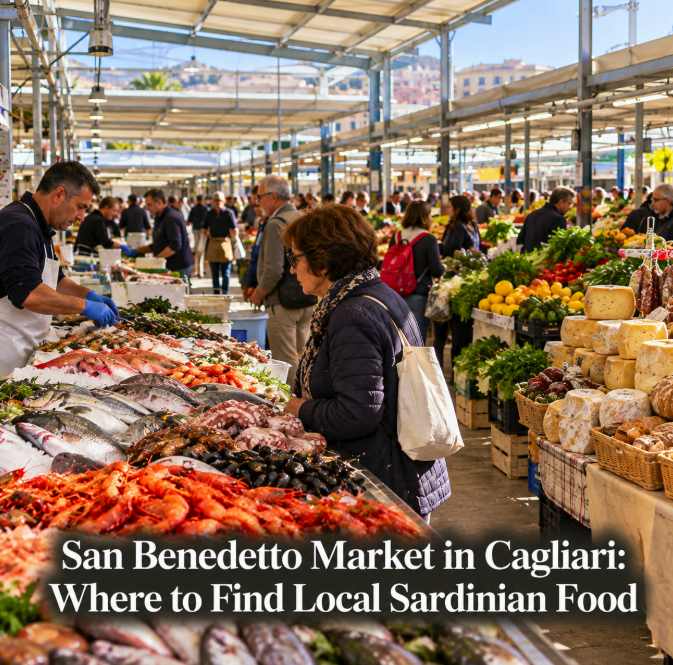
San Benedetto is Cagliari’s best-known food market, but visitors following an older guidebook need to know about an important change: the historic market building in Via Francesco Cocco Ortu is currently closed for renovation. The traders have moved to a temporary covered market in Piazza Nazzari, near the Teatro Lirico, where the San Benedetto market continues to sell fish, meat, fruit, vegetables, bread, cheese, cured meats, wine and other everyday Sardinian foods.
The temporary setting is different from the famous two-level building that generations of Cagliaritani knew as simply “the Market,” but the municipal administration transferred the operators rather than suspending the market. For travelers interested in local food, it remains one of the most useful morning stops in Cagliari.
Where San Benedetto Market is now
The current San Benedetto municipal market is in Piazza Nazzari. The City of Cagliari says the temporary covered structure has an area of about 4,000 square metres, including roughly 2,700 square metres devoted to sales, and accommodates around 170 commercial activities.
It can be entered from Via Sant’Alenixedda, Via Bacaredda and Via Cao di San Marco. The market is also accessible to people with disabilities.
Public transport is straightforward. Cagliari’s official tourism service identifies CTM bus line M and the “via Bacaredda - mercato civico” stop as a convenient connection. Visitors staying in central Cagliari can also combine the market with a walk through the surrounding San Benedetto district.
Go in the morning
San Benedetto is a morning market. Current official opening hours are 7:00 a.m. to 2:00 p.m. from Monday to Friday and 7:00 a.m. to 3:00 p.m. on Saturday. It is closed on Sunday.
For visitors, arriving between roughly 8:00 and 11:00 a.m. is a practical choice. The market is fully active, there is time to browse without worrying about closing, and you can turn the visit into a late breakfast or pre-lunch food stop.
Saturday gives you an extra hour but can naturally be busier. If photography and slow browsing matter more than atmosphere, a weekday morning may feel easier.
Start with the fish counters
San Benedetto has long been particularly associated with seafood. Cagliari faces the Gulf of the Angels and sits within a wider coastal food culture where fish, shellfish and bottarga are central ingredients.
The exact catch changes with season and availability, so a market visit is more interesting when you look at what is actually on the ice rather than arriving with a rigid shopping list. Depending on the day, counters can include Mediterranean fish, molluscs and crustaceans destined for local home kitchens and restaurants.
If you are staying in an apartment, ask the fishmonger what is suitable for the way you plan to cook. Simple phrases such as da fare alla griglia for grilling or da fare al forno for baking can help start the conversation.
Travelers without a kitchen can still use the fish section as a window into Cagliari’s food culture, but raw seafood bought at the market should be transported and stored properly. Do not carry fresh fish around the city for hours in warm weather.
Look for Sardinian cheese and cured foods
The temporary market includes delicatessen and cheese stalls, making it a good place to compare Sardinian cheeses beyond the single generic word “pecorino.” Ask what is young, semi-aged or mature and whether a cheese is intended for immediate eating or will travel well.
Pecorino Sardo is one of the island’s protected cheeses, but Sardinia’s dairy culture is broader than one designation. A knowledgeable seller can point you toward different textures and levels of saltiness, including cheeses that work well for a picnic and firmer products better suited to taking home.
You may also find Sardinian cured meats and pantry products. If you are flying outside the European Union, remember that the rules for carrying meat and dairy products depend on your destination country. A product being vacuum-packed does not automatically make it admissible through customs.
Bread, sweets and pantry ingredients
San Benedetto is useful for edible souvenirs because not everything requires refrigeration. The municipal description confirms bakery and confectionery stalls as part of the current market mix.
Look for Sardinian breads and crisp breads, biscuits and other baked products that are easier to carry than fresh seafood or cheese. Depending on the stall and season, you may also find honey, preserved foods, olive products and other ingredients associated with Sardinian cooking.
If you have been searching for pane carasau, the thin crisp bread strongly associated with Sardinia, a food market is a much more interesting place to compare packages than an airport shop. Ask whether there are local or artisanal versions available rather than assuming every packet is equivalent.
Fruit and vegetables reveal the season
The fruit and vegetable stalls are worth browsing even if you are not cooking. They show what Sardinians are buying at that moment of the year rather than what a restaurant menu has decided tourists expect.
Artichokes are important in Sardinian cooking during their season, while tomatoes, citrus, melons, figs and other produce change through the year. The point is not to expect every iconic ingredient every month. Local markets are seasonal by nature.
If you have an apartment or picnic planned, buy only what you can realistically eat. A few tomatoes, fruit, bread and cheese can make a simple Sardinian lunch without requiring a full kitchen.
Do not forget the wine stalls
The current Piazza Nazzari market includes an enoteca, or wine shop. This gives visitors a chance to look beyond the most familiar Sardinian labels.
Cannonau is the island’s best-known red grape, while Vermentino is closely associated with Sardinian white wine. In and around Cagliari, it is also worth asking about wines from southern Sardinia rather than treating the entire island as one wine region.
If you are buying a bottle for dinner, tell the seller what you are eating and your preferred price range. Market shopping works best as a conversation, not as a hunt for a supposedly definitive “best” bottle.
The historic building is closed, not the market
The original San Benedetto market opened on June 1, 1957 and became a symbol of everyday Cagliari. The municipality closed that building for renovation in March 2025 and transferred its operators to Piazza Nazzari.
The temporary market opened on March 18, 2025. Municipal information published in 2026 continues to refer to the operation as San Benedetto–Piazza Nazzari, confirming that visitors should still use the temporary location while the redevelopment continues.
This distinction matters because old travel articles, maps and photographs still point to Via Cocco Ortu 46. Walking there expecting the famous market hall can lead to confusion. For the active food market, use Piazza Nazzari.
What to buy for a simple Sardinian picnic
A market picnic does not need to become an elaborate tasting menu. Choose a piece of Sardinian cheese, bread or pane carasau, seasonal fruit and perhaps a small portion of olives or another prepared product. Add something sweet from a bakery stall and you have a portable lunch that reflects what the market actually sells.
If you are heading to Poetto afterward, remember that dairy, meat and seafood should not sit for hours in a hot beach bag. Buy shelf-stable products for later or return refrigerated food to your accommodation first.
Why San Benedetto is still worth visiting
The temporary pavilion cannot reproduce every architectural detail or memory associated with the old two-level market. Yet San Benedetto’s importance was never only about its building. The municipality describes it as a commercial, social, cultural and tourist reference point for Cagliari, and the transfer preserved the concentration of traders while renovation takes place.
For a traveler, that means the reason to visit remains compelling: instead of seeing Sardinian food presented as a collection of souvenirs, you can see fishmongers, butchers, greengrocers, bakers, cheese sellers and wine merchants working inside an active city market.
Go early, arrive hungry, ask questions and pay attention to what is in season. And until the historic building reopens, remember the detail that matters most: San Benedetto Market is alive and operating, but its current address is Piazza Nazzari.