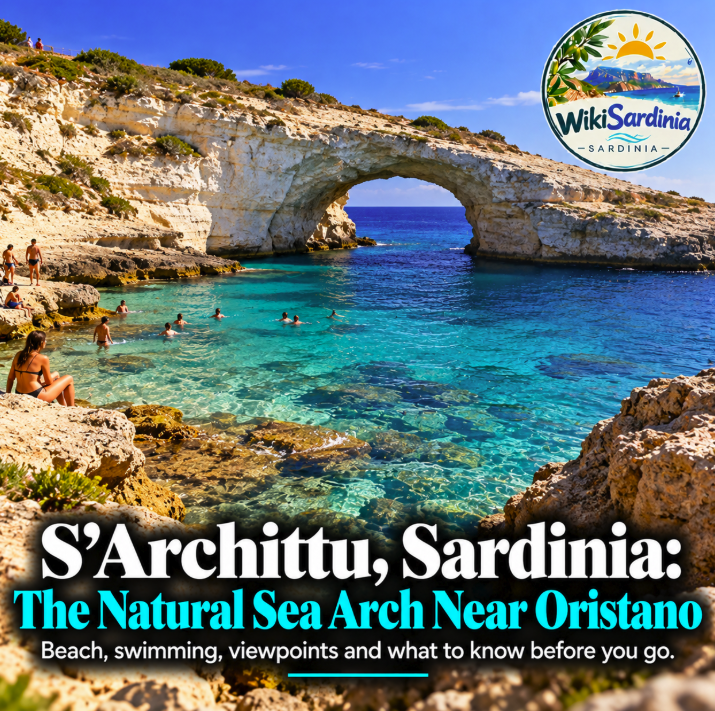
On Sardinia's west coast, a pale limestone cliff curves directly over the Mediterranean and forms one of the island's most recognizable natural landmarks.
This is S’Archittu, a small seaside village in the municipality of Cuglieri, in the province of Oristano.
Its name literally points to the feature that made it famous: the little arch.
What is S’Archittu?
S’Archittu is both a coastal village and the name commonly used for the spectacular natural sea arch beside it.
The Municipality of Cuglieri describes this stretch of coast as a landscape of white cliffs, vertical walls, small rocky islands and fossil-rich limestone promontories.
The sea has gradually carved one of those promontories into the famous arch that now gives the village its name.
Is the arch protected?
Yes. The Municipality of Cuglieri identifies S’Archittu as a protected natural monument, recognized under Sardinian regional legislation.
That status is worth remembering when visiting: this is not simply a photogenic rock formation but a protected geological feature.
Where is S’Archittu?
S’Archittu lies on the central-western coast of Sardinia in the territory of Cuglieri, north of Oristano.
It sits between the nearby coastal settlements of Torre del Pozzo and Santa Caterina di Pittinuri.
This makes it an easy stop on a west-coast road trip through the Oristano area.
How far is S’Archittu from Oristano?
The village is roughly 20–25 kilometres north of Oristano by road, depending on your starting point and route.
It is close enough for an easy half-day excursion, although combining it with other places along the Cuglieri coast can turn it into a full day.
Is there actually a beach at S’Archittu?
Yes, although visitors expecting a huge sweep of fine white sand may be surprised.
The attraction here is the combination of small coastal areas, rock platforms, pale cliffs and exceptionally clear water around the natural arch.
S’Archittu is much more about its geological setting and swimming atmosphere than the classic long sandy-beach experience.
Can you swim at S’Archittu?
In suitable sea conditions, swimming around the bay is one of the pleasures of visiting.
The transparent water and pale rock can produce beautiful blue and turquoise colors, especially when the sea is calm.
But this is an exposed west-coast environment. Conditions can change with wind and swell, and rock entries can become slippery.
Never assume that because people are swimming in photographs, conditions are safe on the day you arrive.
Can you swim through the arch?
Strong swimmers may see people in the water around and beneath the arch during calm conditions.
Whether that is sensible on a particular day depends on swell, currents, boat activity and local restrictions.
If the sea is rough, admire the arch from shore. The photograph is not worth taking unnecessary risks.
What about jumping from S’Archittu?
The arch has a long association with cliff diving and has attracted expert divers in the past.
That does not make jumping from it an ordinary tourist activity.
Height, underwater conditions, swell and changing local rules make cliff jumping potentially dangerous. Do not copy videos or other visitors without verified local safety information and appropriate expertise.
The best thing to do: walk to the arch
You do not need a boat or specialist equipment to enjoy S’Archittu.
A coastal pedestrian route leads from the village toward the natural monument, providing changing views of the rock formation as you approach.
The walk itself is part of the experience, particularly in the evening when the limestone catches warmer light.
S’Archittu is a superb sunset location
The west-facing Sardinian coast is naturally suited to sunset.
At S’Archittu, the arch gives the horizon a ready-made frame.
Depending on the season and the sun's position, the light can illuminate the limestone or appear through and around the opening, while the sea turns gold and orange.
Arrive before sunset rather than at the last minute so you can explore the viewpoints safely in daylight.
October is still worth it
S’Archittu is not only a July-and-August destination.
In October, the village is much quieter and the coastal walk can be more pleasant without peak-summer heat.
Swimming depends entirely on weather and sea conditions, but even on a day when you never enter the water, the natural arch is worth seeing.
Autumn also gives photographers dramatic skies and stronger Atlantic-facing coastal weather.
What is the rock made of?
The coast around S’Archittu is characterized by pale sedimentary rock, including limestone formations rich in fossils.
Wave erosion exploits weaknesses in coastal rock over long periods, enlarging cracks and cavities until openings such as sea arches can form.
The result at S’Archittu is unusually elegant: a broad natural bridge standing directly over the sea.
Do not climb fragile sections
Natural arches are products of erosion, and erosion does not stop when a place becomes famous.
Avoid damaging or disturbing the rock and respect any barriers, signs or temporary restrictions.
The safest viewpoint is not necessarily the most dramatic-looking position someone has used for a social-media photograph.
What else is nearby?
Santa Caterina di Pittinuri is just along the coast and has another striking setting beneath cliffs and a historic coastal tower.
The Municipality of Cuglieri describes its shoreline as predominantly rocky, with a pebble beach whose stones reveal the area's complex geology.
In the other direction, Torre del Pozzo offers more coastal scenery and views toward Capo Mannu.
Combine S’Archittu with Cuglieri
Do not automatically stay on the coast.
The inland town of Cuglieri sits around 479 metres above sea level on the slopes of the Montiferru massif.
From the historic town, the landscape descends through forests and countryside toward the three coastal settlements of Santa Caterina di Pittinuri, Torre del Pozzo and S’Archittu.
It is a good way to understand that this corner of Sardinia is more than a single beach stop.
Parking in summer
The Municipality of Cuglieri operates managed paid parking areas in S’Archittu and Santa Caterina during the summer season.
For 2026, the municipality formally tendered the seasonal management of these paid parking and beach-service areas.
Outside peak season, arrangements may differ, so follow current local signage rather than assuming summer restrictions apply year-round.
Is S’Archittu suitable for children?
Families can enjoy the village, coastal walk and sheltered-looking parts of the bay, but this is a rocky environment rather than a uniformly shallow sandy beach.
Watch children carefully around rock edges and slippery shoreline areas, and make swimming decisions based on actual sea conditions.
What shoes should you wear?
For the village and main coastal approach, ordinary comfortable walking shoes are sufficient for most visitors.
If you plan to explore rocky sections near the water, footwear with grip is much better than smooth flip-flops.
Wet limestone can be slippery.
When is the best time to visit?
For swimming, choose a calm summer or early-autumn day.
For photography, late afternoon and sunset are difficult to beat.
For a quieter experience, May, June, September and October avoid much of the peak-season pressure while still offering excellent coastal light.
WikiSardinia's verdict
S’Archittu is not the place we would choose if your only goal were kilometres of soft sand.
Go because the landscape is different.
You can walk out of a tiny west-coast village and, within minutes, stand opposite a protected limestone arch sculpted by the Mediterranean.
Pair it with Santa Caterina di Pittinuri, Cuglieri or a longer Oristano coast road trip, and S’Archittu becomes one of those small Sardinian stops that is far more memorable than its size suggests.