
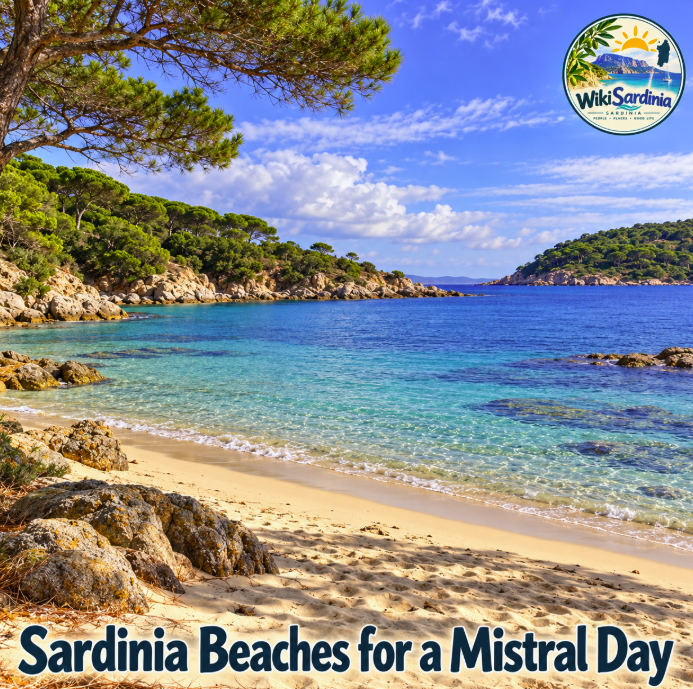
When the Mistral disrupts an October beach day in Sardinia, look for a sheltered setting close to your base rather than chasing the island’s most famous stretch of sand. Mugoni near Alghero and Cala Suaraccia near San Teodoro are two options worth assessing. They offer different geography, but neither can be declared calm or safe to swim from a destination description alone.
We could not confirm a forecast valid for 4 October 2026 from the ARPAS pages accessed for this guide. The reported strong wind today should therefore be treated as a condition to check locally, not an island-wide weather bulletin verified here.
Mugoni for an Alghero-area plan
Sardegna Turismo describes Mugoni as sheltered within the almost enclosed bay of Porto Conte, about 16 kilometres from Alghero. That makes it a sensible place to consider if you are staying around Alghero and want an alternative to a more exposed coastal setting.
The bay’s shape is the reason to shortlist it, rather than a promise that the weather disappears once you arrive. Walk to the beach and assess the actual wind before unloading everything. Conditions can differ across a bay, and a pleasant place to sit does not establish that the water is suitable for your group.
For an October outing, keep the plan simple: a beach walk, a comfortable stop and the option to leave if it is unpleasant. Check parking arrangements and access locally. A description of summer facilities does not establish that refreshments, rentals or supervision are available on your date.
Cala Suaraccia for the northeast
For visitors around San Teodoro and Capo Coda Cavallo, Cala Suaraccia, also called Le Farfalle, has a more explicit wind-related description. The regional tourism site calls it a bay sheltered from the Mistral, with Mediterranean vegetation behind it and views toward Molara and Tavolara.
That is useful evidence for choosing a candidate beach. It is still not a measurement of today’s gusts, waves or currents. Go with a flexible plan and decide what is appropriate after checking current information and observing the shoreline.
Cala Suaraccia and Mugoni belong to different parts of the island. Choose the one that fits where you are staying. A long drive across Sardinia to pursue an uncertain improvement can consume the daylight you hoped to spend outside.
Check the wind and the sea separately
Maestrale is the Italian name for the northwesterly Mistral. A headland can reduce the wind felt on part of a beach, but shelter on land does not settle the condition of the water. Do not use a still patch near the sand as your only basis for deciding to swim.
Consult the ARPAS marine bulletin and its detailed area forecasts, checking the issue time and the period they cover. An older page returned by a search engine may concern yesterday or another forecast interval.
Then check local notices and any advice from beach staff. If a warning or restriction applies, a general travel guide does not override it. If no supervision is available, do not interpret that absence as an indication that swimming is permitted or safe.
A sheltered visit can still be worthwhile without a swim
October beach plans work better when the visit has more than one purpose. Bring a layer for wind, choose an accessible stretch for a walk and keep your return straightforward. Families can enjoy looking at the bay without committing to entering the water.
Do not replace an uncomfortable beach with an exposed cliff walk simply to stay by the sea. Pick a setting that suits the conditions and your group, and be ready to spend the afternoon in town if the coast is unpleasant.
For a practical choice, start near your accommodation, check a current forecast and assess the beach on arrival. Mugoni offers Porto Conte’s enclosed setting; Cala Suaraccia has documented Mistral shelter. Those are useful starting points for a decision, while today’s conditions determine the activity.


