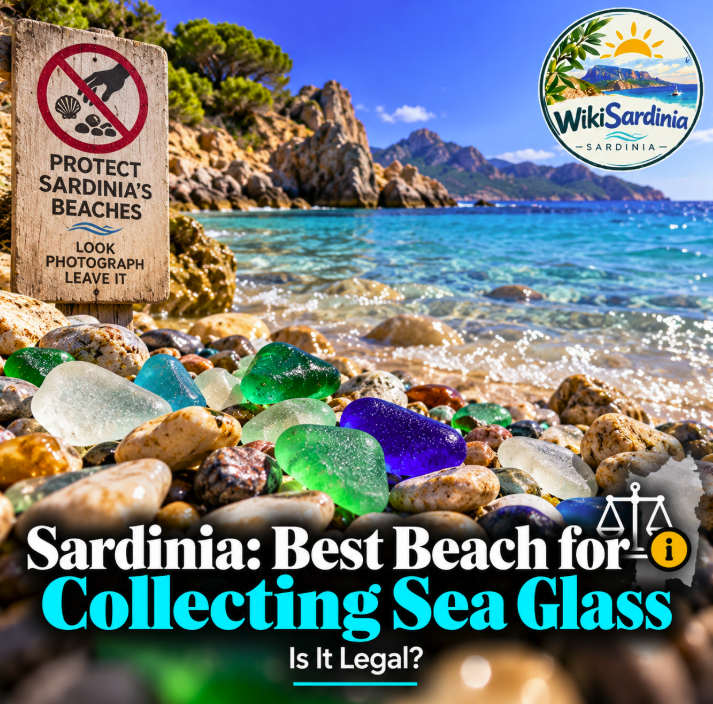
Finding a piece of frosted blue or green glass among the stones can feel like discovering a tiny piece of Mediterranean history.
But if you are beachcombing in Sardinia, there is a more important question than where to find sea glass:
Can you legally take it home?
The safest answer in Sardinia is simple: look at it, photograph it and leave it on the beach.
Sardinia has unusually strict rules about taking beach material
In July 2026, the Autonomous Region of Sardinia again reminded residents and visitors that removing, possessing or selling coastal materials is prohibited.
The Region specifically lists sand, pebbles, stones and shells and states fines ranging from €500 to €3,000.
The 2026 regional bathing ordinance also confirms environmental safeguards against removing material from Sardinia's beaches.
Does the rule specifically say “sea glass”?
This is where the answer needs nuance.
The Region's public 2026 guidance explicitly names sand, pebbles, stones and shells. Sea glass is not separately named in that short list.
Sea glass is normally manufactured glass that has been rounded and frosted by years of movement in the sea, so it is not geologically the same thing as a natural pebble.
That does not make collecting it an obviously safe legal loophole.
The safest interpretation is not to remove beach finds
Sardinia's coastal-protection rules are intentionally strict, and local or protected-area rules can be broader than a short public-information list.
Trying to decide at the shoreline whether a particular object legally counts as litter, coastal material, an archaeological object or something protected by a site-specific rule is not a sensible holiday gamble.
If your goal is simply to collect a souvenir, leave the sea glass where you found it.
Why WikiSardinia does not recommend a “best beach to collect it”
There are online reports of visitors finding sea glass on Sardinian beaches, including rocky and pebbly stretches in northern Sardinia.
But reliable evidence for one consistently productive “sea glass beach” on the island is weak.
A specialist 2026 Italian sea-glass guide specifically left Sardinia out of its recommended collecting locations because it could not document a sufficiently reliable named beach and because Sardinia's beach-material rules make the island a poor destination for filling a souvenir pouch.
So we would not send travelers to a fragile Sardinian beach with instructions to remove material from it.
You can still go sea-glass spotting
There is a much better version of the activity: sea-glass spotting rather than collecting.
Walk slowly along a pebbly shoreline, especially after rough weather, and look among the wet stones for pieces with rounded edges and a matte, frosted surface.
White, brown and green are common bottle-glass colors. Blue and aqua are less common and particularly beautiful when wet.
Take a photograph in place, then leave the piece for the next person — and for the beach.
Do not confuse sharp broken glass with sea glass
Real sea glass has normally spent enough time being tumbled by waves and sediment that its edges become rounded and its surface develops a frosted appearance.
Fresh broken bottle glass is different.
If you find a sharp fragment that is clearly recent litter and poses a danger, the environmental issue is waste removal rather than souvenir collecting. Use common sense and avoid handling sharp glass with bare hands.
What if you find pottery?
Be more cautious.
A small ceramic fragment may be modern rubbish, but Sardinia has an exceptionally rich archaeological record stretching from prehistoric and Nuragic cultures through Phoenician, Punic, Roman, medieval and later periods.
If an object looks genuinely old or potentially archaeological, do not pocket it.
Photograph it, record the location and report a potentially significant find to the relevant authorities rather than removing it as a souvenir.
Protected areas require even more care
Sardinia contains marine protected areas, parks, reserves and other environmentally sensitive coastal zones.
These places can have additional rules governing what visitors may touch, remove or disturb.
Never assume that something is collectible simply because it is loose on the shoreline.
Read signs at beach entrances and follow the rules of the specific protected area.
Never take sand, pebbles or shells
Here the rule is much clearer.
The Region's 2026 visitor guidance explicitly says that sand, pebbles, stones and shells must not be removed, possessed or sold.
The published fine is €500 to €3,000.
That applies whether the amount looks insignificant or whether you intended to keep it only as a small holiday souvenir.
Why is Sardinia so strict?
A handful of sand feels negligible to one visitor.
Multiply that behavior by millions of beach visits and the cumulative effect is different.
Sardinia's campaign frames its beaches as a shared natural resource and explicitly reminds visitors that even one grain of sand is precious.
The rules also protect dunes and other coastal ecosystems from damage and prohibit activities that degrade the shoreline.
Can airport or ferry controls find beach material?
Sardinia has spent years combating the removal of sand and other beach material, and confiscations from travelers have been widely documented.
The practical lesson is straightforward: do not pack beach material in your luggage and hope that a small quantity will be ignored.
A photograph weighs nothing, causes no environmental damage and creates no legal uncertainty.
What makes good sea glass?
For spotting and photography, look for a surface that is visibly frosted rather than shiny.
The edges should be smooth and rounded, with none of the dangerous sharpness of newly broken glass.
The most familiar pieces originate from bottles and jars, but older glass can appear in many shades depending on its original use and composition.
When is sea glass easiest to spot?
On rocky or pebbly shores, wave action can move small objects into bands of similarly sized material.
After periods of rough sea, newly rearranged stretches of shoreline may reveal objects that were previously buried.
Wet glass is also easier to notice because its color stands out among duller stones.
But Sardinia has a very small tidal range compared with famous Atlantic sea-glass destinations, so classic “low-tide hunting” advice is less important here.
Is Capriccioli a sea-glass beach?
Some travel pages mention sea glass among the objects that can be spotted around Capriccioli on the Costa Smeralda.
That should not be interpreted as permission to collect it.
Capriccioli is valuable precisely because of its natural beauty, and the general Sardinian rule remains the sensible guide: enjoy what the shoreline reveals without treating the beach as a source of souvenirs.
What about Petra Ruja and nearby northern beaches?
There are anecdotal visitor reports from 2026 describing sea glass found around the Petra Ruja/Petra Bianca area.
Those reports are useful evidence that sea glass can occur there, but they are not official collection guidance and they do not establish that removing it is lawful.
We would treat such places as potential spotting and photography locations, not collection sites.
If collecting sea glass is the purpose of your trip, Sardinia is not the best Italian destination
This may sound counterintuitive for an island with almost 2,000 kilometers of coastline.
But the best destination is not simply the place where glass may exist. It is the place where finds are documented and collecting is clearly compatible with local rules.
Specialist sea-glass resources currently document stronger collecting locations elsewhere in Italy, particularly around older urban and port shorelines.
Sardinia is better approached differently: as a place to observe an extraordinary coastline without removing pieces of it.
The simple rule for visitors
If you find something beautiful on a Sardinian beach, ask yourself whether you really need to own it.
For sand, shells, stones and pebbles, the official answer is clear: leave them.
For sea glass, the wording is less explicit, but the environmentally responsible and legally safest choice is exactly the same.
Find it. Photograph it. Leave it.
The next traveler deserves the same moment of discovery.