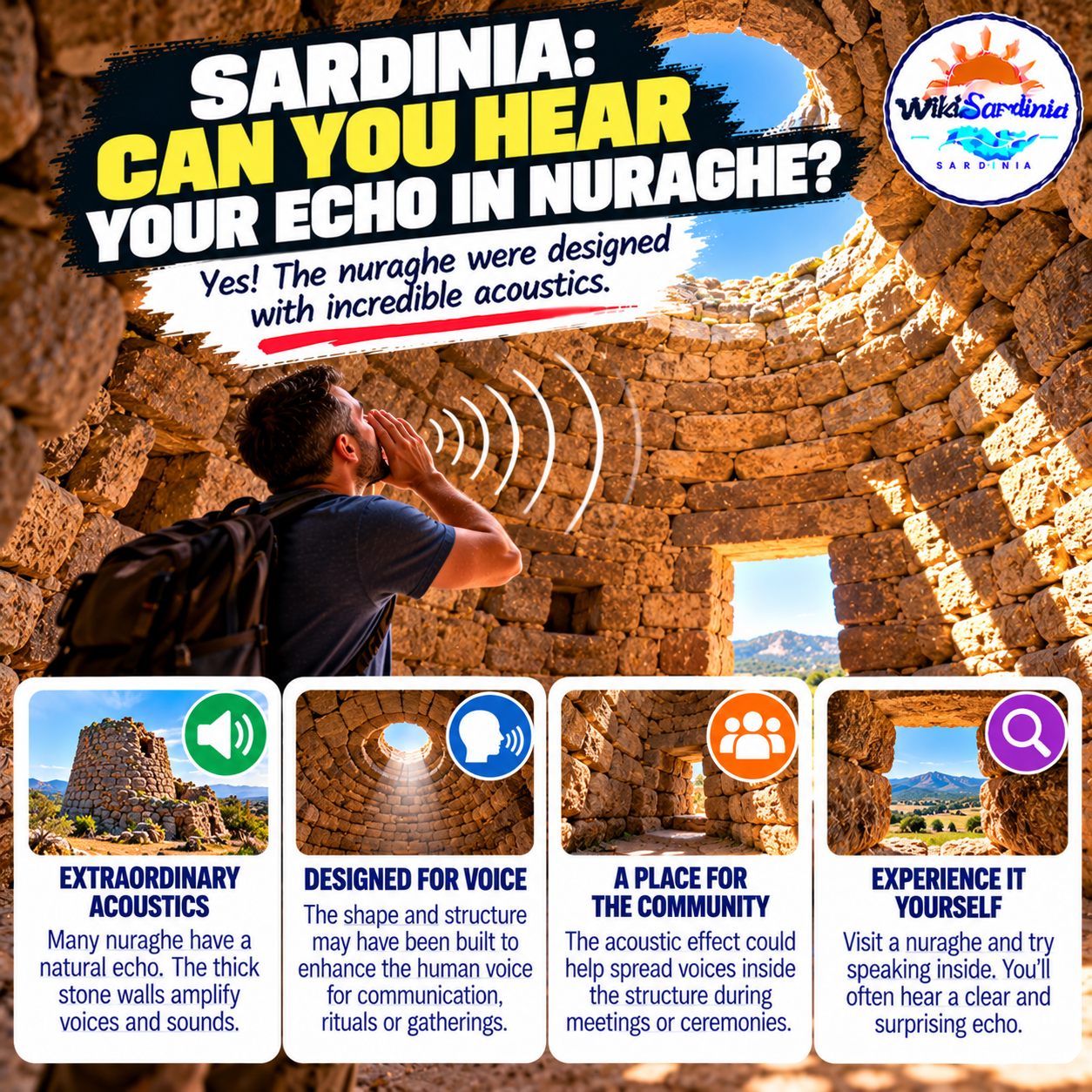
Step inside a Sardinian nuraghe, speak a few words and listen carefully: depending on the chamber, your voice may sound deeper, louder or slightly echoed. It is a fun way to experience these extraordinary prehistoric stone structures—but does that mean the builders designed them specifically for the human voice?
Why can you hear an echo inside a nuraghe?
Many nuraghi contain circular chambers built from thick stone walls, with rows of stones gradually projecting inward to form a corbelled roof. In an enclosed space, sound waves reflect from hard surfaces instead of being absorbed as they would be by soft furnishings. Depending on the chamber’s size, shape, openings and the position of the listener, these reflections can make a voice sound resonant or create a noticeable echo.
The effect will not be identical at every site. Some chambers are partly collapsed, open to the sky or altered over centuries, and the acoustic experience changes with the room’s geometry and background noise.
Were nuraghi designed to amplify voices?
That is an intriguing idea, but it is important to separate an acoustic effect you can experience today from a claim about the builders’ intentions. There is no general proof that nuraghi across Sardinia were all designed as acoustic chambers or specifically to amplify speech. A space can produce a striking echo because of its architecture even if sound was not the main reason for building it.
Archaeologists interpret nuraghi through their construction, location, associated settlements and the objects found during excavations. The best-known examples are understood primarily as Bronze Age defensive or monumental structures, although their roles could change over time.
What were nuraghi used for?
Nuraghi are distinctive stone towers built by Sardinia’s Nuragic civilisation, especially during the Bronze Age. Their form varies from single towers to complex structures with several connected towers and surrounding settlements. Their elevated positions and robust construction support defensive interpretations, while archaeological evidence also shows that some sites were later reused for sacred, social or other community purposes.
It is therefore too simple to give every nuraghe one identical function. Different buildings may have served different roles, and their use could change over the many centuries in which communities lived around them.
How to try the acoustics respectfully
If you visit a site that is open to the public, ask your guide whether there is a safe place to listen to the sound inside. Speak at a normal volume rather than shouting, and follow any instructions about where visitors may go. Some chambers are fragile, restricted or unsafe to enter without a guide.
- Pause in an accessible chamber and listen before speaking.
- Say a short sentence softly and notice how the sound changes.
- Compare the sound near the centre with the sound closer to an opening, if the route allows.
- Do not climb on walls, enter closed areas or touch fragile masonry.
- Be considerate of other visitors and avoid loud noise at archaeological sites.
Which nuraghe should you visit?
Su Nuraxi di Barumini is Sardinia’s best-known nuragic complex and a UNESCO World Heritage Site. Its towers, passages and surrounding remains offer a vivid introduction to Nuragic architecture. Access to individual spaces may depend on the current visitor route, so check the official site information before planning to test the acoustics.
Other nuraghi across the island have different layouts and states of preservation. If sound interests you, ask a local guide to explain the chamber’s shape and what is known—and not known—about its original use.
The short answer
Yes, you may hear an echo or a resonant voice inside some nuraghi, because their enclosed stone chambers reflect sound. But that does not prove the structures were deliberately designed for singing, ceremonies or voice amplification. Their acoustic qualities are a fascinating part of the experience, while the exact purposes of individual nuraghi remain a question for archaeological evidence.
For reliable background, read UNESCO’s overview of Su Nuraxi di Barumini and its broader description of the Nuragic monuments of Sardinia.