
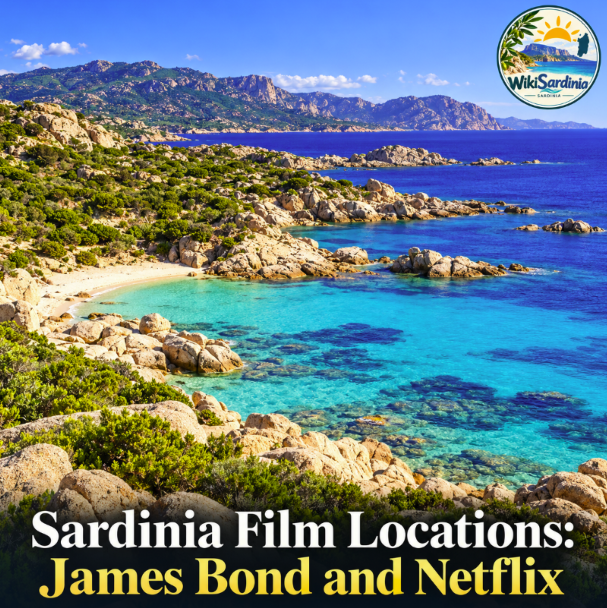
Sardinia’s film locations offer more than a familiar beach backdrop: they can give a holiday a route and a reason to stop. James Bond fans should start in the northeast, where The Spy Who Loved Me used the Costa Smeralda. Netflix-linked productions lead elsewhere, including Cartoe on the east coast and Capo Boi in the southeast. The useful distinction is between a verified filming location, a fictional setting and a place you can actually visit.
James Bond’s Sardinia: The Spy Who Loved Me
Roger Moore’s 1977 Bond adventure is the essential starting point. The official James Bond archive identifies Sardinia and its Lotus Esprit chase as part of the film’s Italian journey. The island’s association with 007 is therefore documented, rather than a travel rumour based on similar-looking scenery.
The Italian national tourism portal’s Bond itinerary names Palau, where Bond and Anya await the Lotus, and Hotel Cala di Volpe, whose reception, waterfront and piano bar appear in the film. It also connects Capriccioli with the car’s emergence from the sea and the area near Hotel Pitrizza with its plunge into the water. These are screen associations, not invitations to reproduce a stunt or enter hotel grounds without permission.
For a practical holiday, use those names to organise a northeast Sardinia outing. Decide whether your priority is the hotel atmosphere, the coastal scenery or the film’s arrival sequence, then give that stop enough time. Comparing a saved still with the surroundings can be enjoyable, but remember that editing joins separate places into a continuous adventure.
Netflix films: Cartoe and Capo Boi
Red Notice also brought a major international production to Sardinia. The Sardegna Film Commission’s 2021 report lists it among productions supported on the island. For a specific beach connection, La Nuova Sardegna’s contemporary reporting documents filming at Cartoe, in Dorgali’s territory, in November 2020, as well as offshore work along the coast between Cala Luna and Capo Monte Santo.
Cartoe gives visitors a named landscape to research rather than an unspecified “Netflix beach”. However, a report of filming does not mean that every scene in the finished film shows Sardinia as Sardinia, or that a particular actor appeared at every location. Treat the production connection as an added layer of interest when choosing a coastal visit.
What We Wanted offers a different mood. This relationship drama uses a Sardinian holiday setting, with filming around Capo Boi near Villasimius identified by SardegnaTurismo. Producer Giovanni Pompili also discussed the use of the Falkensteiner resort at Capo Boi in an interview about the production. Contact the property before planning any visit to its interiors or facilities; its screen appearance does not establish public access.
A Sardinian Netflix setting is not always a film
Netflix’s own Media Center confirms Sardinia as the setting of Love Never Lies: Destination Sardinia, a reality series featuring two villas. That confirms the island connection but does not provide a visitor address or access arrangements. Do not turn an unidentified villa seen on screen into a sightseeing destination, especially where it may be someone’s private property.
Build a route around places, not a montage
Choose one area first. A Bond-focused trip belongs around Palau and the Costa Smeralda; Cartoe is a separate east-coast choice; Capo Boi fits a southeast itinerary. Trying to cover all three as a casual afternoon excursion would make the screen connection more important than enjoying the actual places.
Before travelling, check the current approach, parking, accommodation arrangements and any access restrictions for each stop. Ask hotels directly about reservations if you want to visit a bar or restaurant. For beaches, plan around the conditions on the day rather than the calm water shown in a film. Finally, check Netflix availability in your own country before making a viewing list: distribution and catalogue listings can change. A little preparation lets the cinema connection enrich a Sardinian holiday without confusing a past production with an operating attraction.


