
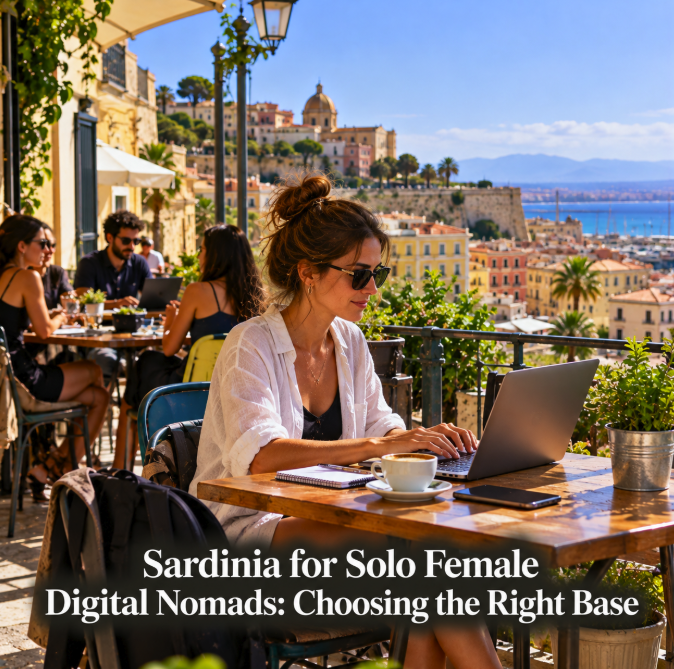
For a solo female digital nomad choosing a base in Sardinia, the useful questions go beyond which town has the prettiest beach. Reliable internet at the exact apartment, walkable daily life, transport after dark, year-round activity and opportunities to meet people all matter. Cagliari, Alghero and Olbia can each work, but they offer noticeably different versions of island life.
No Sardinian town should be described as automatically safe for every solo traveler, and crime statistics alone cannot predict an individual experience. Normal precautions still matter: choose accommodation on a well-used street, understand how you will get home at night, keep control of drinks and valuables, and use licensed transport when a walk feels uncomfortable. With that in mind, the three cities can be compared on practical infrastructure rather than vague promises.
Cagliari: the strongest urban ecosystem
Cagliari is Sardinia's capital and the island's largest urban center. Its official tourism service describes a metropolitan area of roughly half a million inhabitants, with culture, nightlife, shopping, parks and the sea all part of the city's everyday life. That scale matters for a remote worker because it creates more opportunities to build routines that do not depend on the summer tourism season.
The central neighborhoods of Stampace, Villanova and the lower parts of Castello put cafés, restaurants and services within walking distance. Castello is atmospheric but hilly, so anyone carrying a laptop every day may prefer the flatter areas around Villanova, Stampace, Marina or the streets between the center and San Benedetto.
Cagliari also has the most complete car-free transport setup of the three. The official city tourism service notes that the center is compact enough to explore on foot, while urban buses and the light-rail network cover wider areas. Poetto and Molentargius are reachable by city bus, and trains connect Cagliari Elmas Airport with the central station at Piazza Matteotti. The port, railway station and principal bus connections are concentrated around the lower city.
For a solo remote worker, that reduces dependence on taxis and rental cars. It also means that living near the center does not require sacrificing access to the beach.
Wi-Fi: verify the apartment, not just the city
Sardinia has seen substantial expansion of fiber infrastructure, but city-level coverage statistics are not a guarantee that one rental apartment has a fast connection. AGCOM's official Broadband Map exists specifically to let users check fixed and mobile network technologies down to individual addresses.
Before booking a month-long stay, ask the host for a recent speed test taken inside the apartment. Check download speed, upload speed and latency, especially if your work involves video calls, large files or remote desktops. Ask whether the connection is private to the apartment or shared across an entire guesthouse.
Also confirm that there is a proper table or desk and a usable chair. A listing that advertises Wi-Fi may still be uncomfortable for eight hours of work.
Cagliari's official accommodation directory allows properties to be filtered for Wi-Fi, but the presence of Wi-Fi says nothing about its actual performance. For a work-critical stay, verify the address with the AGCOM Broadband Map and request a current test from the host.
Community is easier in a larger city
“Digital-nomad community” is difficult to measure because informal meetups, coworking groups and international residents change throughout the year. Cagliari's advantage is not that every café is full of nomads; it is that a larger resident population supports more cultural events, professional networks, gyms, language exchanges and social activities outside the tourism economy.
That can be especially useful for a woman traveling alone for several weeks. A sustainable social life often comes from repeated activities rather than hoping to meet people spontaneously in a tourist bar. A coworking space, fitness class, climbing gym, language exchange or recurring cultural event gives you a reason to see the same people again.
Summer naturally brings more international visitors, while winter feels more local. If you want a month-long stay in January or February, a city with a substantial year-round population has a practical advantage over a resort-oriented destination.
Alghero: compact, coastal and easier to know quickly
Alghero is smaller than Cagliari and has a very different rhythm. Its historic center, bastions, marina and waterfront are concentrated within a compact area, making daily life easy to understand quickly. For a solo traveler who values walking to coffee, dinner and the sea, that scale is attractive.
The trade-off is seasonality. Alghero remains a real town throughout the year, but tourism has a stronger influence on the local economy and some businesses reduce hours or close outside the main season. The social environment in July is therefore very different from January.
Alghero can suit remote workers who prioritize atmosphere and proximity to the coast over the breadth of services available in the capital. It is also a useful base for exploring Porto Conte, Capo Caccia and northwest Sardinia, although a car becomes more valuable when you want to move beyond the town itself.
Internet should again be checked at the exact accommodation. Never assume that a beautiful apartment inside an old building has the connection quality required for professional video calls.
Olbia: practical for frequent flights and northeast Sardinia
Olbia's main strength for a remote worker is connectivity to northeast Sardinia. Its airport is extremely important during the summer season, and the city is positioned for access to the Costa Smeralda, San Teodoro, Palau and other parts of the northeast.
If your work arrangement includes frequent flights or you plan to mix remote work with weekend exploration, Olbia can be logistically convenient. The city center has normal year-round services and is less dependent on the image of the Costa Smeralda than first-time visitors sometimes assume.
Its weakness for some nomads is that the urban experience is less immediately cohesive than Cagliari's and less postcard-compact than Alghero's historic center. A car becomes useful relatively quickly if your goal is to explore the surrounding beaches and smaller coastal towns.
Olbia is therefore worth considering when airport convenience and northeast Sardinia are priorities, rather than simply because it is close to famous beaches.
Everyday safety for a woman living alone
Choosing a neighborhood carefully is more useful than trying to label an entire Sardinian city “safe” or “unsafe.” Before booking, inspect the route between the accommodation and the places you expect to use at night. A charming isolated apartment can be less convenient than a less photogenic one above an active residential street.
Look for good lighting, nearby supermarkets and cafés, and transport options that continue after your normal working or social hours. Read recent accommodation reviews specifically for comments about noise, street access and the immediate surroundings rather than relying only on the overall rating.
Basic precautions are the same as in other European destinations: keep valuables controlled in crowded areas, do not leave a laptop unattended in a café, avoid isolated shortcuts late at night, and have a transport plan after an evening out. Italy's single emergency number is 112.
Solo travel can also create a practical vulnerability unrelated to crime: nobody notices immediately if you get into difficulty on a hike or remote beach. When leaving the city alone for outdoor activities, tell someone your route, carry water and a charged phone, and avoid assuming that mobile coverage will be perfect everywhere.
Where to stay in Cagliari
Villanova is useful for someone who wants a residential atmosphere close to central cafés and shopping. Stampace offers convenient access to the railway station and lower city. Marina puts restaurants and evening activity close at hand, though individual streets can be noisy. Castello has extraordinary character and views but involves slopes and stairs.
San Benedetto is another practical area for a longer stay. It feels more residential, has extensive everyday shopping and remains within reach of the center. For remote work, a quiet apartment with verified fiber can be more valuable than paying extra for a balcony directly inside the busiest tourist streets.
Whatever neighborhood you choose, check the legal status of short-term accommodation. Italy requires tourist rentals and accommodation businesses covered by the rules to display the national CIN identification code, which can be another useful check when evaluating a listing.
Choosing between the three
Cagliari offers the broadest combination of year-round city life, public transport, airport access, social activities and easy access to an urban beach. Alghero offers a smaller, highly walkable coastal environment that can feel particularly appealing when you want daily life concentrated around an attractive historic center. Olbia makes sense when frequent airport access and exploring northeast Sardinia are central to the stay.
None of those differences determines where an individual woman will feel most comfortable. Someone who prefers small towns may settle into Alghero more easily than Cagliari; someone who wants a busy calendar and less dependence on a car may find the capital more practical.
The best way to make the decision is to treat Wi-Fi, neighborhood and social routine as separate questions. Verify the actual apartment connection, map the walk home from the places you will use, and identify two or three recurring activities where you can meet people. Sardinia can be an excellent remote-work base, but the successful version is usually built around ordinary daily logistics rather than the view from the laptop.


