
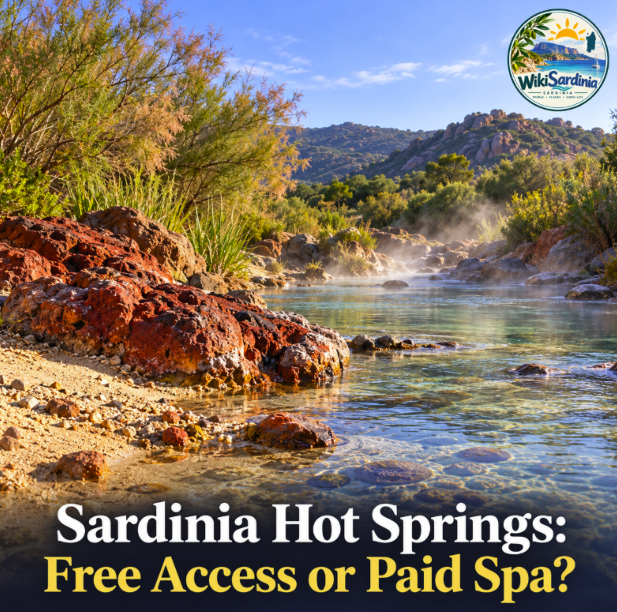
If you are searching for a free natural hot spring in Sardinia, Benetutti and Casteldoria are useful places to investigate—but a spring, a freely accessible landscape and a managed thermal pool are different things. The practical question is not simply which looks best in a photograph. It is what you can access, whether bathing is permitted at the exact spot and which facilities you want during your visit.
Casteldoria: free access to a natural area
The Ministry of Culture’s Idese listing for the Fontana Termale di Casteldoria identifies the natural thermal area at Li Caldani, near the boundary between Viddalba and Santa Maria Coghinas. It lists entry as free and describes hot water emerging from the sandy banks close to the Coghinas River.
This is the strongest distinction for a budget-minded visitor: free entry to the natural area is documented, but that listing is not a ticket to an equipped swimming pool or a blanket authorisation to bathe anywhere in the river. It also lists no parking or bar at the site and only partial mobility accessibility. Check the precise approach and current local information before relying on those arrangements.
The water is another reason to distinguish sightseeing from bathing. Idese describes spring temperatures ranging from about 40°C to 70°C. Those are source temperatures, not a comfortable, controlled pool temperature. Do not enter a spring outlet because it is labelled “natural”, or assume that nearby river water has a uniform temperature.
The Municipality of Santa Maria Coghinas separately describes the Casteldoria thermal establishment. That is a different visitor proposition from the riverside natural area. For pool access, wellness services or treatments, contact the named establishment to confirm what is currently operating and how it can be booked.
Benetutti: springs and organised pool visits
Benetutti’s thermal heritage centres on the San Saturnino area. The National Association of Thermal Municipalities describes springs emerging between 34°C and 43°C, some used by establishments and others freely accessible. That supports the existence of open-access springs, but it does not give a verified current swimming itinerary for a specific unmanaged basin.
For a predictable pool visit, Terme Aurora publishes reservation-based Spa Day options. Its online list shows €30 for a morning-only or afternoon-only thermal-pool package. The same page includes meal packages, pool facilities and requirements for a swimming cap and slippers. Reconfirm the tariff, available session and inclusions before travelling, because the page does not identify a clear validity period for every offer.
Notice the wording carefully: pool use described as “free” within a paid package means included in that package. It does not mean that anyone can enter the establishment without paying. This distinction is easy to miss when reading a search-result excerpt rather than the full price list.
What you are comparing
A natural-area visit suits someone interested in the river landscape and thermal geology, provided access is confirmed. A managed pool visit suits someone who wants a defined session and clearly described facilities. The second option costs money, but the first should not be chosen on the assumption that it offers the same experience without a ticket.
Likewise, a hotel or agriturismo swimming pool with “Casteldoria” in its name is not necessarily a thermal pool. Check the specific property and water source rather than using the place name as proof. Ask whether day visitors are accepted, whether a stay is required and which services are included.
Check the exact site before you go
For a natural spring, contact the relevant municipality or local visitor service about the exact location, current access and any restrictions. A visitor photograph cannot establish water quality, permission or today’s conditions. Respect signs and property boundaries; do not take an informal track as evidence that a bathing spot is open.
For a paid visit, request the session time, final price, booking conditions and information about changing facilities. Explain any access needs before reserving. If you are travelling with children, ask which areas they may use and what the establishment requires. Thermal treatment bookings and leisure-pool admission may also follow different arrangements.
Plan an alternative nearby activity so the day does not depend entirely on an unconfirmed soak. Both destinations have a genuine thermal identity, but the useful choice comes from matching the visit to your expectations: free access where documented, bathing only where permitted and suitable, and paid services understood before booking.


