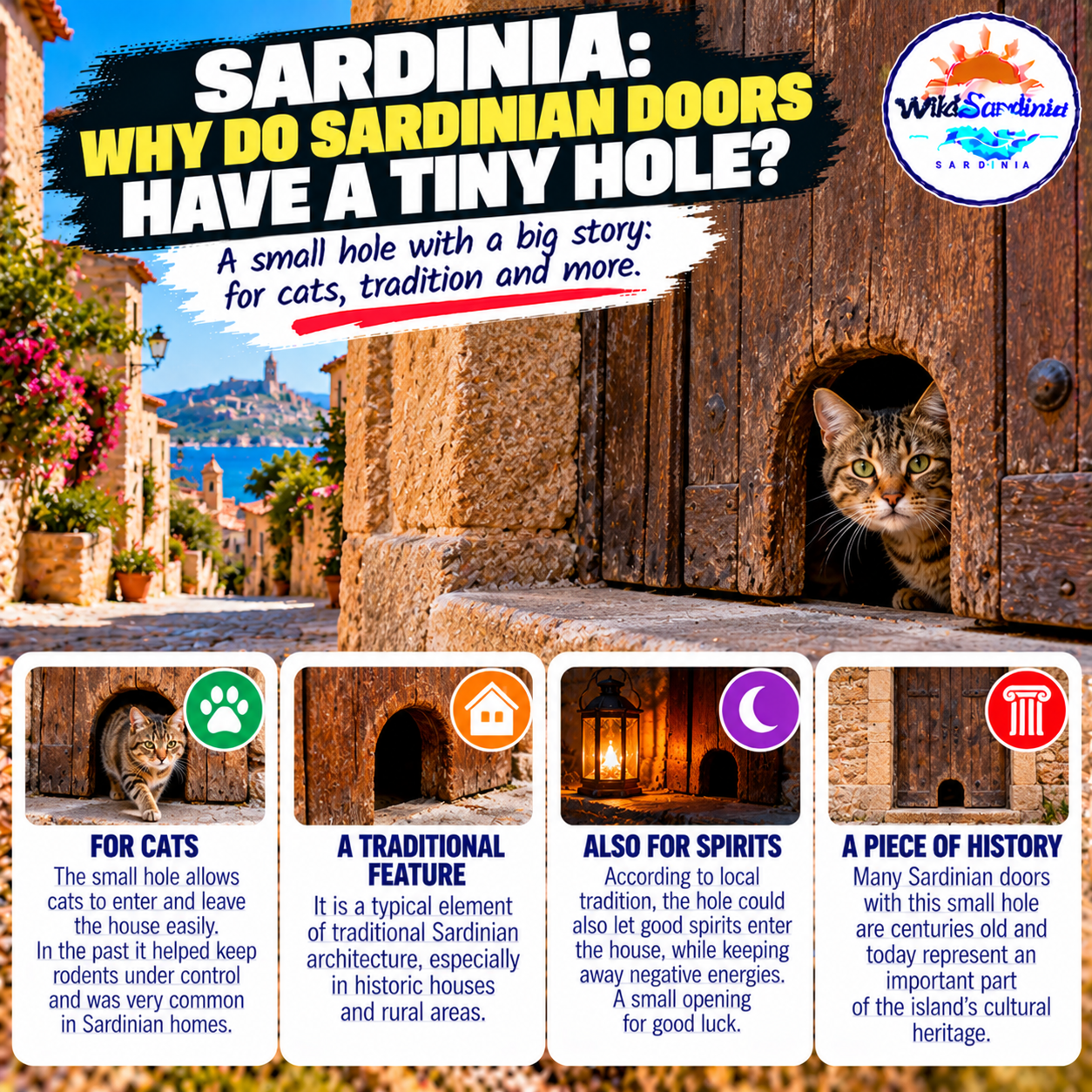
Walk through an old Sardinian village and you may spot a curious detail in a weathered wooden door: a small opening close to the ground. It looks too tiny to be a normal doorway, so what was it for? One practical possibility is a passage for a household cat—but the answer depends on the particular house, and not every hole has the same story.
A little door for the cat?
In traditional rural homes, cats were useful partners in keeping mice and rats away from food stores, kitchens and grain. A low opening could let a cat come and go without someone needing to open the main door. Similar cat openings, often called cat doors or “gattaiola” in Italian, are known in other parts of Italy and Europe.
That explanation makes sense when the opening is low enough and large enough for a cat, but it should not be treated as a universal explanation for every small hole in Sardinian doors. The opening might also have been created for another practical reason or added during a later repair.
What do Sardinian traditions say about doors?
In Sardinian folk culture, doors and thresholds could carry meanings beyond their everyday function. They marked the boundary between the household and the outside world, and historical accounts describe protective practices and superstitions associated with entrances and doorsteps. Such traditions varied from place to place and from family to family.
Stories about spirits, witches or protective objects belong to the island’s rich folklore. However, there is no solid evidence that the tiny hole in every old door was deliberately made to let good spirits in or keep bad spirits out. It is better to present that idea as a possible local story rather than an established architectural fact.
Why do old Sardinian buildings have small openings?
Traditional Sardinian architecture often favoured solid walls and relatively small openings, though building styles vary considerably across the island. The regional heritage documentation for rural settlements in Sulcis, for example, describes small and limited openings as a recurring feature of local building traditions. Materials, climate, privacy, security and the layout of the home all influenced the design.
A tiny hole near the base of a door is a different feature from a small window or ventilation opening in a wall, so it is important not to confuse them. Its shape, position and signs of wear may offer clues, but they do not always reveal a definitive answer.
How to read the clue when you see one
- Look at the size and height: a low opening that a cat could pass through may have served as a cat door.
- Check the surrounding wood: worn edges or a fitted flap may suggest repeated use, although they cannot prove the original purpose on their own.
- Consider the building: a rural home with storage areas may have had different practical needs from a town house.
- Ask locally: residents, craftspeople or a local heritage guide may know the history of that particular doorway.
- Keep folklore in context: stories about protective thresholds are culturally interesting, but they should not be presented as proven explanations for every opening.
A small detail, a bigger story
The tiny hole in an old door is a reminder that historic buildings preserve traces of everyday life. It may have helped a cat patrol the house, or it may have another explanation specific to that doorway. Sardinia’s traditions about thresholds add a layer of folklore, but the most honest answer is to combine curiosity with care: look closely, ask about the building’s history and avoid assuming every old door follows the same rule.
For further reading, see the Sardinian heritage authority’s overview of traditional doors and windows, the local history article on Sardinian beliefs about doors and thresholds, and this explanation of the cat door in traditional homes.