Why is Sardinia called Sardinia?
The short answer is surprisingly satisfying: the island has carried a form of the name “Sardinia” for almost three thousand years — but nobody can say with certainty where the name originally came from.
Long before modern Italian Sardegna, Latin Sardinia or today's Sardinian Sardigna, an ancient inscription was already recording a name that scholars associate with the island.
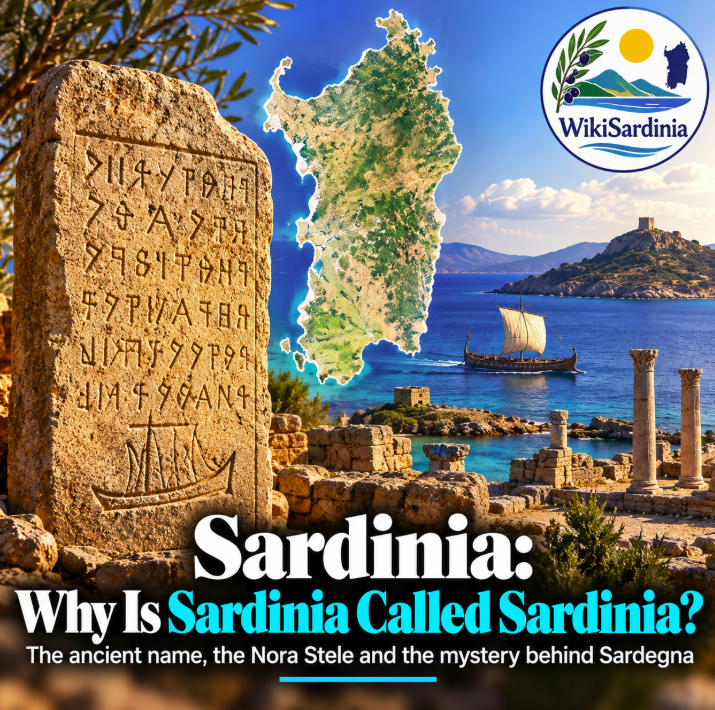
The oldest written clue is the Nora Stele
One of the most important pieces of evidence comes from Nora, the ancient settlement on Sardinia's southern coast near modern Pula.
The famous Nora Stele, generally dated to around the 8th century BC, contains a Phoenician inscription. SardegnaCultura identifies it as the earliest written occurrence of the name of Sardinia.
The inscription includes the consonantal form commonly transcribed as ŠRDN.
That matters because it shows that a recognizable ancestor of the island's name was already in circulation in the early first millennium BC. The name is therefore far older than Roman rule and older than the Italian language by many centuries.
So the Romans did not invent the name Sardinia
No. Rome inherited an existing name.
The Romans eventually used the Latin form Sardinia, from which the familiar English name comes. Italian later developed Sardegna, while Sardinian has forms including Sardigna.
The linguistic forms changed, but the ancient Sard-/Šard- root survived.
Was Sardinia named after Sardus Pater?
Ancient writers offered their own explanation.
Pausanias tells a tradition involving Sardus, or Sardus Pater, a figure associated with the island and later worshipped as an important Sardinian divinity.
In that classical story, Sardus came from Libya and the island eventually took its name from him.
Sardus Pater was not merely a literary character. His cult became deeply connected with Sardinia, and the monumental sanctuary at Antas in the southwest of the island was dedicated in Roman times to Sardus Pater Babai.
But there is an important caution: an ancient myth explaining a place name is not the same thing as a proven linguistic etymology. The story may preserve old cultural memories, or it may be an explanation created after the name was already established.
What about the mysterious Shardana?
This is the theory that tends to capture people's imagination.
Egyptian records from the Late Bronze Age mention a people usually called the Sherden or Shardana, one of the groups associated with the so-called Sea Peoples.
The similarity between Shardana and Sardinia has led generations of scholars to ask whether the two names are connected.
Some theories identify the Shardana with ancient Sardinians. Others have proposed an eastern Mediterranean origin and connections with Sardis in Lydia.
The problem is that similarity is not proof.
Even modern reference works continue to present the relationship as debated. There is no universally accepted demonstration that Sardinia was named after the Shardana, or that the Shardana were definitively Sardinians.
Could the name be even older?
Possibly.
The Nora Stele gives us an early written form, but an inscription is evidence that a name existed at that moment — not necessarily evidence of when it was invented.
The root may predate Phoenician writing on the island and could belong to an older Mediterranean linguistic layer that is difficult to reconstruct today.
That is one reason the ultimate etymology remains uncertain.
Before “Sardinia,” the Greeks also called the island Ichnusa
If you spend time in Sardinia, you will eventually encounter another ancient name: Ichnusa.
It survives today everywhere from businesses and cultural references to the famous Sardinian beer.
The Greek name Ichnoussa was traditionally connected with the word for a footprint. Ancient geographical imagination saw Sardinia's outline as resembling a human footprint.
This was a Greek name for the island, however, not the ancestor of modern “Sardinia.”
And what was Sandalyon?
Ancient Greek tradition also used a name commonly rendered Sandalyon, linked to the idea of a sandal.
The explanation is similar: viewed as a shape, the island could be imagined as a footprint or sandal floating in the western Mediterranean.
These names tell us something wonderful about ancient geography, but they did not replace the Sard- name that ultimately endured.
Why did Sardinia become Sardegna in Italian?
The English Sardinia stays visibly close to Latin Sardinia.
Italian Sardegna reflects later phonetic development from the Latin name, while Sardinian forms such as Sardigna preserve their own linguistic evolution.
They are not separate names invented for different islands. They are descendants of the same ancient naming tradition.
What do Sardinians call Sardinia?
In Italian, the island is Sardegna.
In Sardinian, Sardigna is a widely recognized form, although Sardinia's linguistic landscape is diverse and local varieties matter.
English speakers use Sardinia, Spanish uses Cerdeña, French uses Sardaigne and other European languages developed their own forms from the same long historical tradition.
The name is older than many of Sardinia's conquerors
This is perhaps the most striking part of the story.
Phoenicians established settlements on the island. Carthage controlled large areas. Rome conquered Sardinia in the 3rd century BC. Vandals, Byzantines, medieval powers and later the Crown of Aragon all left their marks.
Yet through enormous political and linguistic change, the essential Sard- root survived.
Empires changed. The island's name endured.
Can we give one definitive origin?
No — and a good history of Sardinia should resist pretending otherwise.
We can say with confidence that an early form of the name appears in the Phoenician inscription on the Nora Stele and that classical traditions associated the island with Sardus Pater.
We can also say that proposed connections with the Shardana are fascinating but disputed.
What we cannot currently do is identify one universally proven person, people or word from which “Sardinia” unquestionably derives.
Where can you see this history in Sardinia?
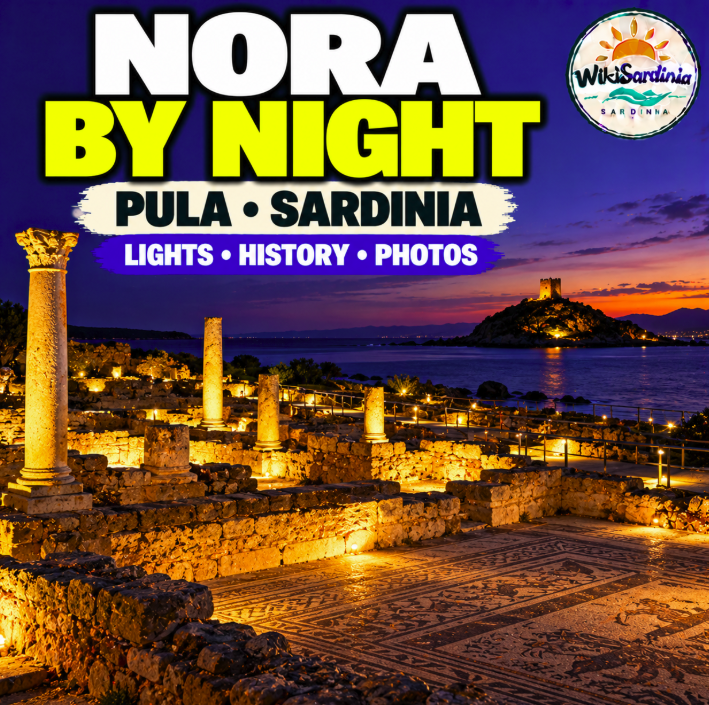
If this story makes you curious, Nora is an obvious place to begin. The archaeological area sits beside the sea near Pula and preserves the remains of the ancient city associated with the famous stele.
The original Nora Stele is preserved at the National Archaeological Museum in Cagliari.
For the story of Sardus Pater, travel west to the extraordinary Temple of Antas, near Fluminimaggiore. The Roman temple stands in a valley with layers of Nuragic, Punic and Roman history.
Together, Nora and Antas turn what sounds like a simple Google question — “Why is Sardinia called Sardinia?” — into a journey across thousands of years.
The answer in one sentence
Sardinia is called Sardinia because a form of the ancient Sard- name has been associated with the island since at least the early first millennium BC, but the ultimate origin of that name remains uncertain.
The Nora Stele gives us the oldest written clue. Sardus Pater gives us the ancient myth. The Shardana give us one of archaeology's most intriguing debates.
And perhaps that uncertainty is appropriate for an island whose history is much older than the languages we now use to describe it.