
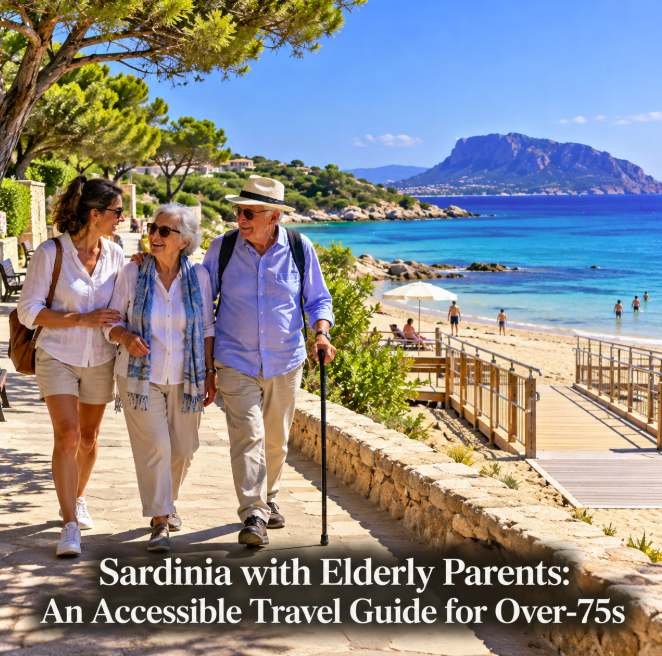
Sardinia can work very well for a trip with parents over 75, but the island rewards careful planning. Beautiful places are not automatically easy places: historic centers can have cobbles and slopes, some famous coves require long walks, and beach access can involve sand, steps or rough paths. The better approach is to build the holiday around comfortable accommodation, short transfers and verified accessibility rather than trying to fit the island’s most photographed locations into a demanding itinerary.
Sardinia’s official tourism authority specifically advises travelers with disabilities or reduced mobility to check public services and ask accommodation providers for detailed information before arrival. That advice is equally useful for older travelers who can walk independently but tire easily or struggle with stairs and long distances.
Choose one base instead of moving every night
For parents in their seventies or eighties, a slower itinerary usually makes Sardinia easier. Instead of changing hotels every one or two nights, choose a well-serviced base and explore within a manageable radius.
Cagliari is practical for the south because the airport is close to the city and urban services are extensive. The long Poetto waterfront provides a much easier seaside environment than remote coves reached by hiking trails. From Cagliari, day trips can also be made toward Pula, Nora, Chia and other southern destinations without repacking luggage.
Alghero is another convenient base. Its airport is about 10 kilometers from the city, according to the airport operator, and the town combines restaurants, waterfront walks and nearby beaches. The old center itself contains cobbled streets, however, so travelers with limited balance or walking endurance should consider accommodation near the waterfront or modern parts of town rather than choosing a room solely for historic charm.
In the northeast, Olbia can work well for travelers planning Costa Smeralda, San Teodoro or nearby coastal areas. A rental car or private transfer is often useful because the region’s attractions are dispersed.
Airport assistance is not only for wheelchair users
European passenger rules cover people whose mobility is reduced because of disability or age. Sardinian airports provide assistance for passengers with reduced mobility, commonly known as PRM assistance.
Alghero Airport explicitly defines PRM to include reduced mobility caused by age. Its assistance categories include passengers who can walk and use aircraft stairs independently but need a wheelchair or other transport for long distances through the terminal. More extensive assistance is available for passengers who cannot use stairs or who require support to the aircraft seat.
Cagliari Airport likewise provides PRM assistance and has a dedicated assistance lounge and contact service. Travelers should request the appropriate assistance through their airline when booking or according to the airline’s stated advance-notice procedure rather than waiting until the day of departure whenever possible.
Using airport assistance can conserve energy for the actual holiday. A parent does not need to be a permanent wheelchair user to benefit from help across a long terminal or during boarding.
Accessible beaches exist, but verify the exact facilities
SardegnaTurismo says many beaches have walkways toward the sea and that some provide chairs designed to help people enter the water. In major resorts, equipped establishments may also have dedicated changing rooms and toilets.
The regional tourism site maintains an accessibility filter that currently identifies beaches including Lazzaretto near Alghero, Campulongu near Villasimius, Su Portu at Chia, Punta Est at Capo Coda Cavallo and Punta Tegge on La Maddalena, among others. This is useful for creating a shortlist, but accessibility should still be confirmed directly before the visit because equipment, seasonal services and the condition or length of walkways can change.
A wooden walkway that reaches partway across the sand is not the same as step-free access all the way into the water. When calling a beach establishment, ask specific questions: How far is parking from the entrance? Are there stairs? Does the walkway reach the umbrella area? Is an amphibious beach chair available? Is there an accessible toilet?
Look for wide, serviced beaches rather than remote coves
Some of Sardinia’s most beautiful beaches require steep paths, uneven rocks or lengthy walks from parking areas. Those can be poor choices for an older traveler even when the total distance appears short on a map.
Broad, serviced beaches generally offer more flexibility. Piscina Rei on the southeast coast, for example, is described by the regional tourism authority as a long, wide beach with shallow water, beach-equipment rental points and nearby services, and is specifically presented as suitable for older visitors seeking relaxation.
La Cinta at San Teodoro is another long sandy beach with shallow water and easy access from the town area, although its popularity can mean crowds and longer walking distances depending on parking. Poetto near Cagliari has the advantage of an urban setting with extensive services nearby.
Sea conditions still matter. Shallow water does not guarantee calm water, and wind can transform an otherwise comfortable beach day. Check conditions locally and choose another activity if getting into or out of the sea looks difficult.
Do not rely on public transport accessibility without checking
SardegnaTurismo notes that many public transport vehicles have equipment to assist passengers with reduced mobility, but also warns that the system does not always allow independent use without assistance. The authority recommends checking the exact vehicle and service with the transport company.
For a family traveling with older parents, a rental car can therefore offer useful control over rest stops, departure times and how close you can get to an attraction. A private driver or NCC service can be even easier when nobody wants to deal with parking or unfamiliar roads.
Cagliari also has Amicobus, a demand-responsive service for people with disabilities. Cagliari Airport reports that the service was extended to the airport in November 2025. Eligibility and booking requirements should be checked directly with CTM rather than assuming it functions as a general tourist shuttle.
Ask better questions when booking a hotel
The word “accessible” can mean very different things. Before paying for accommodation, ask whether there is step-free access from the street or parking area to the room, whether an elevator reaches every relevant floor, and whether the shower has a step.
Also ask about the distance from the room to breakfast, restaurants and parking. A beautiful resort spread across a hillside may technically have accessible rooms while still requiring long daily walks.
If a parent uses a walker or wheelchair, request doorway measurements and bathroom details rather than relying on photographs. For travelers who simply have reduced stamina, a central room close to the elevator may matter more than a formally adapted bathroom.
Plan around heat and recovery time
Sardinian summer heat can make ordinary walking much more tiring. Schedule archaeological sites, historic centers and outdoor sightseeing in the morning, then leave the hottest part of the day for lunch, rest or a shaded activity. Carry water and avoid itineraries where the only way back to the car is a long exposed uphill walk.
September and late spring can be particularly attractive for multigenerational trips because temperatures are often more comfortable than peak summer and major destinations can be less crowded, although weather is never guaranteed.
One substantial activity per day is often enough. A morning in Nora followed by a relaxed lunch is a better plan than adding multiple distant beaches simply because they appear close together on a map.
Accessibility is personal, not just a checklist
Age alone does not define what a traveler can do. One 78-year-old may comfortably walk several kilometers, while another may need frequent seating and assistance on steps. Build the itinerary around the actual mobility, balance and endurance of your parents rather than the number on their passport.
Sardinia can provide an excellent slower-paced holiday: waterfront promenades, archaeological sites with visitor facilities, long serviced beaches, scenic drives and meals that do not require strenuous activity. The key is to verify the details that matter—steps, walking distance, parking, shade, toilets and airport assistance—before arrival. With those practical choices made in advance, traveling with parents over 75 becomes far more comfortable without reducing the trip to staying at the hotel.


