What do Sardinians eat for breakfast when they live to 100? It is an appealing question, but the available evidence does not reveal one shared centenarian menu. A more useful starting point for travellers is the island’s food traditions: bread, milk and pastoral dairy products tell stories about particular households and places. Exploring those foods can enrich a Sardinian holiday without turning breakfast into a promise of exceptional longevity.
There is no single breakfast of the centenarians
One concrete account comes from Tortolì. In its profile of Gino Mereu on his hundredth birthday, L’Unione Sarda reported that he ate bread and milk every morning. That is a personal habit recorded in a local newspaper, not a survey of everyone who reaches 100 and not proof that the meal explains his age.
The distinction matters when a short video presents a breakfast as “what Sardinian centenarians eat”. Ask whose meal is shown, where the person lives and whether the information comes from an interview, a historical account or a measured study. A genuine individual story can still be misleading when its caption expands it into a rule for an entire population.
Casu axedu and the pastoral breakfast tradition
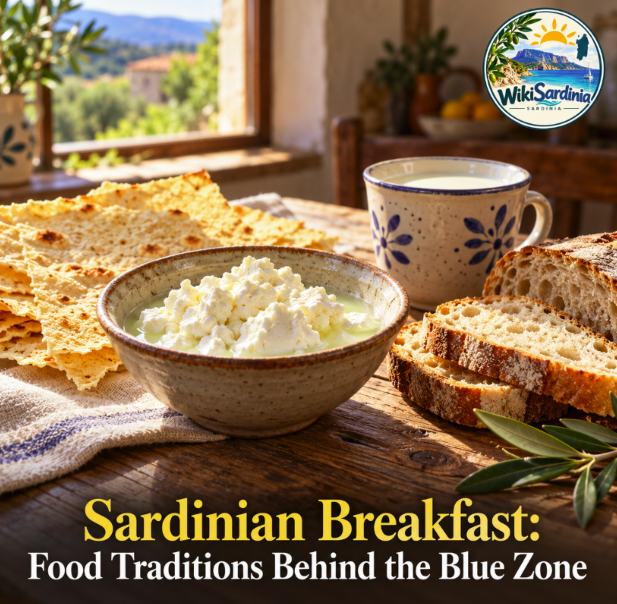
For a documented food connection, look at casu axedu. The Italian National Organisation of Cheese Tasters’ product sheet describes its historic use as a shepherds’ breakfast. The fresh product is white, soft and tangy, and differs from a firm aged pecorino. Its texture and acidity are part of its identity rather than evidence of a particular health effect.
A contribution from the Italian Academy of Cuisine also discusses casu axedu in Ogliastra’s pastoral tradition, including its association with carasau or pistoccu bread. This gives visitors a specific combination to ask about. It does not establish that every Sardinian household eats it for breakfast, or that every hotel buffet will serve it.
If you find the product, ask the producer which milk is used and how that particular version is served. Similar local names can refer to preparations with different characteristics. Treat a tasting as an opportunity to understand the food, rather than trying to match a photograph from social media exactly.
What longevity research can actually tell us
A 2021 study in Nutrients examined dietary patterns among 150 residents aged 90–101 in Sardinia’s Longevity Blue Zone. It used interviews about food consumption and explored changes across the island’s nutritional transition, together with associations with health indicators. It was not an experiment testing whether a particular breakfast makes someone reach 100.
The research describes a changing food pattern, with both Mediterranean foods and persistent pastoral customs. That is a more nuanced picture than a single “longevity food”. Its observational design and reliance on reported eating habits also limit the conclusions that can be drawn about cause and effect. The study population should not be treated as a description of every Sardinian resident.
For the same reason, a traditional recipe and a nutrition recommendation are different things. A food can be culturally important without being a universal choice for every person. This guide focuses on understanding local breakfast traditions, not prescribing a diet or identifying a secret ingredient.
How to explore breakfast during your trip
Before booking a countryside stay, ask what breakfast actually includes and which products come from the property or nearby producers. “Local breakfast” is a broad description; a clear answer about bread and dairy is more useful than a longevity slogan. If casu axedu interests you, request it by name and confirm availability rather than expecting it everywhere.
Keep the enquiry simple: ask what the host serves, how the food is made and whether a tasting can be arranged. Mention any dietary requirements in advance. If your accommodation offers a different breakfast, visit a producer or specialist shop as a separate food experience; the meal need not imitate someone else’s daily routine to be worthwhile.
At the table, let the conversation go beyond ingredients. Ask how breakfast differed in the host’s family, whether working days shaped the meal and which foods are associated with the area. Those answers give the experience a human context that a universal “Blue Zone breakfast” cannot provide. Sardinia’s morning food is worth discovering for its flavour and history, with individual stories kept in their proper place.