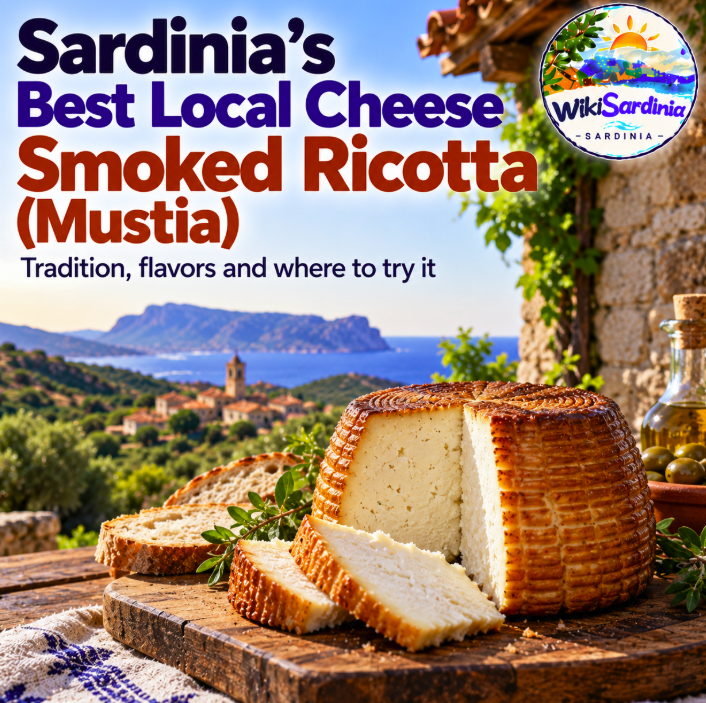
If you love discovering local food when you travel, put ricotta mustia on your Sardinian tasting list. This traditional Sardinian smoked ricotta is a distinctive dairy specialty, prized for its savory flavor, firm texture and unmistakable smoky aroma. Unlike soft, fresh ricotta eaten by the spoonful, ricotta mustia is usually a more compact product that can be sliced or grated, depending on its maturity and the producer's method.
Quick answer: ask for ricotta mustia or ricotta affumicata sarda at a local cheese shop, food market or dairy producer. Its taste is often gently salty and smoky, with a milky core. The exact texture and intensity vary, so tasting before buying is ideal.
What is ricotta mustia?
Ricotta mustia is a Sardinian specialty made from ricotta that is salted, dried and smoked. As with other ricottas, its starting point is whey remaining after cheese production, sometimes enriched with milk according to the producer's recipe. Heating the whey allows the ricotta proteins to separate and be collected. Further draining, salting and smoking transform the delicate fresh curd into a more concentrated product.
It is often grouped with cheeses in shops and menus, although technically ricotta is a whey-based dairy product rather than a conventional cheese made primarily by coagulating casein. That distinction matters less at the table than the flavor: ricotta mustia is one of Sardinia's memorable regional specialties.
Why is it called 'mustia'?
The Sardinian name mustia is commonly associated with the smoked or dried character of the ricotta. Local spellings, recipes and descriptions may vary across the island. Rather than assuming a single universal method, ask the cheesemaker how their version is prepared and smoked.
How does Sardinian smoked ricotta taste?
Expect a balance of dairy sweetness, salt and smoke. Some pieces are mild and pliable; others are drier, denser and more assertive. Smoking method, wood choice, moisture content, salting and storage can all influence the finished flavor. If you normally prefer fresh ricotta, start with a small piece before buying a whole form.
How is ricotta mustia made?
- Whey is heated: the dairy proteins are brought together to form ricotta.
- The curd is drained: moisture is reduced to help it hold its shape.
- The ricotta is salted: the amount and timing vary by maker.
- It is dried and smoked: traditional processing develops its characteristic aroma and firmer texture.
- It is stored and sold: the final moisture level determines whether it is best sliced, crumbled or grated.
This is an overview, not a standardized recipe. Producers may use different smoking arrangements and maturation times, and not every product sold as smoked ricotta is made in the same way.
Ricotta mustia vs fresh ricotta vs pecorino
| Product | Typical texture | Flavor | Best use |
|---|---|---|---|
| Ricotta mustia | Firm to semi-firm, sometimes grateable | Milky, salty, smoky | Antipasti, bread, pasta |
| Fresh ricotta | Soft and moist | Delicate and creamy | Breakfast, desserts, fillings |
| Sardinian pecorino | Varies from young to aged | Sheep's-milk cheese flavor, often savory | Cheese boards, cooking, grating |
Both ricotta mustia and pecorino can be made in Sardinia, but they are different dairy products. Do not confuse the smoky aroma of ricotta mustia with the characteristic taste of aged sheep's-milk cheese.
Where can you buy ricotta mustia in Sardinia?
Try independent caseifici (dairies), salumerie (delicatessens), traditional food shops and markets that stock regional cheeses. Ask specifically for a Sardinian-produced version, because smoked ricotta is also made elsewhere in Italy. Availability may vary with the shop, producer and season.
In larger towns such as Alghero, Sassari, Nuoro, Oristano and Cagliari, specialist food shops can be useful starting points, but stock at any particular store should be confirmed in advance. Inland villages and dairy producers can be especially rewarding if you want to learn about the production process. If visiting a working dairy, arrange an appointment rather than assuming tours are available.
How to eat ricotta mustia like a local
- With pane carasau: pair thin slices or shavings with crisp Sardinian flatbread.
- On a cheese board: serve with olives, tomatoes and other local products.
- Grated over pasta: a drier piece can add smoky depth to simple tomato-based dishes.
- With seasonal vegetables: try a little grated or crumbled over grilled courgettes or aubergines.
- As an aperitivo snack: offer small pieces with bread and a drink.
Start with a modest amount: the smoky, salty flavor can be more intense than expected.
Can you bring smoked ricotta home?
Ask the retailer whether the product is suitable for travel, how it should be wrapped and whether it needs refrigeration. Follow the storage instructions on the label; smoking and drying do not automatically make a dairy product shelf-stable. If flying, check your airline's baggage rules and any food-import restrictions at your destination, especially outside the European Union.
How much does ricotta mustia cost?
Prices vary with the producer, size, milk and whey sources, processing and retailer. Without checking current shop inventories, it would be misleading to quote a single island-wide price. Compare prices per kilogram, read the label and ask whether the product is locally produced.
What to look for when buying
Check the producer's name, ingredients, allergens, origin information, date markings and storage instructions. The exterior may be darker from smoking, but appearance alone cannot confirm quality or traditional processing. If the shop offers a tasting, compare a softer piece with a drier one to find your preferred style.
FAQ
Is ricotta mustia the same as smoked ricotta?
Ricotta mustia is a Sardinian traditional style of smoked ricotta. Smoked ricotta also exists in other Italian regions, so the terms are not always interchangeable in terms of origin.
Is ricotta mustia made with sheep's milk?
Sheep's-milk whey is common in Sardinian dairy traditions, but ingredients depend on the producer. Check the product label if the type of milk matters to you.
Can you eat the outside of ricotta mustia?
Ask the producer or retailer about the specific product and its outer layer. Do not assume every smoked exterior is intended to be eaten.
Does ricotta mustia need to be refrigerated?
Storage requirements depend on the product's moisture level and packaging. Always follow the manufacturer's instructions.
Is ricotta mustia suitable for vegetarians?
Suitability depends on how the whey was produced and the original cheesemaking process. Ask the producer about animal rennet if you follow a vegetarian diet.
WikiSardinia's recommendation
For a food souvenir with a strong sense of place, ricotta mustia deserves a spot beside Sardinian pecorino and pane carasau. Choose a locally produced piece, ask about the smoking process and try it first with simple bread so its flavor can shine. It is an excellent way to discover a different side of Sardinia's dairy heritage.