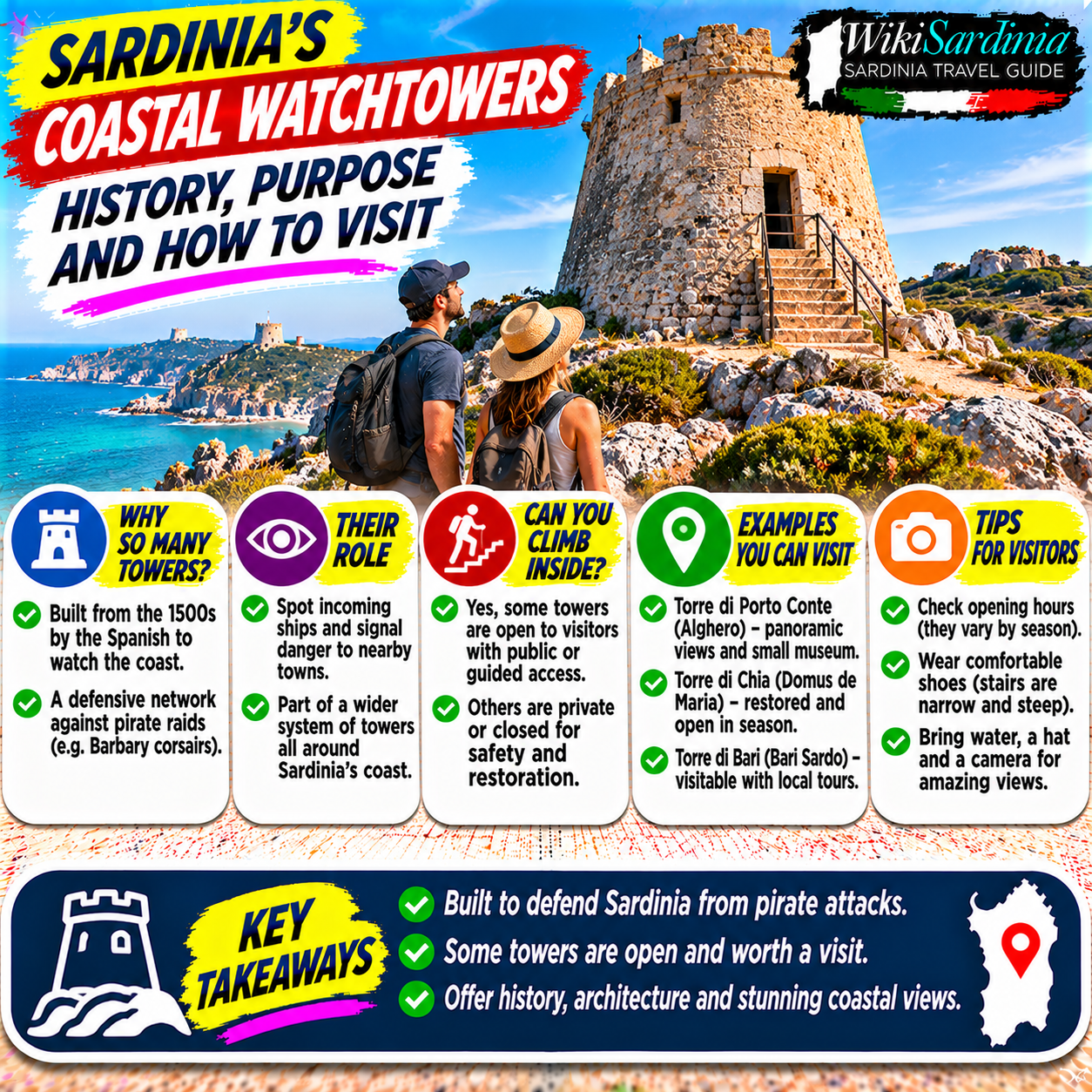
Sardinia's coastal watchtowers formed a defensive and early-warning network against maritime raids. Some restored towers allow visitors inside and onto terraces, but many are closed ruins or protected monuments. Longonsardo and Chia are documented examples of interior visits, subject to seasonal opening.
Why are there so many towers?
Coastal fortifications existed before Spanish rule, but the network expanded substantially during the late sixteenth century under Philip II. The University of Cagliari maritime history atlas records 46 new towers between 1584 and 1621 and around 80 by the early decades of the seventeenth century. Local communities helped finance, build and maintain them. Their placement protected settlements, harbors and economic activity from maritime raids.
Guards watched the sea and relayed warnings using visible signals. Fortifications also served fiscal and public health surveillance functions. The Royal Administration of the Towers, established in 1587, was responsible for maintaining and managing the network until its abolition in 1842.
How many survive?
One regional conservation inventory identifies 103 towers in the historical coastal defense system, of which 92 were surviving at the time of that inventory. These figures are not a current structural survey or a count of accessible interiors.
Where can you go inside?
| Tower | Visitor access |
|---|---|
| Longonsardo, Santa Teresa Gallura, Via Bechi | Documented interior and panoramic terrace visits; seasonal ticketed access. |
| Chia, Domus de Maria | Ministry heritage listing describes paid summer guided visits with stair access. |
| San Michele, Arbatax, Via Lungomare | Ministry listing identifies exterior viewing only, with entry prohibited because of its use by Guardia di Finanza. |
Longonsardo
The granite tower contains a vaulted chamber and stairs leading to a terrace overlooking the Strait of Bonifacio. SardegnaTurismo describes the monument and its views toward Corsica. The operator's timetable lists July and August opening every day from 10 am to 1 pm and 5:30 pm to 8:30 pm, and closure from November 1 to March 31. Confirm shoulder-season hours and current admission prices before traveling. Contact the operator at +39 349 8347698. Its FAQ states that the tower is not wheelchair accessible.
Chia
The Ministry of Culture heritage listing describes summer guided entry via a steel staircase and access toward the terrace by an internal stone stairway. It identifies the monument as not accessible to visitors with mobility impairments. Confirm actual tour dates, ticket prices and terrace access with the municipality before departure.
Arbatax
The official San Michele listing states that the tower can be viewed from outside only. Do not mistake a publicly visible monument for an open museum.
Exploring towers safely
Many coastal towers stand on exposed headlands with uneven trails, wind and steep drops. Wear suitable shoes, bring water and check weather. Do not climb walls, cross barriers or enter unlocked ruins without explicit permission. Even restored towers may have narrow stairs and restricted rooftop access. Ask about accessibility before purchasing a ticket.
Are these the same as nuraghi?
No. Nuraghi are prehistoric stone monuments from Sardinia's Bronze Age civilization. Most of the visible coastal defense network belongs to much later historical periods. Their similar shapes do not mean they served the same purpose.
Useful Italian phrases
- Si può visitare l'interno della torre? — Can we visit the interior?
- Si può salire sulla terrazza? — Can we go up to the terrace?
- È necessaria la prenotazione? — Is booking required?
- Ci sono molte scale? — Are there many stairs?
FAQ
Are all towers free to enter?
No. Some charge admission or require guided access, while others are closed entirely.
Are they open in winter?
Not necessarily. Longonsardo's operator publishes a winter closure. Always check the specific monument.
Can I enter a tower if its door is open?
Only where public access is explicitly authorized.
The bottom line
These stone landmarks connect Sardinia's maritime history with its coastal landscape. Choose an officially managed tower for an interior visit and enjoy other monuments from safe public paths. Visitor information reviewed November 2026; future schedules may change.