
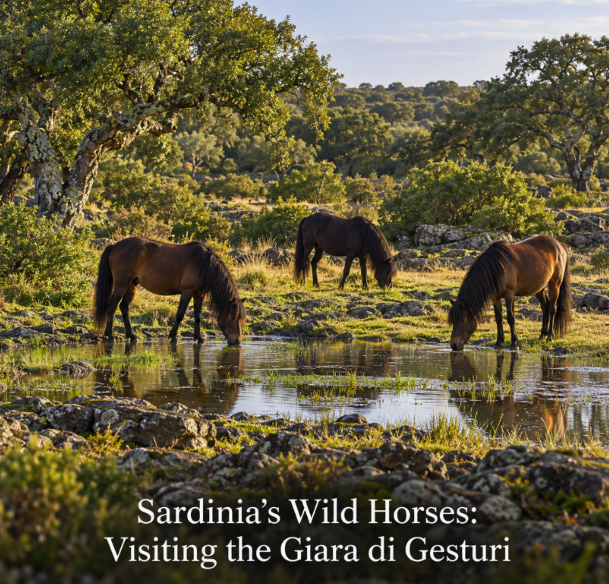
The cavallini della Giara are one of Sardinia's most distinctive wildlife encounters: small, free-ranging horses living on a basalt plateau in the island's central-southern interior. Visitors come to the Giara di Gesturi to look for them among cork oaks, scrub and seasonal pools. The experience is a countryside walk with the possibility of an animal sighting, rather than a scheduled performance or a close-up encounter that can be guaranteed.
A short video may capture a beautiful moment beside the water, but it leaves out the waiting and the landscape around it. Plan your visit for the plateau as a whole. That makes a walk worthwhile even when the horses remain out of sight, and helps keep their movements separate from your expectations.
Small horses with a local history
The regional agriculture service's Giara horse profile identifies them as small horses rather than ponies, with bay, chestnut or black coats and abundant manes. Its breed standard gives adult male height at the withers as 125–135 centimetres and female height as 115–130 centimetres. Their origin remains uncertain.
Calling them wild describes their free-ranging life, but their history also involves people. The same regional account records their former use in agricultural work and the subsequent effects of mechanization. They are a local horse breed with a human history, rather than a separate species whose story is explained entirely by isolation.
That distinction can enrich the visit. Instead of looking only for a photogenic silhouette, ask a guide how the horses use the plateau and how their relationship with surrounding communities has changed. Avoid repeating an exact population count without a dated census: general destination pages are not necessarily current monitoring reports.
A plateau shaped by water and seasons
SardegnaTurismo's Giara guide describes a basalt plateau between Marmilla and Sarcidano, shared by Gesturi, Genoni, Tuili and Setzu. Its seasonal depressions, known as paulis, collect rainwater. Their appearance changes through the year, with many drying in summer and vegetation responding to the seasons.
This matters when choosing a date. A spring photograph of flowers around a pool does not show what every October visitor will find. Nor does a horse sighting at one pool establish that animals will be there when you arrive. Ask about current ground and water conditions before selecting a route.
For the Gesturi approach, the Italian regional tourism page directs visitors through the village onto Via Giara and then along the signs. Confirm the specific access point with your guide or accommodation. The broader area has several approaches, so a meeting arranged from Tuili should not be treated as interchangeable with one from Gesturi.
Arrange a walk that suits your group
The local visitor service Parco della Giara advertises guided excursions by prior reservation. Its booking page lists October–March departures at 10 a.m. and 2:30 p.m.; these remain subject to confirmation for your date. Published contact numbers are +39 070 9364277 and +39 348 2924983.
Before booking, ask about duration, distance, meeting point, language and total cost for your party. Explain any mobility requirements and ask whether the proposed ground conditions suit them. “Plateau” does not mean every section is smooth or accessible, and a short walk may be a better choice than an ambitious route.
Wear suitable walking shoes, bring water and layers, and check the forecast before departure. For an afternoon outing in autumn, confirm the expected return time and plan around daylight. A guide can help interpret the habitat and choose a route, while still being unable to promise where the horses will be.
When animals appear, observe quietly from a distance. Do not feed, chase or approach them for a selfie, and keep their route through the landscape clear. Use binoculars or a zoom lens rather than moving closer. Follow your guide's directions and treat a departing group of horses as an encounter ending naturally.
The best footage records what happens without directing it: horses grazing, a pause beside a pool, or the woodland they move through. Give the location and season when sharing it. The Giara's appeal comes from seeing animals in their environment, with enough time and space for them to continue their day.


