
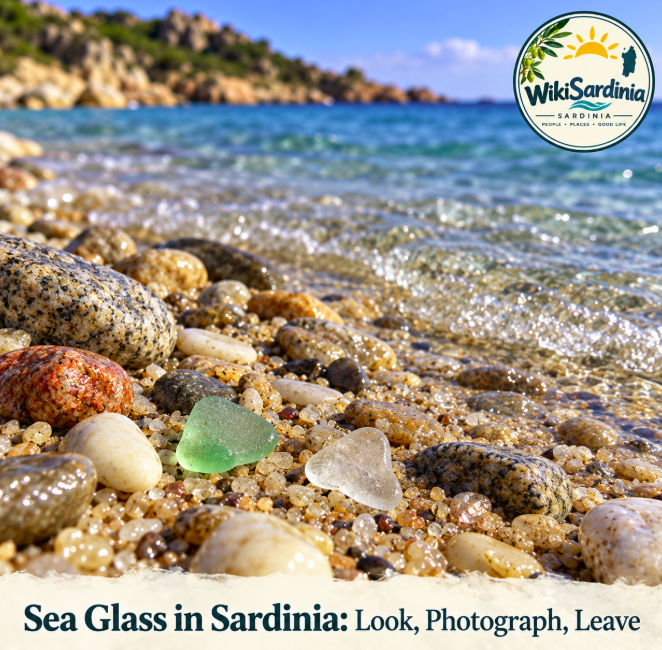
Looking for the best beach for sea glass hunting in Sardinia? We could not verify a reliable, named “best beach” on the island. Nor did we find evidence establishing a new American travel trend. An occasional fragment is possible, but it is not a reason to plan a long detour around a promised haul.
A better approach is to make a shoreline walk part of a beach day you already want to enjoy. Look closely, photograph anything interesting and leave beach materials in place. That gives you an enjoyable way to notice Sardinia’s coast without treating it as a souvenir supply.
What sea glass actually is
Sea glass is weathered manufactured glass, rather than a natural gemstone. The NOAA Marine Debris Program explains that fragments left in the environment for long periods can develop smoother edges and a frosted appearance. A newly broken bottle is different: it may retain sharp edges and should not be handled as a decorative find.
For a photograph, look at texture rather than colour alone. A green or brown object could be glass, but colour does not establish its identity, age or origin. Do not turn an uncertain find into a claim that it came from a particular ship, historical settlement or century.
You also do not need to pick something up to appreciate it. A close photograph taken where it lies can show the contrast between a frosted surface, wet stones and surrounding sand. Include a wider view if you want to remember the setting.
What Sardinia’s rules say—and what they do not settle
The Region of Sardinia’s official beach-protection guidance says sand, pebbles, stones and shells must not be removed, possessed or sold, and lists fines from €500 to €3,000. A small quantity is not presented as a souvenir exception.
That published summary does not specifically settle the treatment of weathered bottle glass. It would therefore be misleading to say that its wording automatically permits collecting sea glass, or that it explicitly names sea glass as prohibited. Local ordinances and protected-area rules may also matter.
If your aim is photography, you can avoid that uncertainty by leaving finds where they are. If you want to collect, ask the municipality or the relevant protected-area authority about the exact location and material first. Advice for an American beach should not be assumed to apply in Sardinia.
Choose a beach walk, not an unverified hotspot
For visitors based around Cagliari, Poetto is a straightforward place to build a coastal walk into a city stay. Sardegna Turismo describes the long sandy beach extending between Cagliari and Quartu Sant’Elena. This is a suggestion for enjoying the shoreline, not evidence that Poetto reliably produces sea glass.
Around Alghero, the town’s Lido is another option for a beach walk. The regional tourism site includes it among the area’s beaches in its Alghero coast overview. Again, choose it because it fits your itinerary, not because of a verified collecting reputation.
Neither sandy beach needs to yield a fragment to make the outing worthwhile. Light on the water, changing surface textures and ordinary coastal details offer subjects of their own. Do not search by digging, disturbing vegetation or moving piles of stones.
Make the search a small part of the day
Wear footwear suitable for the surface, keep clear of sharp debris and choose a comfortable stretch of accessible shoreline. Avoid approaching exposed rocks or rough water simply because someone suggests a storm might reveal more finds. For children, a photographic spotting game works better than handling unknown fragments.
If you notice dangerous broken glass, report it to beach staff or the municipality rather than asking a child to remove it. A supervised cleanup has a different purpose from souvenir collecting and should follow its organiser’s instructions.
The most useful keepsake can be a small photo diary: the beach name, the date and the details you noticed. Sardinia does not need to be advertised as a glass-hunting destination for a slow coastal walk to be memorable.


