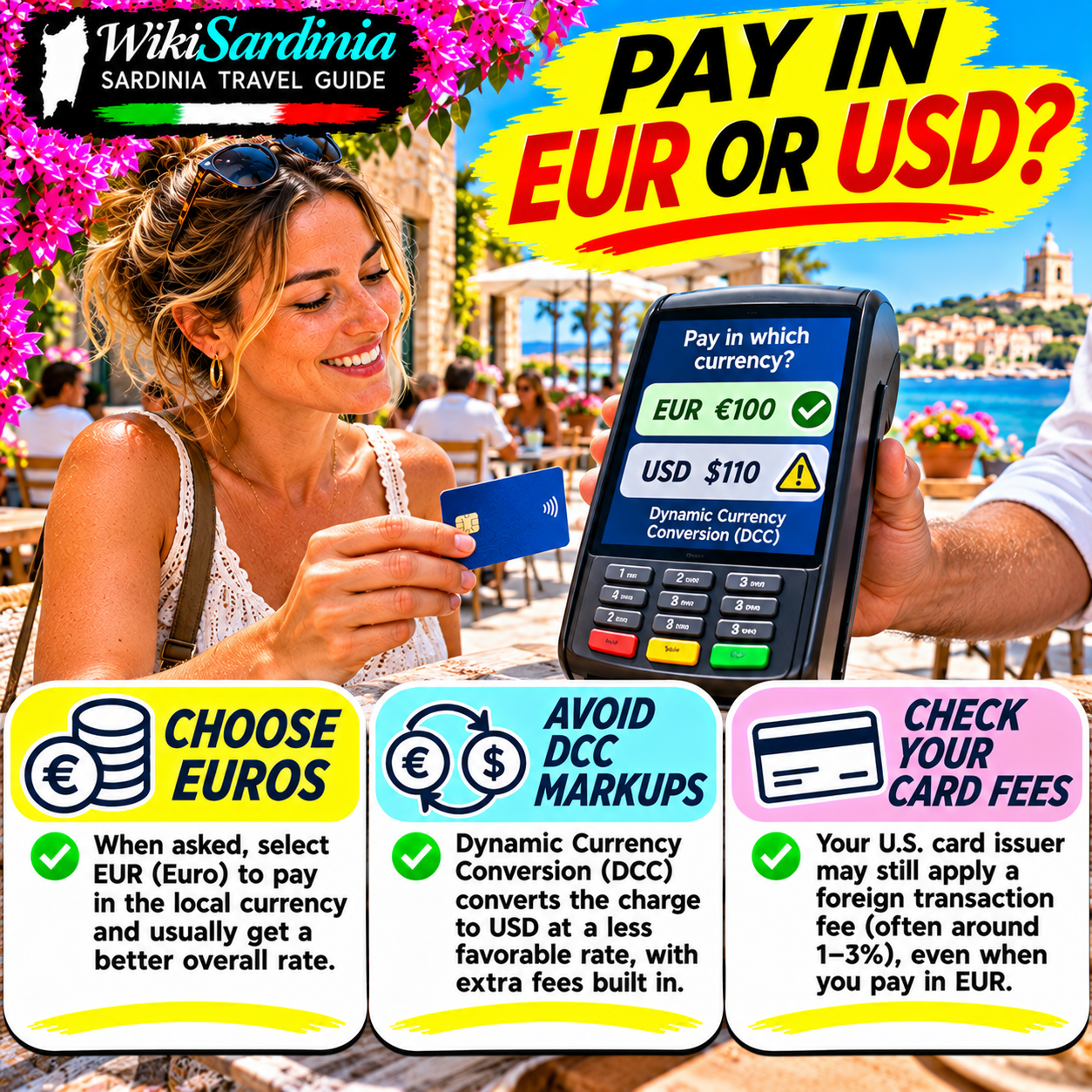
When a card terminal in Sardinia asks whether you want to pay in euros (EUR) or US dollars (USD), choosing euros is usually the better option for American visitors. Selecting USD typically activates Dynamic Currency Conversion (DCC), which lets the merchant's payment provider convert the amount at its own quoted rate, often including a markup. Paying in EUR instead generally lets your card network and issuing bank handle the currency conversion. Compare the actual terms of your card, because the cheapest choice is not guaranteed for every card and transaction.
What is Dynamic Currency Conversion?
Dynamic Currency Conversion is an optional service offered by some merchants, hotels, ATMs and payment terminals. A terminal may recognize that your card is billed in USD and offer to charge you in dollars rather than the local currency. This can make the amount look familiar, but the conversion rate and markup are set by the DCC provider. Visa explains that the display should show the local and converted amounts, exchange rate and additional charges, and that the choice belongs to the cardholder.
Which button should you press in Sardinia?
For a US-issued card, look for “Pay in EUR,” “EUR,” “Local currency,” or “Decline conversion.” These generally avoid the merchant's DCC service. The alternative may read “USD,” “Pay in your home currency,” “Accept conversion,” or “Guaranteed exchange rate.” Choose EUR unless you have compared the displayed USD amount against the cost your card would charge and found a genuine advantage. Be careful: a screen asking whether to “accept” or “decline” conversion is not asking whether you want to accept or decline the purchase itself.
Does every POS terminal offer DCC?
No. DCC requires a participating payment provider and an eligible card or transaction. Many Sardinian merchants simply process all card purchases in euros, with no currency-choice screen at all. A terminal that offers USD is not necessarily malfunctioning or fraudulent: DCC is a legitimate optional service, but it can be more expensive than letting your own card convert the purchase.
How much can DCC cost? A simple example
Imagine a restaurant bill of €100. Suppose your card network and bank would convert it to $108 with no additional foreign transaction fee. A DCC terminal instead offers to charge $114. Choosing USD would cost $6 more in this hypothetical example, or about 5.6% more than the $108 alternative. These numbers are illustrative, not today's exchange rate or a universal DCC fee. Actual results depend on the provider's rate, the bank's rate and your card's fees. A DCC markup may already be embedded in the quoted conversion, rather than listed as a separate line item.
Does paying in EUR avoid all bank fees?
No. Your US card issuer may charge a foreign transaction fee even when you pay in euros. Some cards have no foreign transaction fee, while others charge a percentage. The issuer's rules may apply based on where the transaction occurs, not only on whether it is denominated in foreign currency. Choosing USD through DCC does not necessarily avoid those fees. Check your card agreement before travelling, and use a no-foreign-transaction-fee card when appropriate.
Is Visa or Mastercard's exchange rate better?
Card networks publish exchange-rate information, but the final amount depends on the transaction date, processing timing and any issuer fees. DCC instead fixes or quotes a rate at the merchant's checkout. The best way to compare is to evaluate the DCC USD total against the likely EUR conversion using your card's terms. In most everyday travel situations, choosing EUR avoids an additional conversion layer that can increase the cost.
Where might you see DCC in Sardinia?
It may appear at hotel receptions, restaurants, jewelry shops, souvenir stores, rental-car desks and ATMs, especially where foreign visitors frequently use international cards. There is no verified island-wide count of DCC-enabled terminals, and individual businesses may change payment providers. The advice applies across Italy, not only Sardinia.
What if the cashier selects USD without asking?
Visa says the customer must be able to choose and that merchants should not make the decision for them. Ask the cashier to cancel or restart the payment in euros before confirming it. You can say “In euro, per favore. Senza conversione.” (In euros, please. Without conversion.) If the transaction was already processed without your informed choice, retain the receipt, document what happened and contact your card issuer about the appropriate dispute process. Do not assume every unwanted DCC charge will automatically be reversed.
Does the same advice apply to ATMs?
Generally yes. An ATM may offer to convert a withdrawal into USD at a guaranteed rate. Declining that conversion and proceeding in EUR often avoids the ATM operator's DCC exchange rate. However, the ATM can still charge an access fee, and your bank may charge withdrawal, cash-advance or foreign transaction fees. Read each screen carefully: declining currency conversion is different from declining a separately disclosed ATM usage fee.
What about Apple Pay and Google Pay?
Mobile wallets typically use the underlying payment card. If the merchant offers DCC, the currency decision can still matter, regardless of whether you tap a physical card, phone or watch. Paying by wallet does not automatically eliminate foreign transaction fees or merchant conversion markups. Check the final transaction currency on the terminal before approving.
Can DCC appear in online hotel bookings?
Yes. Some travel websites and online checkouts offer to display or charge a USD amount instead of euros. A website showing an estimated USD price for convenience is not necessarily charging in USD; check the actual settlement currency at the final payment step. If the merchant offers conversion, compare the rate and charges and check the refund policy. For prepaid bookings, the chosen transaction currency may also affect the amount returned if exchange rates change.
What does European law require?
EU rules require providers offering currency conversion at the point of sale or ATM to disclose the conversion charges as a percentage markup over the relevant European Central Bank reference rate, alongside other required information. Mastercard's merchant guidance also sets rules for presenting currency options clearly and neutrally. A DCC offer is permitted, but consumers should receive the necessary information to make an informed choice. If the screen is confusing, ask the merchant to process the original euro amount.
What should you check on your receipt?
Confirm the amount and currency actually charged. A receipt may show both EUR and USD, the conversion rate and markup if DCC was used. Keep it for comparison with your card statement, particularly for expensive purchases or hotel deposits. If you expected EUR but the final charge appears in USD, ask the merchant immediately for clarification.
Useful Italian phrases
“Pago in euro, grazie.” — I'll pay in euros, thank you. “Non voglio la conversione in dollari.” — I don't want conversion to dollars. “Può annullare e rifare il pagamento in euro?” — Can you cancel and redo the payment in euros? “Il totale è in euro?” — Is the total in euros? “Posso avere la ricevuta?” — Can I have the receipt?
Frequently asked questions
Should Americans select EUR or USD at a Sardinian card terminal?
Usually EUR, because it generally avoids the merchant's DCC exchange-rate markup. Compare your own card's fees for a precise answer.
Is Dynamic Currency Conversion a scam?
No. It is a legitimate optional currency-conversion service, but its exchange rate can be less favorable and it must be presented transparently.
Will I pay more if I choose USD?
Often, but not always. The actual difference depends on the displayed DCC rate and your card issuer's conversion and fee policies.
Does choosing EUR eliminate foreign transaction fees?
No. Your bank may still charge a foreign transaction fee.
Can I decline conversion without canceling the purchase?
Yes. Declining DCC should allow the payment to continue in euros.
Does DCC apply at ATMs?
It can. Declining an ATM's offered currency conversion usually leaves the withdrawal denominated in euros, although other ATM and bank fees may still apply.
Does contactless payment avoid DCC?
Not necessarily. The terminal may still offer a currency choice for eligible contactless transactions.
What if the merchant charges USD without permission?
Ask for correction, keep the receipt and contact your card issuer if the transaction cannot be resolved directly.
The takeaway
For US visitors paying in Sardinia, the simplest rule is: choose EUR, not USD, when a terminal offers both. That normally avoids Dynamic Currency Conversion and lets your card issuer handle the exchange. Check your card's foreign transaction fees, read ATM prompts carefully and retain receipts for large purchases. A familiar-looking dollar amount is not necessarily the cheapest one.
Official sources: Visa — Dynamic Currency Conversion Explained; Mastercard — DCC Merchant Guide; EU Regulation 2021/1230 — Currency Conversion Charges; Your Europe — Electronic Payments and DCC.