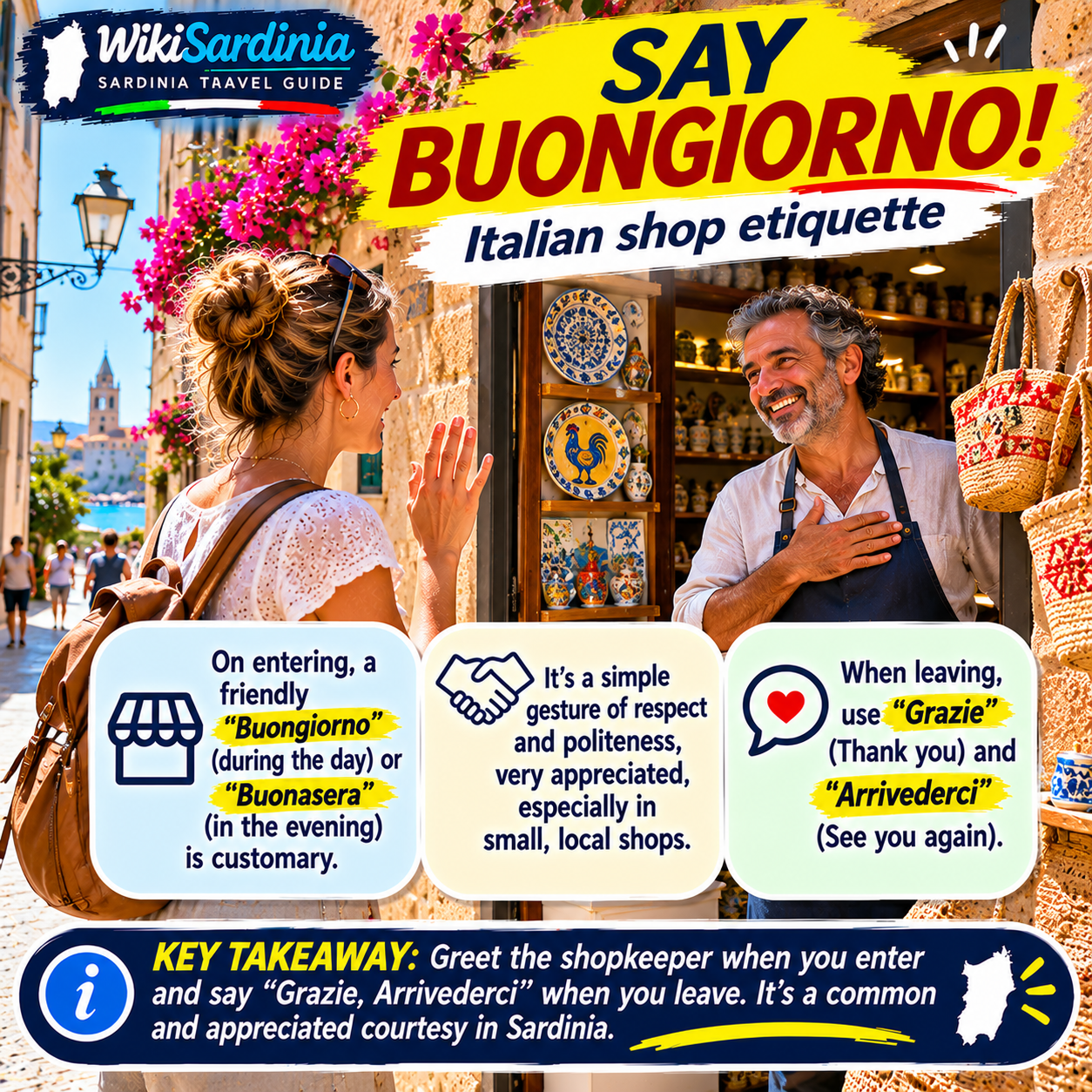
When you walk into a small shop in Sardinia, one of the easiest ways to make a good first impression is to say a simple “Buongiorno!” or “Buonasera!” to the person behind the counter. It takes only a second, and it is a familiar part of everyday Italian courtesy.
Yes, greeting a shopkeeper when entering—and saying goodbye when leaving—is customary in Italy. The habit is especially noticeable in small, independently owned shops, cafés, bakeries and local businesses. You do not need fluent Italian, perfect pronunciation or a long conversation: a friendly greeting is enough.
Should I say buongiorno when entering a shop in Sardinia?
Generally, yes. If a shopkeeper, cashier or owner is present and you can reasonably acknowledge them, a brief “Buongiorno” is the polite default during the morning and much of the day. The LIUC University international student guide explicitly recommends “buongiorno” or “buonasera” when entering shops and “arrivederci” when leaving. The same convention is described by Fodor’s guide to Italian etiquette.
In Sardinia, where many visitors shop at family-run food stores, village bakeries, craft workshops and small cafés, greeting the person serving you is a simple way to recognise them as a person rather than treating the shop as an anonymous checkout.
When do Italians say buongiorno and buonasera?
Buongiorno literally means “good day” and is commonly used in the morning and into the afternoon. Buonasera means “good evening,” but Italians may start using it in the afternoon, earlier than an American visitor might expect.
There is no universally enforced nationwide cutoff time. Usage varies by region, season and individual. If you are unsure, follow the shopkeeper’s lead. If you say “buongiorno” and hear “buonasera” in response, there is no reason to be embarrassed.
Is saying hello really that important?
It is a widely recognised social courtesy, not a legal requirement or a test tourists must pass. In a small shop, walking directly to the counter and making a request without any greeting can feel abrupt. A quick hello establishes a warmer tone.
That does not mean every Italian shopkeeper expects a greeting from every customer in every situation. A busy supermarket, a crowded tourist store and a quiet village delicatessen are different environments. Use ordinary judgment rather than worrying about strict rules.
Should I say ciao instead?
Ciao is friendly and informal. It is ideal with friends, people you know or a shopkeeper who has already established an informal tone with you. When speaking to an unfamiliar shop owner or an older person, buongiorno and buonasera are safer, more neutral choices.
Another option is salve, a neutral greeting that can work at many times of day. However, “buongiorno” or “buonasera” often sounds more natural as the opening to a polite shop interaction.
What should I say when leaving the store?
Even if you did not buy anything, it is perfectly natural to say “Grazie, arrivederci!”—“Thank you, goodbye!” You may also hear “Buona giornata” (“Have a nice day”) or “Buona serata” (“Have a nice evening”).
If the owner says “Grazie, buona giornata,” you can reply “Grazie, anche a Lei” (“Thank you, you too,” in a polite form) or simply “Grazie, arrivederci.” No elaborate exchange is necessary.
What if I enter only to browse?
Say hello if someone is there, then feel free to look around. You do not need to buy anything to justify entering a shop. If the shopkeeper asks whether you need help, you can reply “Sto solo guardando, grazie” (“I’m just looking, thank you”).
When you leave, “Grazie, arrivederci” is appropriate even if you purchased nothing. The greeting is about courtesy, not an obligation to spend money.
Does this apply to bakeries, cafés and restaurants?
Yes, particularly when you enter a smaller place and approach someone serving customers. A friendly “Buongiorno” before ordering bread or coffee is natural. In a restaurant, you might greet the host with “Buonasera” before explaining your reservation or asking for a table.
In a large, busy establishment where nobody is close enough to hear you, there is no need to call out a greeting across the room. Simply acknowledge staff when you begin interacting with them.
Is it different in small Sardinian villages?
The basic Italian courtesy is the same, but the personal atmosphere of a small village shop can make greetings feel especially natural. Regular customers may know the owner, exchange a few words about the weather or ask how the family is doing.
As a visitor, you are not expected to imitate these relationships. A friendly hello, a smile and a thank-you are plenty. Avoid assuming every Sardinian community follows identical customs or that every shopkeeper wants a long chat.
Do I need to speak Italian?
No. Shopkeepers in popular tourist destinations may speak some English, but the level varies. Beginning with one Italian greeting shows consideration, and you can then politely ask “Parla inglese?” (“Do you speak English?”).
Speak normally and patiently. There is no need to exaggerate an Italian accent or raise your voice if the other person does not understand.
Should I use Lei or tu?
Italian distinguishes between the informal tu and the polite Lei. When addressing an unfamiliar shopkeeper, Lei is a safe choice if you need a full sentence, although everyday speech varies by age and setting.
For example, “Mi scusi, può aiutarmi?” means “Excuse me, can you help me?” and uses a polite form. The simplest greetings—“Buongiorno,” “Grazie” and “Arrivederci”—do not require you to master this distinction.
Do I have to greet everyone inside?
Usually you greet the person serving you or the room in a small shop, not every customer individually. A simple greeting directed toward the counter is enough. If the shop is crowded or the staff are busy, wait until you can make eye contact or begin your transaction.
What about supermarkets and shopping malls?
At a large supermarket, you generally do not need to greet the entire store as you enter. It is still polite to say “Buongiorno” when speaking with a cashier or asking an employee for help, and “Grazie” when the interaction ends.
Social etiquette is flexible. The important distinction is between acknowledging someone you interact with and feeling obligated to greet an anonymous crowd.
What if I forget to say hello?
Nothing dramatic happens. Most people understand that visitors come from different cultures, and a missed greeting is not an offence. Simply be polite when you begin speaking. A warm “Scusi” or “Buongiorno” can easily reset the interaction.
Useful Italian phrases for shopping in Sardinia
| Italian | English | When to use it |
|---|---|---|
| Buongiorno | Good morning / good day | Entering during the day |
| Buonasera | Good evening | Entering later in the day |
| Salve | Hello | Neutral greeting |
| Mi scusi | Excuse me | Getting someone's attention |
| Per favore | Please | Making a request |
| Grazie | Thank you | After receiving help |
| Sto solo guardando, grazie | I'm just looking, thank you | Browsing without assistance |
| Quanto costa? | How much does it cost? | Asking a price |
| Parla inglese? | Do you speak English? | Asking about language |
| Arrivederci | Goodbye | Leaving the shop |
| Buona giornata | Have a nice day | Friendly daytime farewell |
| Buona serata | Have a nice evening | Friendly evening farewell |
A simple example: buying something in an Alghero shop
You walk into a small shop selling Sardinian ceramics. The owner looks up from the counter.
You: “Buongiorno!”
Shopkeeper: “Buongiorno, prego.”
You: “Posso dare un'occhiata?” (“May I have a look?”)
Shopkeeper: “Certo!” (“Of course!”)
You: “Grazie.”
After browsing, whether you purchase something or not, you can finish with “Grazie, arrivederci!” The exchange is simple, polite and completely natural.
Frequently asked questions
Should I say buongiorno every time I enter an Italian shop?
It is a good habit when someone is present, especially in smaller shops. It is not a strict requirement in every busy retail environment.
Is buonasera used only after sunset?
No. Many Italians use it from the afternoon onward. There is no fixed nationwide switch-over hour.
Is ciao rude to a shopkeeper?
Not inherently, but it is informal. Buongiorno or buonasera is usually a safer first greeting with someone you do not know.
Should I say goodbye even if I buy nothing?
Yes. “Grazie, arrivederci” is a natural way to leave a small shop after browsing.
What if I cannot pronounce buongiorno correctly?
Make a friendly attempt. Perfect pronunciation is not required.
Do Sardinians expect tourists to speak Italian?
No. A few polite words can be appreciated, but visitors are not expected to be fluent.
Should I greet the cashier at a supermarket?
Yes, a short greeting when your transaction begins is polite. You do not need to greet everyone when entering a large supermarket.
Can I say salve instead?
Yes. Salve is a neutral hello that works in many situations.
Is it polite to say grazie and arrivederci together?
Absolutely. It is one of the easiest and most natural ways to end a shop interaction.
What should I do if a shopkeeper greets me first?
Simply return the greeting, smile and continue with your request or browsing.
The bottom line
In Sardinia, a simple greeting is an easy way to show courtesy. Say “Buongiorno” or “Buonasera” when entering a small shop, and “Grazie, arrivederci” when leaving. You do not need perfect Italian or an elaborate conversation. Just acknowledge the person serving you, and enjoy the warmer, more personal side of shopping in Italy.