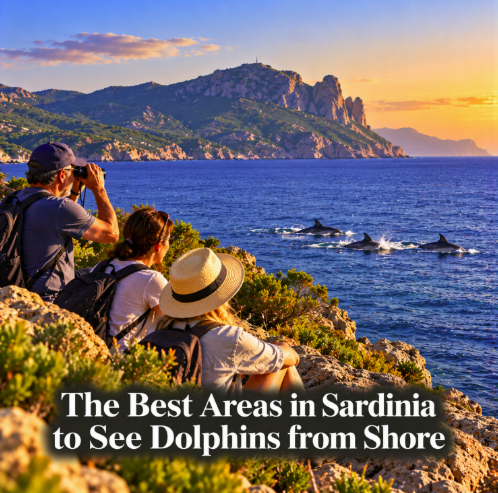
If you want to look for wild dolphins from land in Sardinia, Capo Figari and the Golfo Aranci coast are among the island’s most interesting areas to try. The promontory projects into the sea on the northeast coast, creating elevated viewpoints over waters where bottlenose dolphins are regularly studied and observed. The important word, however, is “try”: dolphins are wild animals, and no viewpoint in Sardinia can guarantee a sighting on a particular morning or afternoon.
Golfo Aranci has become especially associated with dolphins because of long-running research in the area. The local research organization Worldrise’s Golfo Aranci project and other scientific work have focused on bottlenose dolphins in these coastal waters, including their interaction with human activities and feeding opportunities. That makes the area more than a place promoted by excursion companies: it is a coastline with documented cetacean presence.
Why Capo Figari is a good place to look
Capo Figari rises immediately east of Golfo Aranci and offers broad views over the sea. Its elevation is the main advantage for land-based wildlife watching. From a higher viewpoint, an observer can scan a much larger surface area than from a beach at water level.
The waters around Golfo Aranci and the nearby island of Figarolo are well known for bottlenose dolphins. Scientific studies in northeast Sardinia have documented the species in this coastal environment, while local research and conservation projects have monitored individuals and their behavior over time.
That does not mean dolphins remain beside Capo Figari all day. They move according to feeding opportunities, social behavior, boat traffic and other conditions. The objective is therefore to spend time scanning the water rather than arriving at a viewpoint expecting animals to appear on schedule.
Where to watch from land
The coastline around Golfo Aranci offers several possibilities, from accessible waterfront areas to higher ground on Capo Figari. For casual observation, the easiest strategy is to start from a safe coastal viewpoint with an unobstructed view toward open water and Figarolo.
More elevated positions on the Capo Figari promontory can provide a broader field of view, but reaching them may involve hiking. Choose a route appropriate to your fitness, footwear and weather conditions. Do not move onto exposed cliff edges simply to gain a few extra metres of visibility.
Some of the best wildlife observation happens by staying still. A comfortable, safe viewpoint where you can scan the same stretch of water for 30 to 60 minutes is often more useful than constantly walking along the coast.
Bring binoculars
Binoculars make an enormous difference. Dolphins seen from land may appear first as a brief dark dorsal fin, a splash or an unusual sequence of movements far offshore.
Scan slowly rather than moving the binoculars rapidly across the horizon. Watch for repeated surfacing in the same general direction. Bottlenose dolphins often travel in groups, so one fin may be followed by others.
A camera with a telephoto lens can help confirm what you have seen, but avoid spending the entire session looking through a screen. Human vision is often better for initially detecting movement across a wide area.
Morning or evening?
There is no universal hour when dolphins are guaranteed to appear. For shore observers, calm sea conditions are often more important than the clock. When the surface is smooth, fins and splashes are easier to distinguish from whitecaps.
Early morning can therefore be attractive when local conditions are settled, while late afternoon offers softer light and can be more comfortable outside winter. Wind can change quickly, particularly on exposed Sardinian headlands.
Check the marine forecast before choosing the day. Strong wind and rough water may make spotting dolphins from shore much harder even if animals are present.
Figarolo and the Golfo Aranci waters
Figarolo, the small island just off the Golfo Aranci coast, is another useful landmark when scanning for dolphins. Boat-based dolphin-watching trips commonly operate in these waters, reflecting the area's established reputation for bottlenose dolphin encounters.
For a land observer, boat activity can sometimes indicate where people are looking, but do not assume every stopped boat has found dolphins. Fishing, swimming and ordinary sightseeing are common too.
If dolphins do appear near boats, watch the animals' behavior rather than focusing only on photographs. Repeated surfacing, changes of direction and group movement can be fascinating even from a distance.
Why dolphins are seen around Golfo Aranci
Bottlenose dolphins are coastal and adaptable cetaceans. They use a variety of habitats and can live relatively close to areas of human activity.
Research in Sardinian waters has examined how dolphins around Golfo Aranci interact with fishing activity and other food sources. This does not mean visitors should feed them. Feeding wild dolphins can alter their natural behavior and create dangerous associations between boats, people and food.
The best encounter is one in which the observer changes nothing: watch from shore, keep your distance and allow the animals to behave naturally.
Can you see dolphins from Golfo Aranci town?
It is possible to spot cetaceans from low coastal viewpoints, but the probability of noticing them improves when you have a broad view and patience. Golfo Aranci's waterfront is easy to access, so it can be worth carrying compact binoculars during a walk.
For a deliberate wildlife-watching session, however, a viewpoint oriented toward open water is preferable to a busy section of harbor where the visual field is restricted.
Do not treat the marina itself as a dolphin attraction. The wider coastal ecosystem is what matters.
What about other parts of Sardinia?
Dolphins occur around Sardinia, so Capo Figari is not the only place where a lucky observer might see them from land. Elevated headlands with wide views of open water can offer opportunities elsewhere on the island.
Northwest Sardinia has dramatic observation points around Capo Caccia, while other exposed promontories around the island provide extensive sea views. However, a beautiful cliff is not automatically a proven dolphin-watching site.
Capo Figari and Golfo Aranci stand out because the local presence of bottlenose dolphins has been documented and studied, making them a more evidence-based choice for someone planning a specific shore-watching outing.
Shore watching versus a boat excursion
Watching from land has major advantages: it is quiet, free of engine noise and creates no risk of approaching the animals too closely. It is also inexpensive and can be combined with a walk.
The disadvantage is obvious. Dolphins may be too far offshore to see clearly, or they may not appear at all during your visit.
A responsible boat excursion can cover more water, but choose operators that follow appropriate wildlife-watching practices. A good skipper should never promise physical contact, feeding or a guaranteed close approach. The animals should determine the distance and direction of the encounter.
How long should you wait?
Give the sea time. Ten minutes is usually too short to decide that there are no dolphins in the area. If conditions are comfortable, spend at least 30 minutes scanning carefully and consider staying for an hour.
Alternate between binoculars and the naked eye. Scan nearshore water, then gradually work toward the horizon. Pay attention to seabirds feeding actively in one area, because concentrations of fish can attract multiple marine predators, although birds are not proof that dolphins are present.
If nothing appears, the outing has not failed. Capo Figari is a striking piece of coastline in its own right, and wildlife watching always includes the possibility of seeing nothing more than the sea.
Respect the landscape too
Capo Figari is a natural environment, not an observation platform built solely for tourists. Stay on appropriate paths, take rubbish away and avoid disturbing vegetation or wildlife.
On hot days, carry water and avoid exposed hiking during the strongest midday heat. In windy conditions, remain well back from cliff edges. Good dolphin watching does not require standing in a dangerous position.
If you are visiting with children, choose a safe viewpoint rather than the highest possible one. Binoculars can make a lower and more secure location just as rewarding.
A realistic dolphin-watching plan
Choose a calm day around Golfo Aranci, bring binoculars and allow enough time that the outing does not depend on an immediate sighting. Start from an accessible coastal viewpoint, then consider a short walk on Capo Figari if conditions and fitness make it appropriate.
Look toward Figarolo and open water, watching for repeated fins and splashes rather than isolated disturbances. If the sea becomes rough or the wind strengthens, enjoy the landscape and try again another day.
Capo Figari is one of Sardinia's most credible places to build a shore-based dolphin-watching outing because bottlenose dolphins are genuinely part of the surrounding marine environment. The experience is at its best when that scientific reality is combined with realistic expectations: a good viewpoint improves your chances, but the dolphins decide whether they appear.