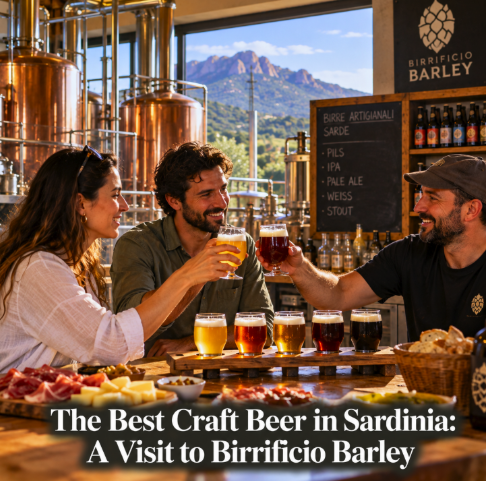
Sardinia is much better known internationally for Cannonau and Vermentino than for beer, but one brewery near Cagliari has spent two decades showing how deeply a craft beer can be connected to the island. Birrificio Barley, based in Maracalagonis in southern Sardinia, was founded in 2006 by Nicola Perra and Isidoro Mascia. Its most distinctive work combines brewing with ingredients drawn from Sardinian wine culture, including grape must from Cannonau, Nasco, Malvasia, Moscato, Vermentino and other local varieties.
That makes Barley particularly interesting for travelers who already know Sardinian wine and food. Rather than simply reproducing international beer styles on the island, the brewery has developed beers whose aromas and ingredients deliberately point back to Sardinia.
A craft brewery near Cagliari
Birrificio Barley operates in the industrial area of Maracalagonis, southeast of Cagliari and close to the SS125 corridor. The brewery says it began in 2006 from the founders’ interest in high-quality beer and gradually expanded as demand grew.
In 2015, Barley added a new production facility in Maracalagonis. The company says this newer site became the center of its logistics and direct sales, while the earlier brewery continued producing smaller formats and the special BB range.
Barley’s production philosophy is also consistent across the range: its beers are unpasteurized, unfiltered and refermented in the bottle. This gives many of them a profile closer to a bottle-conditioned specialty beer than to a standard industrial lager.
BB10 and the meeting of beer and Cannonau
If there is one Barley beer that explains the brewery’s Sardinian identity, it is BB10. The brewery describes it as an Imperial Stout made with sapa, cooked must from Cannonau grapes.
Cooked grape must has a long place in Sardinian food traditions, particularly in sweets. Nicola Perra’s idea was to take this familiar ingredient and use it in beer. Barley began producing BB10 in 2006, combining dark malt character with the fruit and vinous qualities of Cannonau must.
The brewery describes BB10 with aromas and flavors including caramel, cocoa, plum, sour cherry, chocolate, liquorice, quince, figs and raisins. It recommends pairing the beer with pecorino, chocolate desserts and ricotta-based sweets.
Barley considers BB10 the pioneer of an Italian approach that later became internationally recognized as Italian Grape Ale. Whether a visitor normally drinks wine or beer, this is the bottle that best illustrates why Barley matters in Sardinia’s contemporary drinks culture.
More Sardinian grapes in the glass
BB10 was only the beginning. In 2008, Barley introduced BBEvò using cooked must from Nasco grapes. BB9 followed in 2011 with cooked Malvasia di Bosa must.
From 2015, the brewery also began working with fresh grape must. BB7 used Moscato di Cagliari, BB6 used Malvasia di Cagliari, and later beers incorporated varieties including Nuragus, Vermentino, Cannonau and Carignano.
Barley now groups this concept under its registered “Uva a Tutta Birra” identity, highlighting beers made with must from indigenous Sardinian vineyards. For travelers accustomed to thinking of beer and wine as completely separate worlds, these bottles make the boundary much less obvious.
Sella del Diavolo: a beer named after Cagliari
Another useful introduction is Sella del Diavolo, named after the famous headland overlooking Cagliari’s Poetto beach. Barley classifies it as a Bière de Garde.
It is amber with toasted malt character and notes the brewery describes as caramel, sour cherry, plum, herbs and pepper. The producer recommends it alongside Sardinian dishes such as roast lamb, spit-roasted suckling pig and medium-aged cheeses.
The name gives visitors an easy geographical connection: walk Poetto and look toward the Sella del Diavolo headland, then try the beer carrying the same name later in the trip.
Friska, Toccadibò and the broader range
Barley is not exclusively about grape-based beers. Its core range includes Friska, Sella del Diavolo and Toccadibò, while the wider catalogue has expanded to numerous recipes.
Toccadibò is a Golden Strong Ale with pronounced fruit character. The brewery describes peach and apricot notes balanced by hop aromas and a dry, warming finish, and suggests pairings ranging from white meat to aged cheese and fruit desserts.
Other recipes have incorporated distinctly local ingredients. Zàgara, for example, uses Sardinian organic orange-blossom honey. This willingness to treat beer as a gastronomic product rather than merely a cold drink is central to Barley’s identity.
A brewery built for the table
Barley says from the outset it wanted its beers to sit naturally in medium- and high-level restaurants, in a role parallel to wine. That approach helps explain the large 75-centiliter bottle format used for many products and the emphasis on food pairing.
For visitors to Sardinia, this means Barley is worth seeking out even without visiting the production site. Look for the beers in specialist bottle shops, enoteche, restaurants and pubs, especially around Cagliari and southern Sardinia.
The brewery’s “Uva a Tutta Birra” mark is particularly useful: Barley says venues displaying it carry its BB selection of grape-must beers made from Sardinian varieties.
Can you visit Birrificio Barley?
The brewery publishes its operating address in the P.I.P. industrial area at Is Tramatzus in Maracalagonis and confirms that direct sales take place at the brewery. It also publishes a telephone number and email address for contact.
However, travelers should not assume that a public brewery tour or guided tasting is available on arrival. The current official information reviewed for this guide clearly confirms production and direct sales, but it does not publish a regular tourist timetable for brewery visits.
If you want to see the brewery or arrange a tasting, contact Barley in advance and ask what is currently available on your dates. This is especially important if you are traveling specifically from Cagliari or another part of Sardinia rather than simply stopping to buy bottles.
What to taste first
For a three-beer introduction, start with Sella del Diavolo to understand Barley’s interpretation of a classic European style, then move to one of the grape-must beers and finish with BB10.
BB10 is rich and strong enough that it makes more sense as a slow tasting beer than as a thirst-quencher after the beach. Serve it at an appropriate temperature rather than ice cold, and share a large bottle if you want to taste several beers in one sitting.
If you prefer something brighter, look for a beer involving white-grape must, such as the brewery’s Vermentino-based creations. Availability can vary, so the most interesting bottle may simply be the one a knowledgeable local beer shop currently has in stock.
A long record of recognition
Barley’s reputation is not based only on local novelty. Its own awards archive records recognition stretching back to the brewery’s early years. BB10 won its category at UnionBirrai’s Birra dell’Anno competition in 2007, while Nicola Perra was named Brewer of the Year in 2009.
Slow Food awards have repeatedly included Barley beers over subsequent editions. The brewery’s archive lists the Chiocciola award and multiple beer distinctions in 2013, 2015, 2017, 2019, 2021 and 2023, alongside recognition at competitions such as the Brussels Beer Challenge.
Awards should never replace personal taste, but this history helps explain why Barley is an established name in Italian craft beer rather than simply a souvenir brand with Sardinian packaging.
Where Barley fits into a Sardinia trip
Maracalagonis is most convenient for travelers based in Cagliari, Quartu Sant’Elena or the southeastern part of the island. It can also fit naturally into a driving day toward the SS125 and the Villasimius side of southern Sardinia.
If you are staying elsewhere, there is no need to cross the island solely to buy a bottle. Search good beer shops and restaurants locally first. Barley distributes beyond Sardinia and has exported internationally, so its better-known beers are not confined to the brewery.
For travelers who do make the trip to Maracalagonis, confirm opening and visitor arrangements before leaving. The production facility is a working brewery, not a guaranteed walk-in tourist attraction.
Sardinian craft beer beyond the beach
Birrificio Barley offers a useful reminder that Sardinian food culture is still evolving. The island’s traditional ingredients do not have to remain confined to traditional formats: Cannonau can become part of an Imperial Stout, Vermentino must can enter a blonde ale, and local honey can shape a modern craft beer.
That combination of experimentation and place is what makes Barley worth knowing. Visitors searching for “Sardinian beer” do not need a generic lager with an island name on the label. They can taste beers whose recipes genuinely engage with Sardinia’s grapes, ingredients and food culture.
Start with BB10 if you want the clearest expression of that idea. Then keep exploring: the most interesting part of Sardinia’s craft-beer scene is discovering how different brewers interpret the island in the glass.