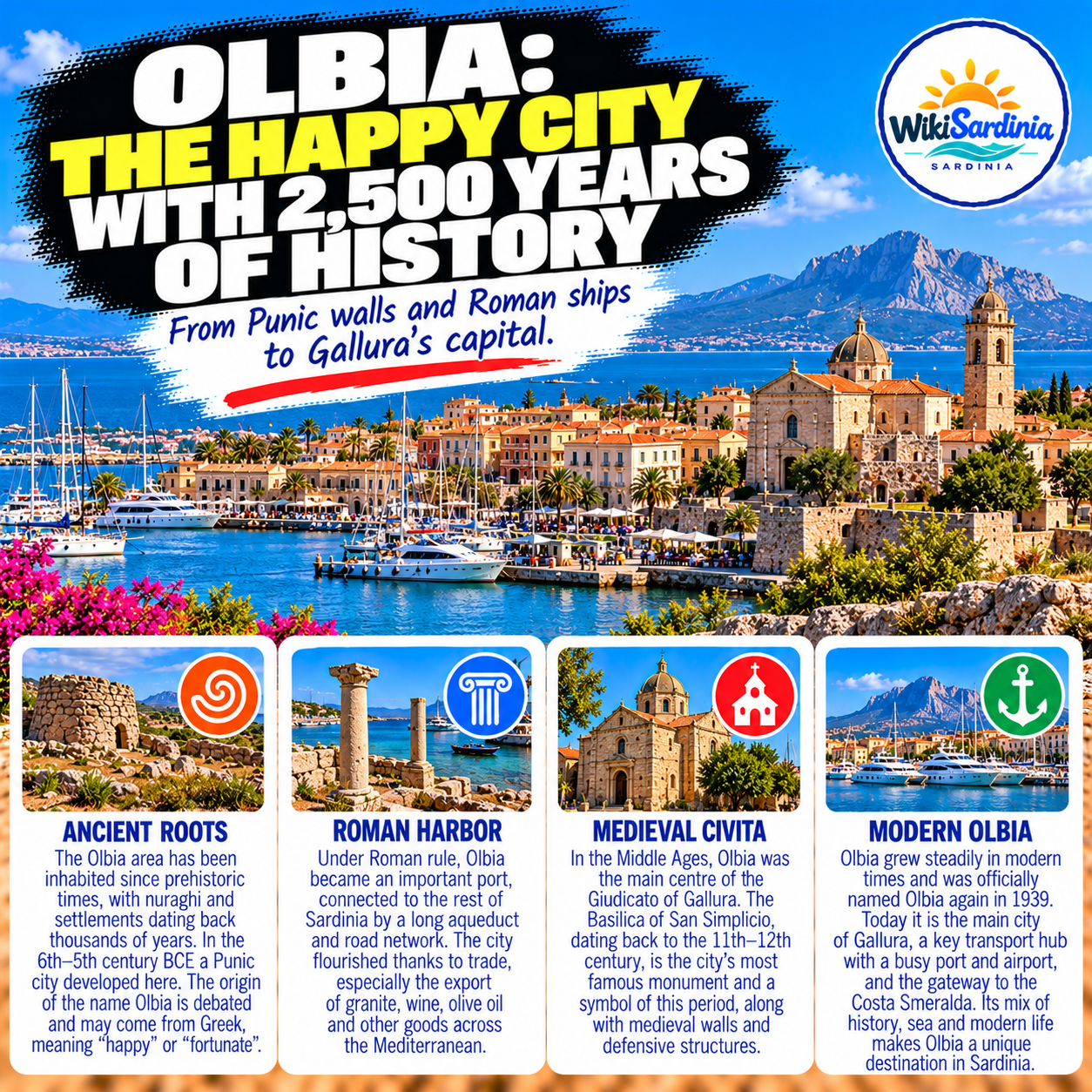
Olbia is often introduced as the gateway to Sardinia’s Costa Smeralda, but the city has a story stretching back more than two millennia. Its sheltered gulf made it a natural crossroads for ancient sailors, merchants, soldiers and rulers. From prehistoric sanctuaries to Punic fortifications, Roman shipwrecks and the medieval capital of Gallura, Olbia’s history is far richer than its reputation as a ferry and airport hub suggests.
Before Olbia: prehistoric Gallura
People lived around the Gulf of Olbia thousands of years before the city took shape. The surrounding territory preserves prehistoric and Nuragic monuments, including the sacred well of Sa Testa, the tomb of the giants of Su Monte ’e s’Abe and nuraghi in the countryside. These places show that the landscape was culturally important long before Phoenician and Punic maritime networks developed.
Why is Olbia called the “Happy City”?
The name Olbia is usually connected to a Greek word meaning happy, fortunate or prosperous. Ancient traditions associate the settlement with Greek visitors and mythical founders. However, a Greek name does not prove a Greek foundation. Scholars continue to debate the earliest urban phase. Archaeological evidence points to activity in the Phoenician period, while the substantial surviving city remains are predominantly Punic and Roman. The official SardegnaCultura heritage portal notes finds dating to at least the seventh century BC and warns against treating the old Greek-foundation theory as established fact.
The Punic city and its defensive walls
Olbia became a strategically important settlement under Carthaginian influence. During the fourth century BC, the Punic city was protected by imposing stone walls and towers. Sections of those fortifications survive near Via Torino, offering visitors a rare glimpse of the city before Roman rule. Its location at the head of a sheltered gulf made Olbia a valuable port for controlling maritime connections along Sardinia’s northeastern coast.
238 BC: Olbia enters the Roman world
Rome took control of Sardinia in 238 BC, and Olbia developed into one of the island’s most important eastern ports. Ships linked the city with the Italian peninsula, while roads connected it with the Sardinian interior. Roman Olbia had a forum, public baths, an aqueduct and other urban infrastructure. Archaeological remains of the aqueduct can still be seen in the Tilibbas area, while traces of the Roman city survive beneath and around the modern centre.
The port was central to its prosperity. Goods, people and ideas passed through Olbia for centuries, making it a busy Mediterranean trading centre rather than an isolated coastal town.
The Roman ships buried beneath the harbour
One of Olbia’s most extraordinary archaeological discoveries came from excavations of the ancient harbour. Archaeologists uncovered the remains of numerous ships, including vessels associated with the turbulent final centuries of Roman rule. Some wrecks have been linked to destructive events during the Vandal period in the fifth century AD. Today, the Archaeological Museum of Olbia tells the story of these finds and of the city’s maritime past. Museum access and exhibitions should be checked with the operator before visiting.
From Byzantine rule to medieval Civita
After the decline of Roman authority in the western Mediterranean, Olbia passed through a period of political and economic change. Byzantine influence followed Vandal rule, and medieval sources refer to the settlement by names including Civita. The city became the capital of the Giudicato of Gallura, one of Sardinia’s four medieval judicial kingdoms. Its role as an administrative and religious centre demonstrates that the harbour town remained important long after antiquity.
The Basilica of San Simplicio
The Basilica of San Simplicio, built principally between the late eleventh and twelfth centuries, is one of Olbia’s most important historic monuments. Its granite architecture reflects the Romanesque traditions of medieval Sardinia. The basilica is dedicated to the city’s patron saint, celebrated in May, and stands close to an archaeological area with burials from different periods. For visitors, it is a tangible connection between the ancient settlement and the medieval city.
Terranova, foreign rule and centuries of change
In later medieval and early modern centuries, the town was widely known as Terranova or Terranova Pausania. Political control shifted through the wider struggles involving Pisa, the Crown of Aragon and subsequent Spanish rulers. The city faced economic difficulties linked to changing trade routes, insecurity and unhealthy marshland conditions. Sardinia passed to the House of Savoy in 1720, and transport improvements during the nineteenth century helped the port recover its regional importance.
1939: the ancient name returns
In 1939, the city officially regained the name Olbia, reconnecting its modern identity with the ancient port. The Second World War brought further disruption, but postwar growth transformed the city. Improved transport links, the expansion of air travel and the development of the Costa Smeralda from the 1960s helped establish Olbia as a major commercial and tourism centre.
Olbia today: more than a gateway
Modern Olbia is a busy city with an international airport, an important passenger port and close connections to northeastern Sardinia. Visitors can explore Corso Umberto I, the Basilica of San Simplicio, the Church of San Paolo, the Punic walls, Roman remains and the waterfront archaeological museum. Excursions into the surrounding countryside reveal Nuragic monuments and historic sites that put the city's urban story into a much longer perspective.
Why Olbia’s history matters
Olbia’s identity has always depended on its position between sea and land. Ancient communities settled around its gulf; Punic rulers fortified it; Roman merchants made it prosperous; medieval judges governed Gallura from it; and modern travellers continue to arrive by ship and plane. Behind the beaches and yachts lies a remarkable history of resilience, trade and cultural exchange.