Few Mediterranean cities reveal as many layers of history as Cagliari, the capital of Sardinia. Overlooking a sheltered gulf, the city has been shaped by prehistoric communities, Phoenician traders, Carthaginian rulers, Roman administrators, Byzantine officials, medieval Sardinian judges, Pisan merchants, Aragonese kings and the House of Savoy. Its ancient streets, archaeological sites and fortifications preserve the story of a city repeatedly transformed without losing its connection to the sea.
Before the city: prehistoric Cagliari
Human activity in the territory of modern Cagliari reaches back to the Early Neolithic, in the sixth and fifth millennia BC. Finds from caves around Capo Sant'Elia reveal the presence of communities long before an urban centre existed. During the Copper Age, the island's Monte Claro culture took its modern archaeological name from a hill in Cagliari where characteristic remains were identified. The city's history therefore begins well before its better-known Phoenician foundation.
Phoenician merchants and Punic Karaly
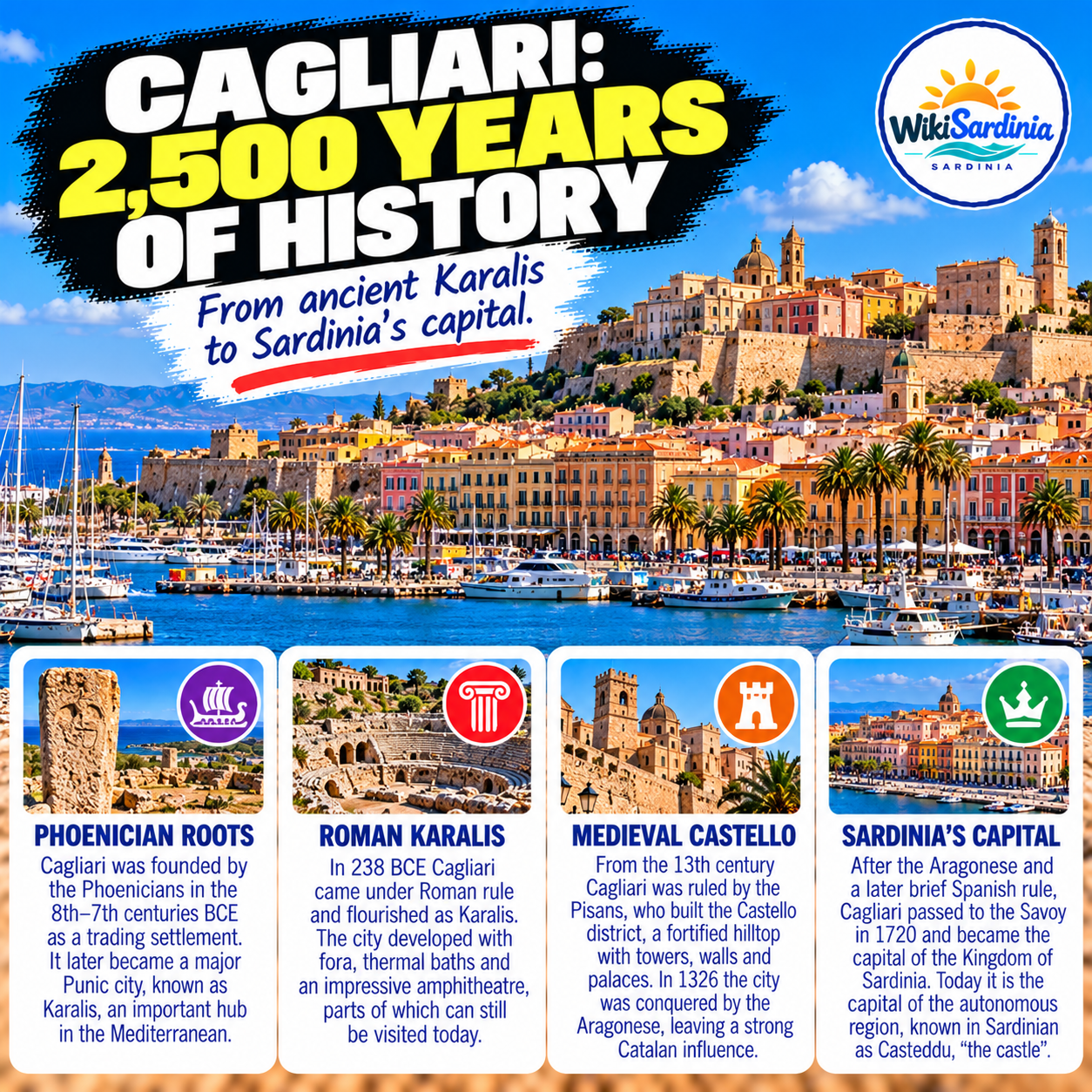
The first urban settlement developed through Phoenician maritime networks during the early first millennium BC. Archaeological evidence includes seventh-century BC remains near the Santa Gilla lagoon, an area well suited to shipping and exchange. Under Carthaginian influence, the settlement grew into a significant Punic centre. The remarkable Tuvixeddu necropolis, with rock-cut chamber tombs, remains one of the most powerful witnesses to that era. The city’s early development was inseparable from its harbour and its position along Mediterranean trade routes.
238 BC: Cagliari becomes Roman
After the First Punic War, Rome took control of Sardinia in 238 BC. The settlement, known in Roman sources as Caralis or Karales, developed into an important administrative and commercial centre. Under Roman rule it acquired public buildings, roads, water infrastructure and private residences. Its surviving Roman amphitheatre, cut partly into a limestone hillside, is among the best-known monuments of ancient Cagliari. The Roman city did not vanish completely: archaeological traces still appear amid today's buildings and streets.
From Vandals and Byzantines to the Sardinian judges
After the western Roman Empire weakened, Sardinia experienced Vandal rule before returning to the eastern Roman or Byzantine sphere in the sixth century. Christianity and new political institutions shaped the city, while insecurity and changing settlement patterns affected its population. Over time, Sardinia developed the distinctive giudicati, independent medieval political entities governed by judges. The Giudicato of Cagliari was centred at Santa Igia, near the Santa Gilla lagoon, rather than in the modern hilltop Castello district.
The Pisans build Castello
In the thirteenth century, the maritime Republic of Pisa consolidated its influence and established a fortified settlement on the limestone hill above the harbour. The Castello quarter grew around its walls and towers, while the older giudicale centre of Santa Igia was destroyed in 1258. The great medieval towers of San Pancrazio and the Elephant, designed in the early fourteenth century, remain defining landmarks. The hilltop quarter became the seat of civic, military and religious authority for centuries.
1326: the Aragonese take the city
Following conflict with Pisa, the Crown of Aragon secured control of the fortified city in 1326. The new rulers reinforced Cagliari's position as a strategic Mediterranean stronghold. Catalan-Aragonese and later Spanish administration left a deep imprint on government, architecture and urban society. Noble residences and religious buildings were built or remodelled, while the city's fortifications continued to evolve to meet changing military needs.
The Savoys and the Kingdom of Sardinia
After the War of the Spanish Succession and a brief period of Austrian rule, Sardinia passed to the House of Savoy in 1720. Cagliari retained its political importance within the Kingdom of Sardinia. Between 1799 and 1815, when Napoleon's campaigns displaced the Savoy court from Turin, Cagliari served as the court's residence. During the nineteenth century, administrative reform and urban development gradually changed the old fortress city. Sardinia became part of the unified Kingdom of Italy in 1861.
War, reconstruction and the modern capital
The Second World War brought severe destruction: Allied bombing in 1943 damaged neighbourhoods, churches, homes and infrastructure. Reconstruction reshaped the urban landscape, and postwar growth drew people from surrounding communities. Today Cagliari is the capital of the autonomous Region of Sardinia, balancing historic quarters, cultural institutions, a busy port and the natural landscapes of its lagoons and coastline.
Why is Cagliari called Casteddu?
In Sardinian, Cagliari is widely known as Casteddu, meaning 'castle'. The name reflects the prominence of the fortified Castello quarter, which for centuries housed the institutions of power and came to symbolize the city itself. It is a reminder that Cagliari has many historical identities: Phoenician and Punic Karaly, Roman Karales, medieval Castel di Castro and modern Cagliari.
Where to see Cagliari's history today
Start in Castello for the cathedral, historic towers, Palazzo Regio and views over the gulf. Visit the National Archaeological Museum for material from Sardinia's prehistoric and ancient cultures. Continue to Tuvixeddu to appreciate the Punic burial landscape, and look for the Roman amphitheatre and the remains of Roman houses in the city. Walk through Stampace, Marina and Villanova to experience how different periods overlap in everyday streets. Access to individual monuments and archaeological sites may change, so check official opening information before your visit.
A city with many beginnings
Cagliari cannot be reduced to one founder or one civilization. Its long history is the result of successive communities building upon a strategically valuable landscape. The most rewarding way to discover it is to move between eras: from prehistoric finds and Punic tombs to Roman ruins, medieval towers and the lively waterfront of Sardinia's modern capital.