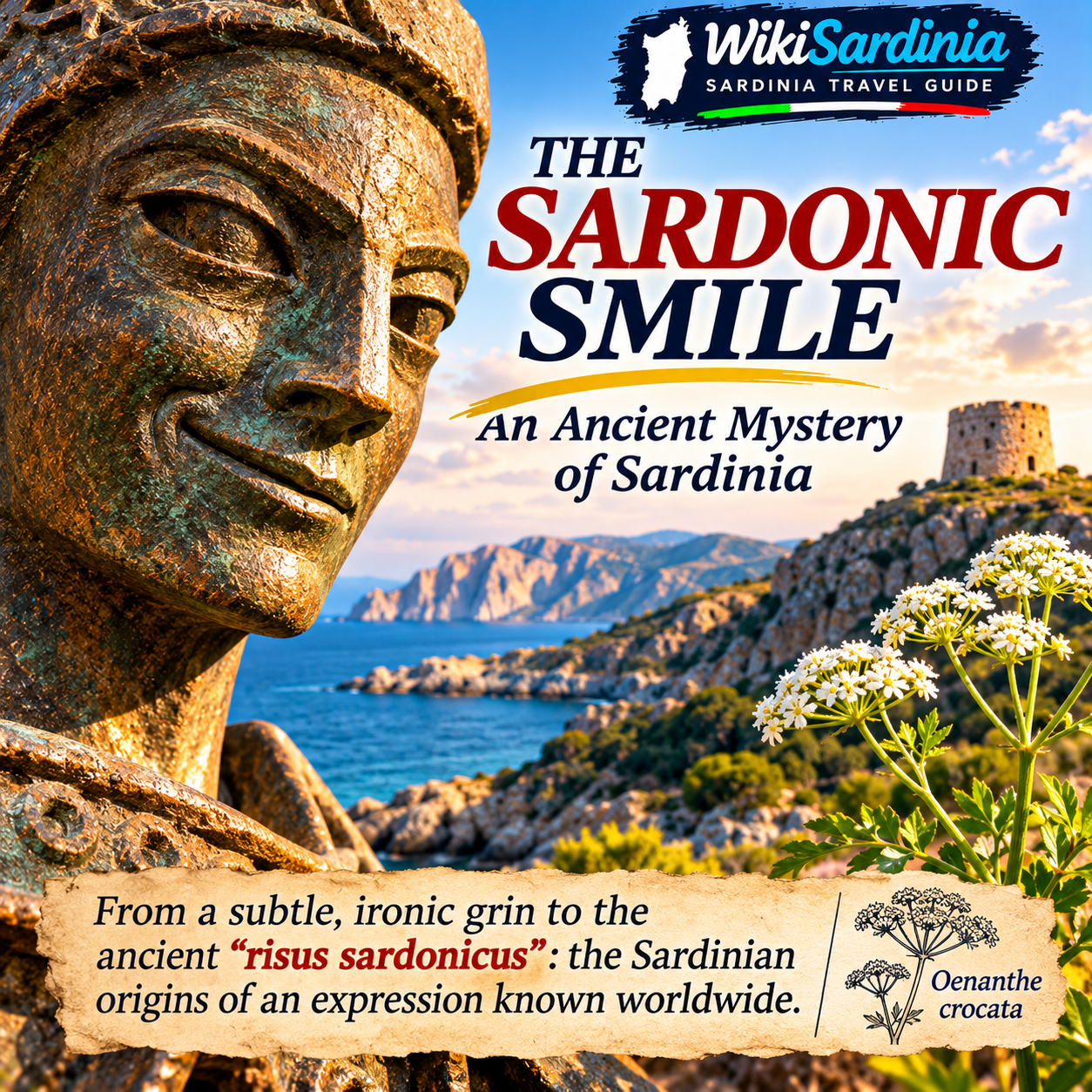
What does a sardonic smile have to do with Sardinia? More than you might expect. The English word sardonic describes a bitter, mocking or scornful smile—an expression that seems amused without necessarily expressing happiness. Behind that familiar adjective lies a fascinating, and still debated, story involving ancient Greek literature, the island of Sardinia, poisonous plants and a medical phenomenon known as risus sardonicus.
What does “sardonic smile” mean?
A sardonic smile is a dry, cynical or mocking expression. It may suggest irony, contempt, disbelief or grim amusement rather than genuine joy. In English, someone might give a sardonic smile after hearing an obviously unconvincing excuse. The related adjective sardonic is also used for humour, remarks and tone of voice.
But the modern figurative meaning should not be confused with the medical phenomenon of involuntary facial spasms. The historical association between the two is what makes the expression so intriguing.
Does the word “sardonic” really come from Sardinia?
There is a long-established connection between the word and Sardinia in ancient explanations, but the full etymology remains contested. Etymological dictionaries trace modern English sardonic through French and Latin to Greek forms describing bitter or scornful laughter. The earlier Greek sardanios, however, has an uncertain origin. Later forms appear to have been influenced by the Greek name for Sardinia and by stories about a poisonous Sardinian herb.
In other words, saying that “sardonic definitely comes from Sardinia” is too simple. A more accurate formulation is that Sardinia became central to the ancient explanations of the phrase, even though scholars continue to debate the earliest origin of the Greek word.
How far back does the expression go?
The expression's history reaches ancient Greek literature. A form of the adjective appears in Homer's Odyssey, Book 20, in a passage describing a bitter, knowing kind of laughter. This is important because the literary usage is very old and does not, by itself, establish a connection to a particular Sardinian plant.
Later Greek and Roman writers developed explanations linking such laughter to Sardinia, poisonous vegetation and disturbing stories of ritual death. These traditions are evidence of how people in antiquity understood the expression, but not proof that every event they described really occurred.
The mysterious “Sardonic herb”
Ancient authors wrote of a plant associated with Sardinia whose ingestion could cause painful contractions of the face, leaving the victim with an expression resembling a grin. Several toxic plants have been connected with the legend. Among the most frequently discussed are species of Oenanthe, particularly Oenanthe crocata, and the poisonous buttercup Ranunculus sceleratus.
A botanical resource associated with the University of Trieste and the Asinara National Park records Sardinian vernacular names such as erba sardonia and sardonica for Oenanthe crocata, while noting that related names have also been applied to Ranunculus sceleratus. This overlapping terminology helps explain why a definitive identification of the ancient herb is difficult.
What is Oenanthe crocata?
Oenanthe crocata, sometimes called hemlock water-dropwort, is an extremely poisonous plant found in parts of Europe, including Sardinia. It belongs to the carrot family and can resemble other plants growing in damp places. Its appearance should never be treated as a reliable basis for safe foraging.
The plant contains potent neurotoxins associated with severe poisoning and convulsions. It is not a traditional edible herb, and there is no safe tourist activity involving tasting it. If you encounter an unfamiliar wild plant, admire it without touching, harvesting or consuming it.
What did scientists discover in 2009?
In 2009, a team of researchers published a study in the Journal of Natural Products titled “Polyacetylenes from Sardinian Oenanthe fistulosa: A Molecular Clue to risus sardonicus.” The scientists investigated Oenanthe fistulosa collected in Sardinia and identified compounds including oenanthotoxin and dihydrooenanthotoxin.
Laboratory experiments showed that these substances strongly inhibited responses mediated by GABA, an important inhibitory neurotransmitter. This provided a plausible molecular explanation for the muscular contractions associated with poisoning by water-dropwort species.
There is a crucial nuance: the study directly examined Oenanthe fistulosa, while the historical discussion often highlights Oenanthe crocata and related species. The research supports the biological plausibility of the ancient description; it does not prove which exact plant was used in antiquity, or settle the word's linguistic origin.
What exactly is risus sardonicus?
Risus sardonicus is a medical term for a fixed, involuntary grimace caused by contractions of facial muscles. It may resemble an unnatural smile, but it is not a voluntary expression of amusement.
The term is also associated with tetanus, a serious illness in which muscle spasms can produce a characteristic facial expression. This medical usage illustrates why the ancient “smile” was understood as sinister: the apparent grin could be a symptom of distress or poisoning, not happiness.
Were elderly Sardinians really sacrificed while laughing?
Some ancient accounts connect sardonic laughter with stories of elderly people being sacrificed in Sardinia, sometimes said to have been made to laugh through the effects of a toxic herb. These narratives appear in later literary traditions and have been discussed by historians and classicists.
They should be presented as ancient reports and legends, not established archaeological facts. Such texts may reflect hostile stereotypes, symbolic storytelling or attempts to explain an unfamiliar expression. There is no sound basis for claiming that the story describes a universal or reliably documented Sardinian custom.
For visitors interested in Sardinia's ancient past, this distinction matters. The island's Nuragic civilisation has a rich archaeological record, but a dramatic classical tale should not be casually attributed to all Nuragic communities.
Why is the connection with Sardinia so memorable?
Because it links three worlds that rarely meet in a single everyday word: language, ancient storytelling and modern toxicology. A familiar expression used in books and films may carry echoes of Mediterranean botany and classical attempts to explain the strange relationship between pain and the appearance of laughter.
It is also an example of how an island can become embedded in the vocabulary of other languages. Sardinia is famous for its beaches, archaeological sites and food traditions, but its name also appears in unexpected corners of European cultural history.
Is a sardonic smile the same as sarcasm?
They overlap, but they are not identical. Sarcasm is usually a form of cutting or mocking speech. A sardonic smile is a facial expression—or, more broadly, a tone—that conveys bitter amusement, scepticism or contempt. Someone can be sardonic without saying anything at all.
In ordinary conversation, the adjective does not imply a medical condition or contact with a poisonous plant. Its ancient and medical associations explain the word's history, not its everyday use.
Can visitors see the plant in Sardinia?
Plants belonging to the genus Oenanthe occur in Sardinia, including in habitats associated with wetlands and damp ground. However, attempting to identify a dangerous species from a travel article or casual photograph is unsafe. Several members of the carrot family can look similar, and some are highly toxic.
If you are interested in the botanical side of the story, use guided nature activities, botanical collections or authoritative flora references. Never collect or taste a plant to test the legend.
Frequently asked questions
What is the meaning of a sardonic smile?
It is a bitter, mocking or scornful smile, often suggesting irony rather than genuine happiness.
Is the word “sardonic” named after Sardinia?
Ancient and later explanations strongly associate the expression with Sardinia, but the earliest Greek etymology remains debated.
What is risus sardonicus?
It is a medical term for an involuntary facial grimace caused by muscular contractions, sometimes associated with tetanus or certain poisonings.
Which plant is linked to the Sardonic smile?
Poisonous Oenanthe species, particularly Oenanthe crocata, are often discussed. Other plants, including Ranunculus sceleratus, have also been proposed.
Did scientists prove the ancient legend?
No. A 2009 study found a plausible toxicological mechanism in compounds isolated from Sardinian Oenanthe fistulosa. It did not establish every historical claim or settle the exact etymology.
Is Oenanthe crocata safe to touch or eat?
It is highly poisonous and must never be eaten. Avoid handling unidentified wild plants and do not attempt amateur foraging based on appearances.
Does the phrase appear in ancient Greek literature?
Yes. A related Greek form appears in Homer's Odyssey, while later authors elaborated the Sardinian plant association.
Did the Nuragic people practise the rituals described in legends?
The sensational stories come from ancient literary accounts. They should not be treated as proven or representative practices of Nuragic Sardinia.
The bottom line
The sardonic smile is more than a synonym for a sarcastic grin. Its history runs through ancient Greek literature, stories about Sardinia and the toxicology of plants capable of causing involuntary facial spasms. The connection is fascinating precisely because some pieces are well documented while others remain uncertain. It is a small but remarkable example of Sardinia's presence in the world's cultural vocabulary.