
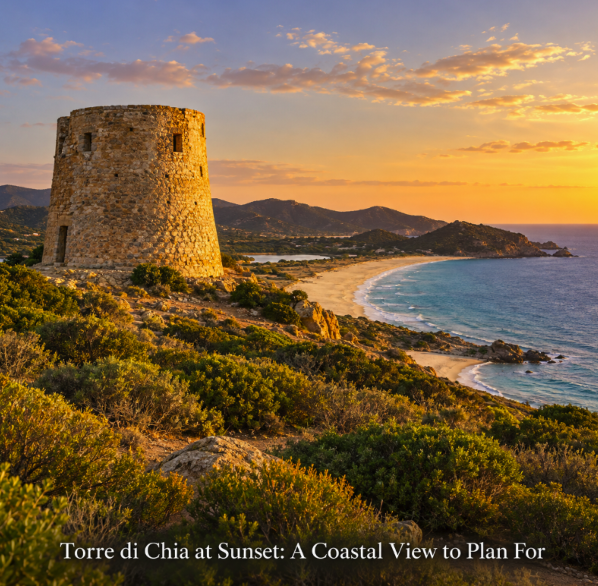
Torre di Chia is a rewarding place to consider for an evening view of southern Sardinia. The stone watchtower stands above the coast in the territory of Domus de Maria, giving the visit a clear focal point as daylight softens. But planning a sunset outing here means checking access and the sun's direction, rather than assuming that a coastal panorama guarantees a sunset directly over the sea.
This is a suggestion for enjoying the landscape around the tower, not a claim that it is Sardinia's best sunset spot. Your experience will depend on the date, weather, viewpoint and any restrictions in place when you visit.
Why the tower makes a useful evening landmark
The municipality's visitor guide identifies Torre di Chia as a panoramic point reachable on foot. The Ministry of Culture's Idese entry places it on a promontory within the Punic-Roman archaeological area of Bithia and describes its historic role in defending the Rio di Chia mouth.
For a visitor, the attraction is the relationship between the tower and the surrounding coast. Late light can bring out the texture of the stone and change the appearance of the beaches and vegetation. You can plan around those details without requiring the sun itself to appear in every photograph.
The tower also gives a simple purpose to the outing: arrive with time to see the surroundings, choose a suitable place to pause and leave enough daylight for the return. Avoid turning the evening into a rushed climb just before the light disappears.
Check the approach and the tower separately
Idese lists a signposted approach of about 310 metres and describes the difficulty as easy. That is a published access description, not the distance from every parking place or accommodation. Assess the actual path, slope and conditions when you arrive.
Do not confuse reaching the area with entering the tower. The cultural entry describes an elevated doorway accessed by a steel staircase during summer guided visits, with a separate internal stair leading to the terrace. A panoramic outing does not establish that the interior or rooftop is open at sunset.
Check the current municipal arrangements before planning an interior visit, including times, charges and any booking requirement. The same source marks the site as not accessible for visitors with mobility limitations, so confirm specific needs directly rather than treating the “easy” walking description as an accessibility guarantee.
Golden hour and sunset are different experiences
The period before sunset can be the most useful part of the visit for seeing the landscape. A low sun produces changing light and shadows while there is still time to judge your footing and identify the route back.
If your priority is watching the sun's disc reach the horizon, check its direction for your travel date against a map of the coast and the surrounding land. Sunset direction changes through the year, and hills can block the sun before the published sunset time. This guide does not verify a date-specific unobstructed horizon from the tower.
Plan a visit that remains worthwhile if clouds obscure the sun. The coastal setting and evening colour can still be the reason to go; a precise photographic effect should be treated as conditional.
Make the return part of the plan
Arrive early enough to inspect the approach in daylight. Wear shoes suited to the path, bring water and carry a light if there is a possibility of returning after dark. Check wind and weather before leaving, and choose a sheltered or lower alternative if the conditions do not suit you.
Stay on permitted routes and respect barriers around the monument and archaeological area. Do not climb the tower or cross a restricted section to obtain a photograph. A closer composition is not a reason to ignore the limits of the site.
Confirm parking arrangements locally and keep track of where you started; this guide does not establish current parking prices or evening transport services. If travelling without a car, settle your return journey before committing to a late visit.
Torre di Chia offers a clear setting for a coastal evening: historic stone, open views and changing light. Treat access, daylight and the return route as part of the experience, and choose your pause point according to what is actually available that day.


