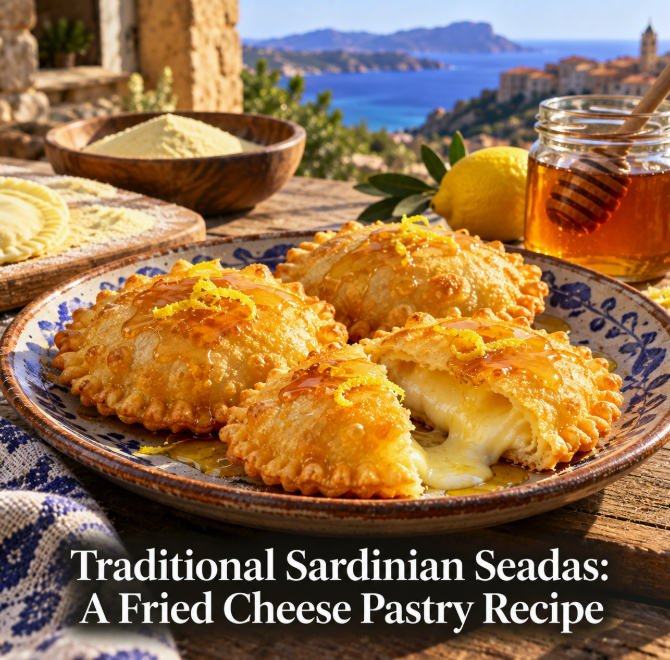
Seadas are one of Sardinia’s most recognizable foods: large round parcels of thin semolina dough enclosing warm, melting cheese, fried until blistered and golden and served immediately with honey. The combination sounds unusual if you have never tried it, but the contrast is the point—the filling is fresh and lightly tangy rather than dessert-sweet, while the honey supplies sweetness at the table.
There is no single household formula used everywhere in Sardinia. Cheese, citrus and even the final honey vary by area and family. What defines the classic preparation is the pasta violada, traditionally made from durum-wheat semolina and lard, together with fresh cheese, frying and a sweet finish.
Ingredients for about 10–12 seadas
- 300 g finely milled durum-wheat semolina, preferably semola rimacinata
- 60 g lard
- About 120–150 ml lukewarm water, added gradually
- A pinch of fine salt
- 300 g very fresh, mild sheep’s-milk cheese suitable for melting
- Finely grated zest of 1 untreated lemon
- Peanut oil or another neutral high-heat frying oil
- Sardinian honey for serving, ideally strawberry-tree honey if available
The quantity of water is deliberately given as a range. Different semolina absorbs differently, so the dough should determine the final amount rather than the measuring jug.
The cheese is the hardest ingredient to reproduce outside Sardinia
Traditional versions commonly use very fresh, unsalted sheep’s-milk cheese with a slight acidity. It is not the same ingredient as a hard, aged Pecorino Sardo that you would grate over pasta. Recent Italian culinary sources describing traditional seadas emphasize fresh sheep cheese that melts and stretches, sometimes allowed to become gently acidic before use.
Regional variations exist. Some Sardinian preparations use cow’s-milk cheese, while alternatives such as Dolce Sardo or peretta are also associated with seadas. That makes a mild, young, good-melting cheese a more sensible substitute abroad than a dry, salty aged pecorino.
If shopping outside Sardinia, ask an Italian cheesemonger for a fresh or very young sheep cheese that will melt smoothly. A mild young cow’s-milk cheese can work when sheep cheese is unavailable, although the flavor will differ. Avoid mozzarella packed in water unless you know how to manage its moisture: excess liquid can make sealing and frying much more difficult.
Make the pasta violada
Place the semolina in a bowl or on a clean work surface and mix in the salt. Add lukewarm water little by little, kneading until a firm dough begins to form. Work in the lard gradually and continue kneading until the dough is smooth, homogeneous and elastic.
This stage deserves time. Traditional pasta violada is worked thoroughly, and the fat should be incorporated evenly rather than left in visible pieces. If the dough feels dry and cracks when folded, add a little more water. If it becomes sticky, use only a small amount of extra semolina.
Form it into a ball, cover it and let it rest for at least one hour. Resting makes the dough easier to roll thinly without springing back.
Prepare the cheese filling
Grate or finely chop the fresh cheese. Mix it with the finely grated lemon zest. Depending on the cheese, you can either form the mixture directly into flat rounds or warm it very gently until it softens enough to shape.
A Nuoro-style method documented by La Cucina Italiana melts fresh Sardinian pecorino with a little milk, adds lemon zest, spreads the mixture in a thin layer and cuts discs once it has set. Another traditional-style preparation simply grates and shapes the cheese before enclosing it. Both illustrate why the behavior of your cheese matters more than following one rigid method.
Aim for filling discs roughly 5–6 cm across and not excessively thick. Chill them briefly if they become difficult to handle.
Shape the seadas like large ravioli
Roll the rested dough very thinly using a pasta machine or rolling pin. A sheet around 1–2 mm thick is a useful target: substantial enough to seal securely but thin enough to blister and crisp during frying.
Place the cheese rounds on one sheet of dough, leaving generous space around each. Cover with a second sheet. Press firmly around the filling, pushing out trapped air as you work. Air pockets increase the chance of the pastry ballooning or breaking in the oil.
Cut around each filling with a round fluted cutter, pastry wheel or sharp knife, making discs roughly 9–11 cm in diameter. Check the entire edge and press again wherever the seal looks weak.
Keep the finished seadas covered while shaping the remainder so the surface does not dry out.
How to fry seadas
Heat a generous depth of neutral frying oil in a wide, heavy pan. Traditional recipes vary in frying temperature; the practical goal is hot oil that quickly blisters the pastry without burning it before the cheese warms through. Around 180°C is a manageable home-kitchen starting point.
Fry only one or two seadas at a time so the oil temperature does not fall sharply. Spoon hot oil over the top if necessary and turn carefully once the underside is golden. They generally need only a few minutes.
Remove with a slotted spoon and drain briefly. Do not leave them sitting for long: seadas are at their best when the shell is crisp and the cheese is still hot and soft.
Honey belongs on at the end
Transfer each hot seada to a plate and spoon honey over the surface. Strawberry-tree honey, miele di corbezzolo, is especially associated with Sardinia and provides a distinctive bittersweet contrast, but other Sardinian honeys are also used. Lavender honey appears in documented Nuoro-style recipes, and families may choose according to local availability and preference.
The pastry itself does not need to be heavily sweetened. Keeping sugar out of the filling allows the salty-acidic cheese, citrus and honey to remain distinct.
Common problems and how to avoid them
If the cheese escapes into the oil, the most likely causes are a weak seal, trapped air or filling that is too wet. Press carefully around the cheese before cutting and inspect the rim for cracks.
If the pastry is tough, it may have been rolled too thick or not kneaded and rested enough. If it absorbs excessive oil, check that the frying oil is properly hot before adding the next seada.
If the filling tastes aggressively salty, the cheese is probably too mature. Seadas depend on fresh cheese; substituting aged pecorino changes both the texture and the balance with honey.
From pastoral food to Sardinian dessert
Seadas are strongly linked with Sardinia’s pastoral food culture and were not necessarily conceived as a dessert in the modern sense. Historical accounts describe a substantial cheese-filled preparation that became the sweet dish familiar today through the addition of honey.
The name also varies. Seada is the singular form, while seadas is the plural most visitors encounter; regional names include sebada and sevada. The precise etymology is debated, though explanations often connect it with Sardinian words relating to animal fat and the lard used in the dough.
For home cooks, the essential lesson is simpler than the linguistic debate: use a semolina-based dough with fat, choose a genuinely fresh melting cheese, seal it carefully, fry it only when you are ready to eat and add the honey while the pastry is still hot. That combination gives seadas their unmistakable character—crisp outside, molten within, aromatic with citrus and finished with Sardinian honey.