
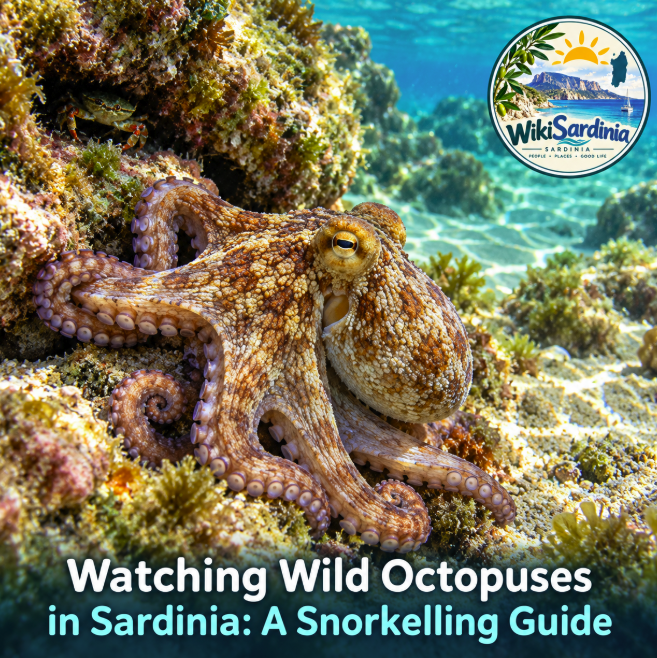
To look for wild octopuses in Sardinia, plan a snorkelling outing around suitable coastal habitat and current sea conditions, rather than chasing a promised shoreline hunting spectacle. Porto Conte near Alghero is a useful starting point for enquiries, with park educational material describing signs of octopus shelters. Elsewhere, SardegnaTurismo highlights rocky underwater scenery around Gallura. None of these references guarantees an octopus encounter, let alone a moment of hunting.
A social-media clip can inspire the trip, but it cannot establish where or when you will see the same behaviour. The TikTok video behind this topic was not supplied for verification, so its location, date and claimed virality remain unconfirmed.
Start with habitat, then choose the outing
The Fondazione Dieta Mediterranea species sheet describes the common octopus, Octopus vulgaris, as a coastal, bottom-dwelling animal found over rocky and sandy seabeds and in Posidonia habitats. It feeds on bivalve molluscs and small crustaceans and can change colour rapidly. Those characteristics help explain why finding one takes patient observation.
The Porto Conte park’s nature-trail booklet describes a small accumulation of shells as a possible sign of an octopus shelter. Treat that as an observation clue, not permission to disturb a den or proof that an animal is present. The booklet is older educational material, rather than a report of sightings this week or confirmation that every described route is currently operating.
For a visit near Alghero, Poseidon Diving Center advertises snorkelling alongside its diving activities in the Capo Caccia–Isola Piana marine protected area. Ask about a guided surface outing suited to your swimming ability and explain your interest in observing octopuses. Its advertised service does not establish a specialist octopus tour, current October departures or a sighting guarantee.
For a different part of the island, SardegnaTurismo’s snorkelling guide describes underwater rocks, crevices and marine life, mentioning octopuses and cuttlefish. It identifies the stretch from Capo Figari to Capo Coda Cavallo as an area of snorkelling interest. Use that regional context to enquire locally about an appropriate permitted site; it is not evidence of a particular hunting hotspot.
Seeing movement does not prove a hunt
An octopus moving across a rock may be exploring, changing position or seeking shelter. Without a clear sequence showing prey capture, avoid labelling every movement as hunting. A guide can help you interpret what is visible, while recognising when the behaviour cannot be determined.
Watch from a comfortable distance and let the animal decide whether to remain visible. Do not bait it, touch it, pull it from a crevice or move rocks to improve the view. An encounter is more interesting when you can observe what happens without creating the behaviour yourself.
If filming, keep the camera steady from your existing position. A wider shot can preserve the animal’s surroundings and movement better than repeatedly closing in. If it retreats, end the observation instead of following it into a shelter. No clip is worth turning a wildlife encounter into a staged performance.
Prepare for the sea you find that day
Before booking, confirm the meeting point, guided route, equipment, swimming requirements, minimum ages and weather cancellation arrangements. In a protected area, ask the operator which rules apply to the chosen location. The presence of a marine reserve does not mean visitors may enter or snorkel anywhere within it.
For an autumn outing, check the marine forecast and follow the guide’s assessment of visibility, wind and waves. Shallow water can still be unsuitable for observation or entry. Choose a route appropriate to your ability, stay with a companion or guided group, and avoid entering caves or unfamiliar submerged spaces.
Plan the excursion for the broader marine environment, with an octopus as a possible bonus. That approach gives you a worthwhile outing even if the animal stays hidden. The strongest answer to “where can I see octopuses hunting?” is a suitable, locally checked habitat and patient observation—not a beach pin promising a repeat of a viral video.


