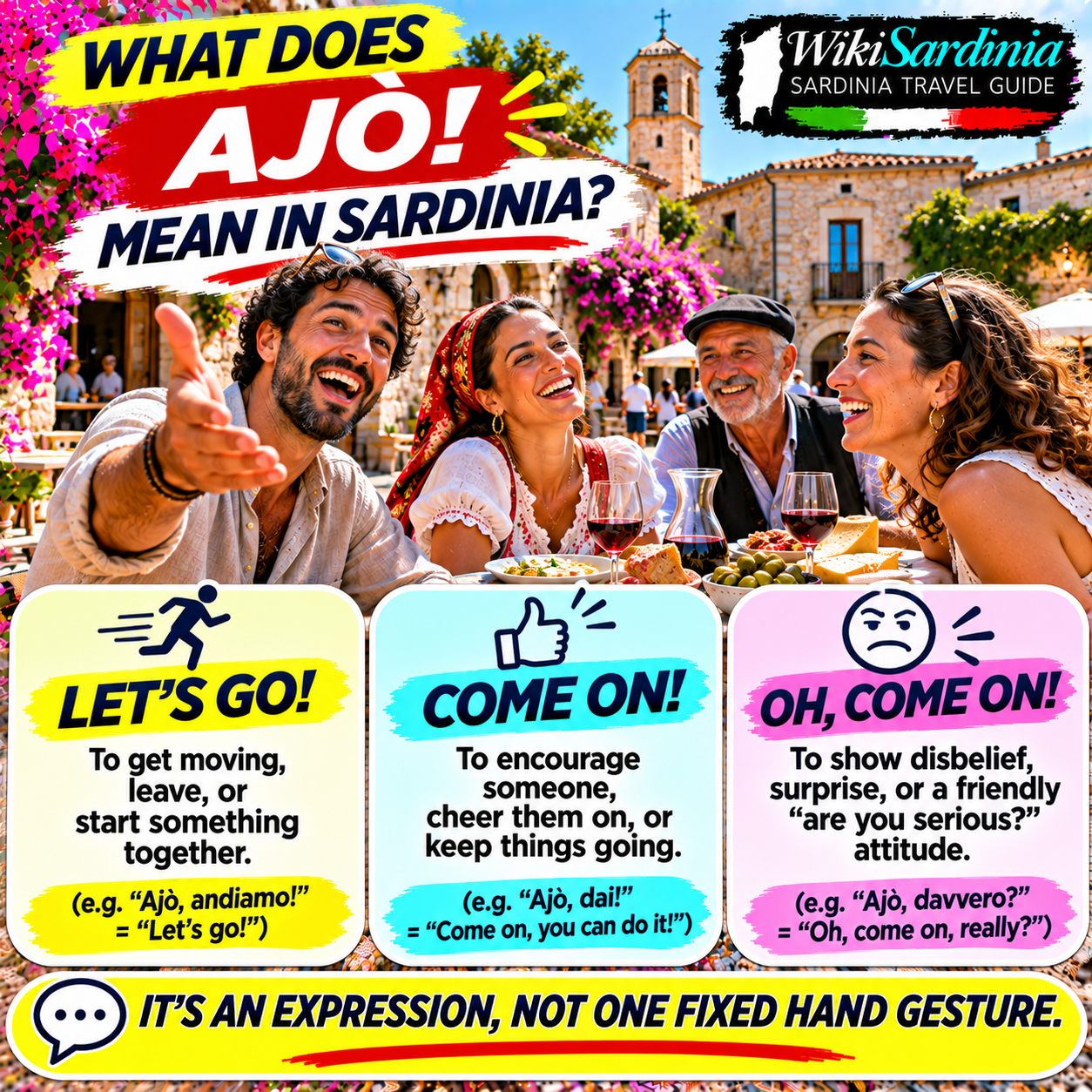
“Ajò!” (also written “Aiò!”) is one of Sardinia’s most recognizable everyday expressions. Depending on the situation and the speaker’s tone, it can mean “Let’s go!”, “Come on!”, “Hurry up!” or even “Oh, come on—seriously?” It is not a formal greeting and it does not refer to one fixed hand gesture. Understanding the context makes it much easier to recognize and use naturally while travelling around the island.
What does “Ajò!” mean in Sardinian?
Its most familiar meaning is an invitation to move or take action: “Let’s go!” or “Come on!”. It can also encourage someone to try harder, express friendly impatience, or question an unbelievable claim. Sardinian newspaper L’Unione Sarda describes these different meanings, and linguistic research from the University of Sassari documents the same broad range—from invitations and encouragement to skepticism and disbelief.
Three everyday meanings of Ajò
| Situation | What “Ajò!” means | Example |
|---|---|---|
| Leaving or starting an activity | “Let’s go!” | “Ajò, andiamo!” — Come on, let's go! |
| Encouraging someone | “Come on, you can do it!” | “Ajò, dai!” — Come on, keep going! |
| Responding to an unlikely story | “Oh, come on!” | “Ajò, ma davvero?” — Oh, come on, really? |
The example phrases mix Sardinian interjection with colloquial Italian, reflecting the way visitors may hear it in everyday speech. They are not intended as standardized sentences in every Sardinian variety.
When do locals use it?
You might hear someone call “Ajò!” when friends are ready to leave a café, a parent is urging the family to hurry, or a supporter is cheering someone on. It can also be a playful response when a friend tells an exaggerated story. The tone is crucial: spoken warmly, it feels inviting; spoken sharply, it can signal impatience or disbelief. Not everyone uses it with the same frequency, and personal and regional speech habits vary.
Is Ajò a hand gesture?
No single standardized Sardinian hand gesture defines “Ajò!”. Speakers may wave a hand forward, open a palm, nod toward a destination or gesture spontaneously while speaking, just as people do when saying “Come on!” in English or “Dai!” in Italian. The gesture is not what determines the word’s meaning. Avoid treating a particular movement as an official traditional sign unless it has been documented in a specific context.
How do you pronounce Ajò?
For English-speaking visitors, a useful approximation is “ah-YOH”, with stress on the final syllable. Pronunciation and spelling can vary, and you may encounter “ajò”, “ajó” or “aiò” in different writing traditions. Listen to local speakers rather than expecting a single accent throughout Sardinia.
Is Ajò used across the whole island?
Yes, the expression is widely recognized across Sardinia and occurs in regional Italian as well as Sardinian linguistic varieties. L’Unione Sarda reports its use in Campidanese, Logudorese and Nuorese, as well as Sassarese and Gallurese, and notes related use in Corsica. Sardinia is linguistically diverse, so this shared interjection should not be taken to mean all the island’s languages and dialects are identical.
Where does the word come from?
The etymology is debated. One commonly discussed explanation connects it with the Latin verb ire, “to go”, while other hypotheses suggest older origins. Newspaper accounts and academic linguistic discussions present competing explanations. It would be misleading to describe any one speculative origin as definitively proven.
Is Ajò the same as “Eja”?
No. “Ajò” usually urges movement or action or expresses a reaction; “Eja” commonly means “yes”. The two are often mentioned together in introductions to Sardinian expressions, but they serve different purposes. Likewise, “Ajò” is not the default equivalent of “hello”, “goodbye” or “thank you”.
Can tourists say Ajò?
Absolutely, when the context is natural. If your friends are ready to leave for the beach, “Ajò!” can be a friendly way to say “Let’s go!”. It is best used conversationally rather than repeated as a catchphrase or a caricature of Sardinian speech. Listen first, and use the word with the same friendliness and context as the people around you.
Mini phrasebook for visitors
- Ajò! — Let's go! / Come on!
- Ajò, andiamo! — Come on, let's go!
- Ajò, dai! — Come on, you can do it! / Hurry up!
- Ajò, ma davvero? — Oh, come on, really?
- Eja! — Yes!
These are illustrative everyday expressions. Exact combinations and usage vary between speakers and places.
Frequently asked questions
Does Ajò mean hello?
Not normally. Its central meanings are “let's go”, “come on” and related reactions.
Is Ajò rude?
Not inherently. It can be warm, enthusiastic, impatient or skeptical depending on tone and context.
Is there a specific Ajò hand gesture?
No universally established gesture. People may use ordinary encouraging hand movements while speaking.
Do people say Ajò in Cagliari and Alghero?
Yes, the expression is widely understood throughout Sardinia, although individual usage and local language varieties differ.
Does Ajò have one confirmed Latin origin?
No. A connection with Latin ire is one hypothesis, but its etymology remains debated.
Can I use it when encouraging a friend?
Yes. That is one of its common uses.
The bottom line
“Ajò!” is a small word with several meanings: let's go, come on, hurry up, or oh, come on! It is a lively part of everyday Sardinian speech, not a single formal gesture. The best way to understand it is to pay attention to the speaker's tone, situation and facial expression.